
PRESENTED BY

THE TOP
Defense at the center of the political world
Welcome back to Defense Quarterly.
The ongoing military campaign in Iran has reshaped the outlook for what was already slated to be a chaotic and unpredictable year for defense policy in Washington.
The debate over the Middle East conflict and President Donald Trump’s other military excursions are all playing out in advance of what is expected to be a hotly contested midterm election.
Foreign policy doesn’t usually swing elections, but skyrocketing gas prices are making the operations targeting Tehran a pocketbook issue as well. Any boots on the ground in the Middle East would also surely capture voters’ attention.
Congress has plenty of defense issues to wrangle over before voters head to the polls. Trump’s desire for a $1.5 trillion military budget was an uphill battle at the outset, but it only gets more complicated with a potential war funding request on its way to the Hill. Many Democrats are pledging to oppose any spending on Iran operations, which they view as an unauthorized war.
There is also the question of what type of oversight congressional Republicans plan to do on the Iran campaign if it drags on beyond the conflicting timelines being laid out by the Trump administration.
With all that in mind, we’re going to take a look at five of the thorniest issues facing Congress as it gears up for a knuckles-out battle over the Iranian conflict.
In this edition, we’ll also take a look at the state of the defense industry, which has been riding the peaks and valleys of an administration that’s sent mixed signals to suppliers.
Major firms are welcoming additional investments into the domestic defense industrial base as they continue to navigate the fallout from a Trump executive order aimed at boosting performance while limiting executive compensation and curbing stock dividends.
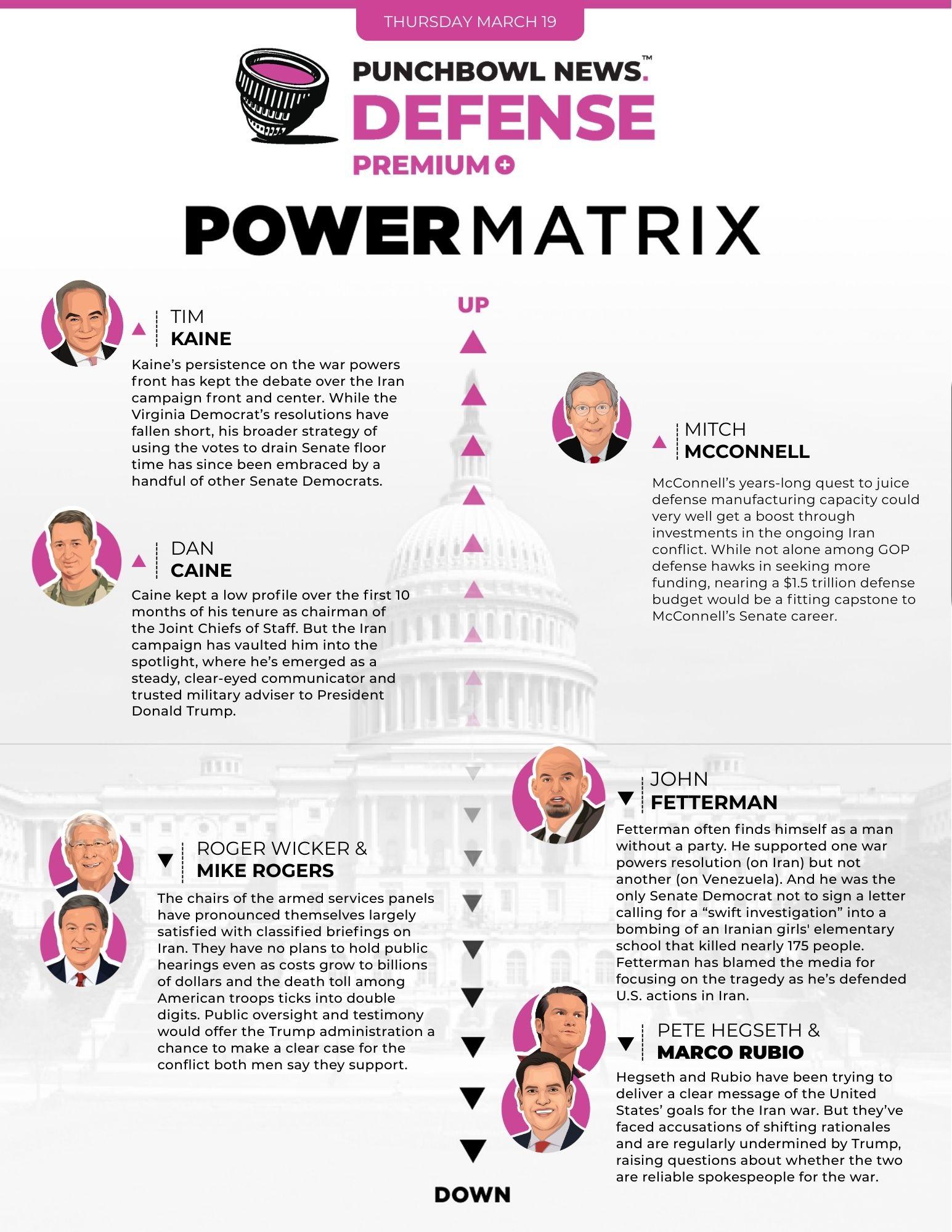
Plus, we’re chronicling who’s up and who’s down in our Defense Power Matrix.
Thank you, as always, for reading. This is just a taste of the coverage we bring you daily. Not a Defense subscriber? Learn more here.
— Anthony Adragna and Briana Reilly
PRESENTED BY THE BOEING COMPANY
Boeing backs America, driving U.S. economic growth
As America’s largest manufacturing exporter, we contribute $97 billion to the U.S. economy annually. With nearly 140,000 U.S.-based employees, we are committed to strengthening the economic vitality of communities across the country. Learn more
MIDEAST FALLOUT
Five questions for what’s next with Iran
The largest Middle Eastern conflict since the invasion of Iraq is forcing Congress to grapple with existential questions about when to assert itself in matters of war.
So far, there’s been some noise, but effectively a blank check for the Trump administration to wage its campaign in Iran. Republicans have been enthusiastic backers of regime change in Tehran and, as always, wary of antagonizing the grudge-prone President Donald Trump.
But with the cost of the Iranian conflict — in both human and fiscal terms — mounting by the day and instability rife throughout the Middle East, Congress will soon be faced with how or whether to engage with the conflict as a coequal branch of government.
Here are five questions we’ll be watching (and reporting on) in the weeks ahead.
Will Republicans get serious about oversight?
Senate and House GOP committee chairs have shown no urgency in getting public testimony from senior administration officials on the war, even amid questions about the administration’s goals, cost and motives behind the operation.
Instead, Republicans have cited frequent news briefings from Defense Secretary Pete Hegseth and Joint Chiefs of Staff Chair Gen. Dan Caine, coupled with classified briefings on Capitol Hill, as good enough. They argue appearances by military leaders before Congress as part of the annual defense budget process will afford members opportunities to question officials.
This doesn’t seem tenable. Republicans held scores of hearings on the Biden administration’s shambolic withdrawal from Afghanistan when the White House belonged to a different party.
“It’s really intolerable that we have had nothing so far,” said Sen. Adam Schiff (D-Calif.). “That pressure is just going to increase every day this goes on.”
Democrats have demanded public testimony from Hegseth and Secretary of State Marco Rubio and, absent that, they are vowing to force a series of war powers votes that require floor debate.
Where do Democrats have leverage?
With the annual defense policy bill as one of the few must-pass bills this Congress, it could be used as a leverage point for Democrats to extract some concessions from the Trump administration on Iran.
Rep. Adam Smith (D-Wash.), the ranking member of the House Armed Services Committee, predicted lawmakers “will try to use various incentives within the NDAA to get” DOD to provide more information.
“What’s going on in Iran? What’s the plan in Iran? How much does it cost?” Smith told reporters Tuesday. “Yeah, a whole host of information that has not been readily provided to us.”
Democrats could also insist on concessions to get their support for an Iran war funding package, such as requiring testimony and or other requirements to make the war effort more transparent. But many Democrats right now are signalling they won’t support a funding request no matter what.
How will Republicans manage Trump’s proposed budget bonanza?
Trump says he will propose a $1.5 trillion Pentagon budget for the upcoming fiscal year. That would be a 50 percent increase above current levels.
Getting this done will be a huge challenge for congressional Republicans, especially with the expected war funding bill now in the mix.
First up is the question of whether the war funding will count toward the $1.5 trillion goal. If not, some GOP spending hawks may push to have some of the Iran conflict funding paid for by spending cuts elsewhere in the budget.
Then there is the question of whether the money should all be moved through the regular appropriations process or if the party-line, filibuster-proof reconciliation process be deployed to enact some of the funding.
Some GOP lawmakers are already talking about using reconciliation for any war spending, but that will spur a more earnest push to offset the cost of the bill. That won’t be easy.
Do Ukraine backers assert themselves here?
A small — but powerful — bloc of Republicans continues to demand further U.S. assistance to Ukraine in its ongoing war against Russia. A funding package for the Iran conflict may be their best avenue to deliver these funds.
“The best way to reduce the need for defense in Europe is to degrade the threat posed by Russia’s military,” said Senate Armed Services Chair Roger Wicker (R-Miss.). “We should support these efforts. We should immediately begin a crash program to take advantage of new production lines here in America.”
Look for other key Ukraine allies, like Sen. Mitch McConnell (R-Ky.), Rep. Michael McCaul (R-Texas) and Rep. Mike Turner (R-Ohio), to make themselves heard on this issue.
How will the political winds blow?
GOP divisions over the war in Iran were thrust into the spotlight this week with the sudden departure of a high-ranking Trump administration official, Joe Kent, who cited opposition to the Iran campaign in his resignation letter.
Before that, public criticism of the effort largely came from conservative media commentators like Tucker Carlson and Megyn Kelly, and war powers hawks like Rep. Thomas Massie (R-Ky.) and Sen. Rand Paul (R-Ky.).
Trump returned to the White House pledging he’d focus on domestic policy and steer clear of foreign wars. If the conflict in Iran doesn’t end quickly, the voting public could sour on Trump’s about face on military interventionism and register their displeasure at the polls during November’s midterm elections.
Congressional Republicans will be walking a political tightrope over Iran if the conflict doesn’t resolve itself soon, especially if the human and fiscal costs are high. On the flip side, a quick end to the hostilities that negate the Iranian threat could buoy the GOP in the midterms.
One political barometer to watch will be if at-risk Republicans begin to turn on Trump’s Iran mission, particularly as the administration sends more troops to the region and weighs boots on the ground options.
— Anthony Adragna and Briana Reilly
BUSINESS OF DEFENSE
A cloudy crystal ball for defense contractors
It’s both the best of times and the worst of times for companies that do business with the Pentagon.
Defense contractors are hoping to cash in on President Donald Trump’s pledge to boost military funding by 50% — but many of those same suppliers are also awaiting possible punishments for failing to deliver products on time and on budget.
The Pentagon has committed to a number of new multiyear deals that would encourage expanded weapons production, but the Hill has yet to authorize or fund those commitments.
The United States’ campaign against Iran could deliver munitions-builders a contracting windfall — but getting additional funding through Congress would be a heavy lift (to say the least).
These dynamics leave the military’s vast vendor network searching for any scrap of information they can get. But parsing public statements only goes so far, especially when leading Defense Department officials remain tight-lipped about what could come, when and in what form.
The money man speaks. Jay Hurst, the Pentagon’s acting comptroller, said this week DOD is targeting April to release its budget justification books, which provide detailed information about various military programs. But Hurst didn’t provide much more information, including which programs would benefit most under the expected windfall.
Or, as Byron Callan, an analyst with Capital Alpha Partners, summed it up: “The outlook for the FY27 DOD budget remains complicated and a bit confusing.”
The Pentagon sent the White House a $200 billion supplemental funding request this week, the Washington Post reported, but it’s unclear how much money the administration would ultimately request from the Hill.
Senate Appropriations Committee Chair Susan Collins (R-Maine) told reporters Wednesday night the figure is “considerably higher than I would have guessed but I don’t know how it’s broken down.”
On notice. Defense suppliers have been on alert for weeks as the Pentagon works to implement a January executive order cracking down on contractors for not building weapons quickly enough or investing enough of their own money in their production capacity.
But DOD has publicly withheld its plans for identifying companies that aren’t in compliance, or what potential enforcement actions could look like. The order says companies’ stock dividends and executive pay could be targeted.
Just this week, Pentagon industrial base policy chief Michael Cadenazzi declined to comment on the status of the department’s contractor watch list. And while he underscored that DOD is “not interested in punishing industry” or going after profits, Cadenazzi said the directive “really reflects frustration at delays and deliveries.”
The administration’s tough talk is coming from the military branch level, too. Air Force Secretary Troy Meink said at the McAleese Defense Programs Conference Tuesday that he wants to see acquisition leaders put “more emphasis on past performance when we award new contracts,” while taking steps to inject more competition into the process by expanding the industry base.
“If you don’t do well, we’ll go over here — that’s a pretty big stick,” Meink said.
For now, the Pentagon’s focus is on “leveraging momentum” created by the executive order to ink deals with industry and drive investment, DOD acquisition chief Michael Duffey said Tuesday.
So far, Lockheed Martin and RTX have announced seven-year framework agreements with the military designed to boost production of critical munitions.
“The executive order getting the attention that it needs so that we can get some things across the line is, I think, a net positive for the department,” Duffey said.
— Briana Reilly
PRESENTED BY THE BOEING COMPANY

Our integrated defense portfolio delivers advanced capabilities to meet the evolving security needs of the U.S. and its allies. With solutions that are connected, adaptable and ready, we are committed to supporting vital missions around the globe. Learn more
DEFENSE WRAPPED
ICYMI: Anthropic, FISA and the new defense strategy
The war with Iran has drawn most of our focus over the last three weeks. But throughout the campaign — and long before it — Defense has been delivering on a host of policy fronts.
What follows is a roundup of our best reporting on the Pentagon’s posture toward its contractors, the forthcoming renewal deadline for a critical surveillance authority and the Trump administration’s National Defense Strategy.
Contractor crackdown. The Trump administration’s relationship with military contractors has been a huge storyline, and there’s no sign that reporting will slow in the months to come.
We scooped that the White House was preparing the executive order. And we were first to report that the Pentagon had pushed off a Feb. 6 deadline to identify “underperforming” businesses. We’ve written about lawmakers’ reaction to the news (in short: they’re receptive but want to see DOD’s final list of contractors) and Democrats’ desire to codify some of these changes.
More recently, we’ve worked with our Tech colleagues to cover the Hill fallout over the Pentagon’s spat with Anthropic because of its Claude AI tool, as well as an emerging legislative push to address military uses of AI-enabled autonomy in the upcoming NDAA.
Spy authority. Congress is facing down an April 20 deadline to renew a highly scrutinized intelligence-gathering authority.
The Trump administration is pushing for a clean reauthorization of Section 702 of the Foreign Intelligence Surveillance Act. But political dynamics — especially in the House — could make that tricky.
The House is slated to take up a clean extension next week, but it’s unclear how the chamber will bring the bill to the floor in the first place, even as top Republicans coalesce around the White House’s push. We also covered the factions that are emerging in the Senate.
A big interview. Pentagon policy chief Elbridge Colby got a chilly reception from House GOP defense hawks when he appeared before them earlier this month to discuss the National Defense Strategy.
But before his public testimony, Colby sat down with us in the Pentagon to talk about force posture changes, his relationship with lawmakers, the administration’s view of China and why he’s bullish on a $1.5 trillion topline for the Defense Department.
Odds and ends. That’s not all. We also covered the Pentagon’s plans to frontload its spending of the $150 billion it received under the One Big Beautiful Bill in FY2026 and the Hill’s drawn-out push to extend two small business grant programs critical to the Pentagon’s innovation ecosystem.
And don’t forget about our reporting on the six Democrats who participated in the “illegal orders” video.
— Briana Reilly
Defense Recap
PRESENTED BY THE BOEING COMPANY
Fueling growth in communities nationwide

With 1.4 million direct and indirect jobs across the country, we are committed to supporting local workers and fueling growth in communities nationwide. Learn how Boeing backs America

Editorial photos provided by Getty Images. Political ads courtesy of AdImpact.
The 340B program is supposed to help vulnerable patients—but without strong safeguards, it’s siphoning away funds that could be used for free and charitable medicine. The 340B Rebate Model Pilot improves program integrity, preventing duplicate discounts and strengthening accountability. Urge HHS to implement the pilot today. Learn why it matters.
Crucial Capitol Hill news AM, Midday, and PM—5 times a week
Join a community of some of the most powerful people in Washington and beyond. Exclusive newsmaker events, parties, in-person and virtual briefings and more.
Subscribe to Premium
Special Projects
Explore our deep dives into the issues that matter the most today and will shape tomorrow's future, with expert reporting that goes beyond the headlines and into the heart of the Capitol.
Check it outEvery single issue of Punchbowl News published, all in one place
Visit the archiveThe 340B program lacks transparency—making it hard to tell if it’s actually helping vulnerable patients. HHS can fix the problem by implementing the 340B Rebate Model Pilot, ensuring the program is transparent, compliant, and accountable. Learn more.