


May 4, 2026



PRESENTED BY

THE TOP
Redistricting frenzy. Plus, ICE dispute is rocking Dem primaries
Happy Monday morning.
The House and Senate are out this week. President Donald Trump is in Washington today. Early this morning, Senate Majority Leader John Thune and NRSC Chair Tim Scott endorsed Rep. Andy Barr (R-Ky.) in the Kentucky Senate race. Trump endorsed Barr Friday.
There’s a redistricting frenzy breaking out across the South as GOP governors and legislators — under pressure from Trump — scramble to redraw minority-majority districts in order to replace Black Democrats with loyal Republicans. This comes after the Supreme Court’s Callais decision. The goal is to try to save Speaker Mike Johnson’s endangered House GOP majority, and maybe the final two years of Trump’s presidency.
Louisiana, Tennessee and Alabama are the battlegrounds for the spiral of legal and political moves and counter-moves. There’s also action in South Carolina, Virginia and Florida.
More than a dozen House seats are in play here. Some of the technical legal questions will likely be resolved by the end of today. But the political scramble is just revving up.
Louisiana. GOP Gov. Jeff Landry has suspended the already begun primary elections for House seats, drawing outrage and lawsuits from Democrats. Landry’s move would allow the Republican-dominated state legislature to redraw congressional maps following last week’s Supreme Court decision gutting Section 2 of the 1965 Voting Rights Act.
Bayou State Republicans could draw out one or both of the Democrats in the congressional delegation, Reps. Cleo Fields and Troy Carter. It’s unclear how far Louisiana Republicans will go. They’re waiting on SCOTUS for a formal Callais notification that will allow them to proceed.
Alabama. GOP Gov. Kay Ivey and Republican state officials are waiting to see if the Supreme Court will lift the injunction barring the state from redistricting until after 2030. Ivey announced on Friday a special Alabama legislative session to establish special primaries for districts “whose boundary lines are altered by court action.”
Republicans would likely get one House seat out of this. But Alabama officials first need the Supreme Court to rule on their appeal to end the long-running case.
Other actions. Tennessee Democratic Rep. Steve Cohen could see his two-decade congressional career come to an end as Volunteer State Republicans look to get rid of their lone House Democrat and make it a 9-0 GOP delegation.
Virginia Democrats won a close referendum in Virginia last month that could net them as many as four seats, but the Virginia Supreme Court still hasn’t ruled on a GOP challenge to the election yet. Democrats are starting to get nervous about this delay.
In Florida, GOP Gov. Ron DeSantis has yet to formally sign a bill creating four new red seats, which would make the Sunshine State delegation 24 Republicans to only four Democrats. Democrats and voting rights groups can’t sue until DeSantis signs.
And in South Carolina, longtime Democratic Rep. Jim Clyburn, 85, may avoid any attempt to redraw his district this cycle, but Republicans will probably try next year.
South Carolina Gov. Henry McMaster sounded open to redistricting, but GOP leaders in the state legislature said they had ruled out drawing new lines this cycle.
ICE bites Dems in primaries. The last line of a House GOP resolution from June 2025 is wreaking havoc on center-left Democrats running in contested primaries this cycle.
Following last summer’s anti-Semitic Molotov cocktail attack in Boulder, Colo., the House passed a resolution by Rep. Gabe Evans (R-Colo.) condemning the incident. Evans’ resolution frustrated Democrats because it focused on the immigration status of the alleged assailant. But 75 Democrats voted for the resolution.
The resolution’s final line — where it “expresses gratitude to law enforcement officers, including U.S. Immigration and Customs Enforcement personnel, for protecting the homeland” — is coming back to haunt some House Democrats in tight races.
The latest example is in the Michigan Senate race. On Saturday, state Sen. Mallory McMorrow slammed Rep. Haley Stevens (D-Mich.) because “she signed onto a resolution to thank ICE.” Shortly after McMorrow’s comments at an American Federation of Teachers forum, Stevens’ campaign updated its “red box” guidance to encourage outside groups to provide backup on her position with ICE.
“Democratic primary voters need to know immediately that Haley Stevens is leading the fight against Trump’s abuses of power and fighting for Michigan,” the message reads, with the word “immediately” underlined.
Stevens spokesperson Arik Wolk argued Stevens has been “fighting back against ICE and Trump’s abuses of power since the start of this administration.”
A similar dynamic is playing out in the Minnesota Senate Democratic primary between Lt. Gov. Peggy Flanagan and Rep. Angie Craig (D-Minn.). Craig’s vote for the Laken Riley Act has become a major sticking point, in addition to Craig’s support for the Boulder resolution.
At a weekend rally with Sen. Bernie Sanders (I-Vt.), Flanagan slammed Craig for when “she broke with Democrats again to join Republicans as the only Democrat from Minnesota to vote to praise ICE while they were in the streets of Los Angeles separating families.”
Craig has said the resolution was intended to be a “gotcha” vote by the GOP but she nevertheless supported it to show her concern over the rising wave of anti-semitism.
Juliana Stratton, the Democratic nominee for Senate in Illinois, also criticized her primary opponent — Rep. Raja Krishnamoorthi (D-Ill.) — for supporting the Boulder resolution, saying he “voted to thank ICE.” Stratton’s allies used this messaging on the airwaves.
The vote is even playing a role in House races. Former Rep. David Trone (D-Md.) is citing Rep. April McClain Delaney’s (D-Md.) vote for the Boulder resolution as he tries to primary the incumbent from the left.
“What I voted on was the resolution about Boulder, Colo., and throwing a Molotov cocktail and maiming and killing people in front of a synagogue,” McClain Delaney said. “But no, we don’t thank ICE for all the things they’ve done, and this was before ICE became ICE. So, it’s just disingenuous.”
– John Bresnahan, Max Cohen, Jake Sherman and Ally Mutnick
Questions about your subscription or account? Our team can answer questions about website access, billing, or upgrading for more coverage. Reach out to us at [email protected] or simply reply to this email.


TROOP WITHDRAWAL
U.S. troop move from Germany draws bipartisan ire
SEDONA, Ariz. — A handful of senior Republicans and Democrats are blasting the Trump administration’s sudden decision to withdraw 5,000 U.S. troops from Germany.
“It’s just not smart. It’s a knee-jerk reaction,” said Rep. Don Bacon (R-Neb.), a senior member of the House Armed Services Committee Saturday at the Sedona Forum. “It continues to weaken NATO, and it undermines the trust that the European countries have towards our leadership.”
Bacon’s views were shared by the Republican chairs of the House and Senate Armed Services committees — Sen. Roger Wicker (R-Miss.) and Rep. Mike Rogers (R-Ala.) — who said they were “very concerned” by the move in a joint statement released Saturday.
Wicker and Rogers instead suggested that U.S. forces be moved to eastern Europe to maintain “a strong deterrent” to adversaries like Russia. The two top Hill Republicans expect Pentagon engagement in the “days and weeks ahead” on the decision, which came just days after Defense Secretary Pete Hegseth testified before both panels.
In interviews on the sidelines of the Forum, multiple lawmakers said the move appeared linked to President Donald Trump’s ire at Germany’s Chancellor Friedrich Merz, who criticized the ongoing U.S. war on Iran.
Trump bashed Merz on Thursday, saying in a Truth Social post that the German leader should focus on “fixing his broken Country” and not “interfering” with Iran.
“We’re going to cut way down. And we’re cutting a lot further than 5,000,” Trump said Saturday in Florida.
Democrats welcomed a comprehensive analysis of U.S. troop deployments in Germany, but not in the knee-jerk way made by Trump.
“Instead of pulling them out, I would be generally in favor of really studying this and figuring out [if] maybe we should move some of them into Latvia, Lithuania, more into Poland — instead of having them in Germany,” Sen. Mark Kelly (D-Ariz.), a member of the Armed Services Committee said at the Forum.
“They have to confer with Congress on that,” Rep. Jason Crow (D-Colo.) said. “Yet again, they’re doing something on a whim based upon an emotional reaction of this president that’s going to put our troops and their families and Americans in a tough spot.”
Language inserted into the last NDAA (Section 1249) aimed to impede the drawdown of U.S. forces to below 76,000 in Europe for more than 45 days without clear presidential certifications to Congress.
Sen. Ruben Gallego (D-Ariz.) noted the NDAA language meant Trump “could not pull out troops from Germany and even from Europe without these certain steps, which we’re going to invoke.”
Gallego linked the move to Pentagon policy chief Elbridge Colby, who he said has an “obsession with trying to get us out of Europe” to focus resources on the Indo-Pacific.
“These passive-aggressive actions are, number one, illegal, since we’re the ones who allocate the money,” Gallego said. “But number two, aren’t very smart.”
— Anthony Adragna
PRESENTED BY AMERICAN INVESTMENT COUNCIL

The difference between a 2 AM idea and a real company is capital. See how private equity powers thousands of small businesses nationwide.

Democratic Hill aides: Thune is most effective leader
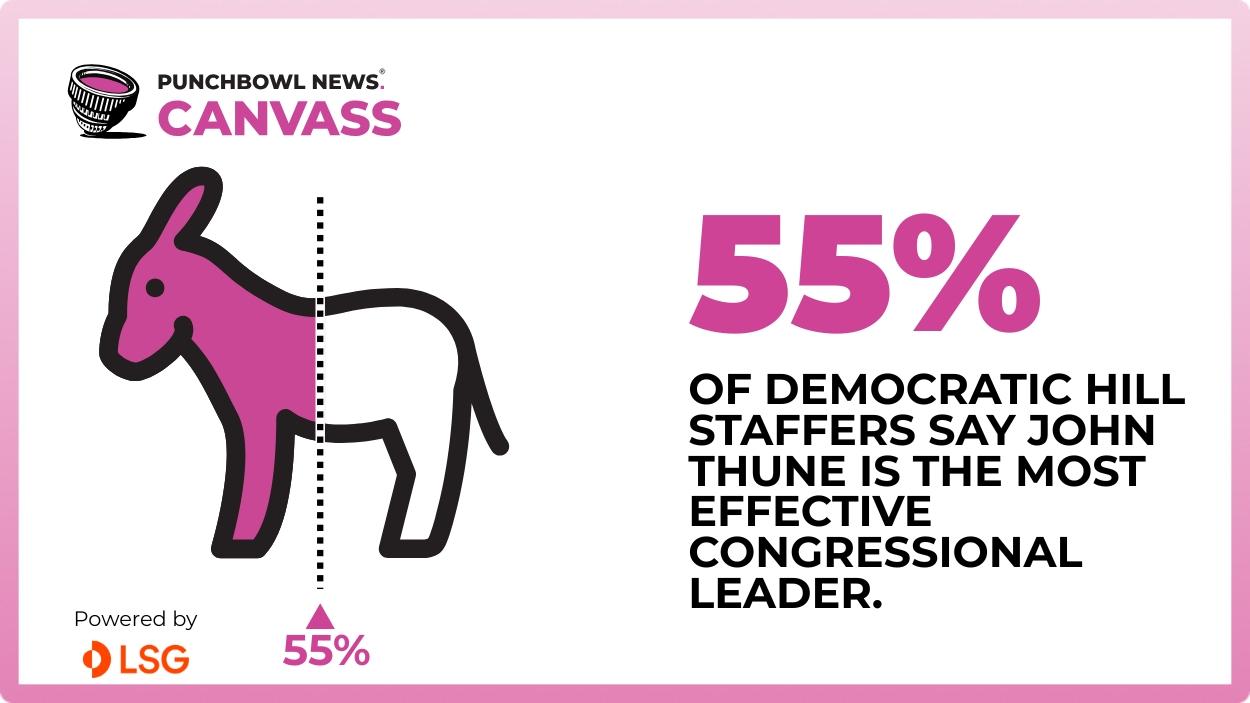
More than half of top Democratic Hill staffers say Senate Majority Leader John Thune is the most effective congressional leader, according to our latest Canvass survey.
Democrats chose Thune at a higher rate than their own party leaders: House Minority Leader Hakeem Jeffries (34%) and Senate Minority Leader Chuck Schumer (8%).
GOP leadership. The survey comes as Thune has been at odds with Speaker Mike Johnson during the past month over funding for the Department of Homeland Security, extension of the FISA Section 702 program and much more. Johnson got a mere 2% approval from Democrats as being an effective leader.
The GOP leadership infighting over how to end the DHS shutdown and the FISA cliff heightened frustrations between House and Senate Republicans. House GOP hardliners have vented at Thune over the Senate’s rejection of some of their priorities, including a central bank digital currency ban that was attached to a FISA reauthorization bill.
Still, Thune’s strategic moves on DHS funding and a short-term FISA patch won out last week, even as it took Johnson several weeks to get there on DHS.
But GOP congressional leaders have new deadlines to tackle this month. Thune will be busy trying to pass a second reconciliation bill and a longer-term FISA extension when Congress comes back next week.
Election odds. While Republicans have several issues they still want to address this session, their time is running short as Democrats are widely favored to pick up seats in the upcoming midterms.
Nearly all (89%) top Hill staffers said the Democratic party is in a stronger position than the GOP heading into the campaign season.
Primaries have already started in states across the country, though the recent Supreme Court ruling that limits the 1965 Voting Rights Act could still shake things up and net the GOP a couple seats this year.
The Canvass Capitol Hill was conducted April 6-24 in partnership with independent public affairs firm, LSG.
Want to take part in The Canvass? Our survey provides anonymous monthly insights from top Capitol Hill staffers and K Street leaders on key issues facing Washington.
Don’t miss out on your chance to weigh in! Sign up here if you work on K Street. Click here to sign up if you’re a senior congressional staffer.
– Shania Shelton
PRESENTED BY AMERICAN INVESTMENT COUNCIL

Private equity turns 2 AM ideas into thriving small businesses.
AND THERE’S MORE
News on a One Nation buy, plus prediction market update
New Senate GOP ad campaign. One Nation, the non-profit linked to Senate GOP leadership, is running a new ad campaign urging Senate Democrats to vote to “fund ICE not illegals.” They’re spending just shy of $1 million over the next three weeks in D.C., Alaska, Georgia, Michigan, and Ohio.
Also, Leading the Future, a super PAC network backed by artificial intelligence industry executives, is investing an initial $750,000 to boost Rep. Andy Barr’s (R-Ky.) Senate bid. The buy, which includes mail, digital and texting, will begin on May 6 and run through the general election. Barr is the first Senate candidate the group has backed.
Bill news. Reps. Eugene Vindman (D-Va.) and Troy Downing (R-Mont.) are urging Defense Secretary Pete Hegseth to prohibit military and civilian DOD personnel “from utilizing prediction markets to place bets on any national security related topic.”
The bipartisan letter, signed by 14 other House members, comes after a highly publicized case where a U.S. special forces servicemember involved in the Nicolás Maduro raid placed a bet on the outcome on Polymarket. The soldier netted over $400,000 from the wager.
“Our intent is not to ban prediction markets. However, contracts that implicate U.S. national security should remain out of bounds,” the lawmakers write.
— Max Cohen and Ally Mutnick
📆
What we’re watching
House. The House is out. The chamber will host a pro forma session on Monday at 10:30 a.m.
Senate. The Senate is out. There are pro forma sessions scheduled for 6:45 a.m. Monday and 10 a.m. Thursday.
Washington. President Donald Trump will participate in a small business summit at 3 p.m.
Campaign world. Indiana and Ohio are holding their primary elections on Tuesday. The race to watch is the GOP primary in Ohio’s 9th District, where a crowded field is vying for a chance to unseat endangered Democratic Rep. Marcy Kaptur (Ohio).
The top contenders are former state Rep. Derek Merrin (who lost to Kaptur in 2024), state Rep. Josh Williams and former ICE official Madison Sheahan. Merrin is considered the favorite given his superior name ID in the district.
In Indiana, Trump and his allies are trying to unseat a number of GOP state Senate incumbents who stood in the way of the state’s redistricting push.
— Max Cohen and Laura Weiss

Presented by AstraZeneca

The 340B program is supposed to help vulnerable patients—but without strong safeguards, it’s siphoning away funds that could be used for free and charitable medicine. The 340B Rebate Model Pilot improves program integrity, preventing duplicate discounts and strengthening accountability. Urge HHS to implement the pilot today. Learn why it matters.

Crucial Capitol Hill news AM, Midday, and PM—5 times a week
Join a community of some of the most powerful people in Washington and beyond. Exclusive newsmaker events, parties, in-person and virtual briefings and more.
Subscribe to Premium
Special Projects
Explore our deep dives into the issues that matter the most today and will shape tomorrow's future, with expert reporting that goes beyond the headlines and into the heart of the Capitol.
Check it outEvery single issue of Punchbowl News published, all in one place
Visit the archive
Presented by AstraZeneca
The 340B program lacks transparency—making it hard to tell if it’s actually helping vulnerable patients. HHS can fix the problem by implementing the 340B Rebate Model Pilot, ensuring the program is transparent, compliant, and accountable. Learn more.