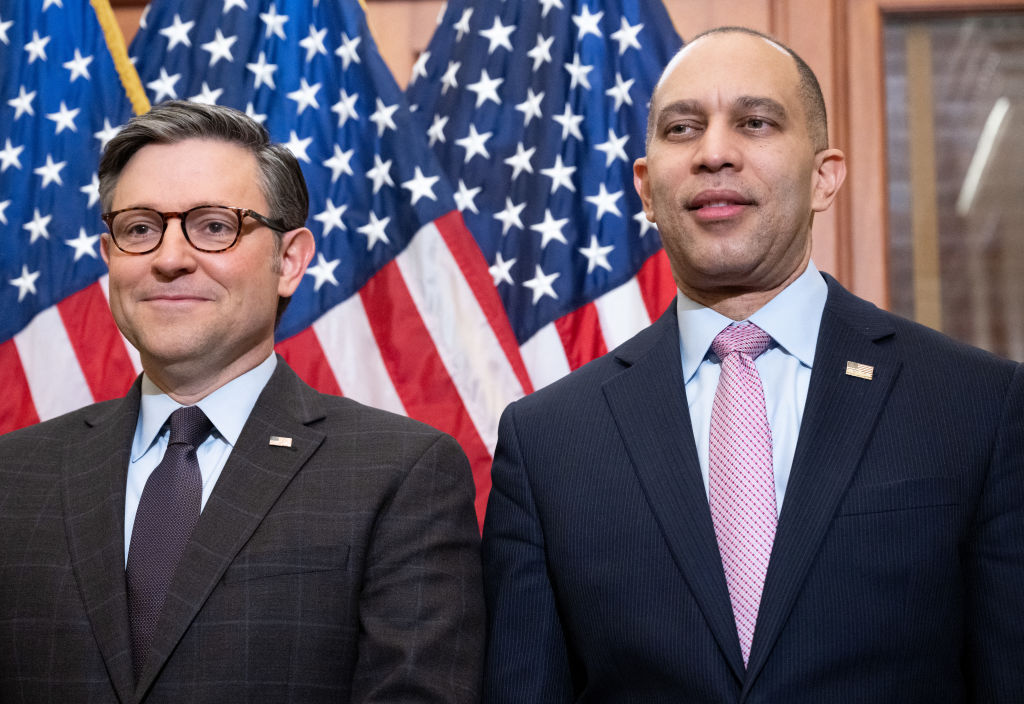
We want to engage in a semi-frequent Punchbowl News tradition: our Leader Look. We’re going to focus this morning on Speaker Mike Johnson and House Minority Leader Hakeem Jeffries. We’ll look at the Senate leadership tomorrow.
Mike Johnson
One year ago today, the House voted to oust Kevin McCarthy as speaker, triggering the end of his political career and beginning an especially embarrassing period for the House GOP.
On Oct. 25, after stumbling around for three weeks, House Republicans tapped Mike Johnson to be speaker. The 52-year-old Louisiana Republican only served in a minor leadership role at the time. But he also had the most important attribute of all — no one disliked him.
To Johnson’s credit, he’s lasted longer in the job than McCarthy did. And Johnson’s laying the groundwork to run for the gavel again next year should Republicans keep the majority.
Campaign trail: Of course, Johnson’s future in House leadership will hinge on the election results. Johnson has been crisscrossing the country raising cash and stumping for candidates, something he had virtually no experience doing before becoming speaker. But he’s started to grow more comfortable in the role.
In private donor events, we’re told Johnson often refers to himself as “the ambassador of hope.”
Fundraising continues to be a big problem for House Republicans, although Johnson isn’t entirely to blame. Johnson has transferred over $20 million to the NRCC. He’s also traveled to 39 states as speaker. Johnson will be in 24 states during October alone.
Trump ties: Johnson strives incredibly hard to tie himself to former President Donald Trump. Johnson met with the former president twice during the last month and successfully worked to defuse Trump’s calls for a government shutdown. Johnson has tapped Hogan Gidley, a former Trump official, to serve as a consultant.
The speaker even does a pretty spot-on Trump impression, which he’s performed publicly on several occasions, although we’ve been told Trump isn’t a huge fan of Johnson’s act.
Johnson’s strength upon becoming speaker was his ties to conservatives. Yet those relationships have been strained over the last year as he tries to govern in a divided Congress. Democrats had to save Johnson from a conservative-led motion to vacate. He’s been forced to play the Trump card to keep from getting outflanked on the right.
Decision Making: One of the biggest internal critiques of Johnson is that he often keeps his own leadership team in the dark. This was especially true during the most recent debate over government funding.
Johnson initially pushed a six-month CR with the SAVE Act attached — a plan championed by controversial Rep. Clay Higgins (R-La.). This privately frustrated other GOP leaders, who saw a clean three-month CR as inevitable. Johnson also leans heavily on his policy director Dan Ziegler when it comes to key policy decisions.
Hakeem Jeffries
In just over a month, the 54-year-old Jeffries will find out if he’s going to make history by becoming the first Black speaker of the House.
If House Democrats don’t take the majority, Jeffries and other party leaders may feel some heat, especially if Harris wins the White House. The House GOP record is abysmal. The DCCC has badly outraised the NRCC. The path to the majority runs through deep blue California and Jeffries’ native New York State. The ascension of Vice President Kamala Harris as the Democratic nominee injected new life into the party. Everything is right there for Jeffries and House Democrats.
The biggest drawback is that, thanks to redistricting, there’s only a handful of House seats in play.
How he performed. Now let’s look at Jeffries’ record, especially over the last few months. Since taking over for former Speaker Nancy Pelosi — who still makes her presence felt in a big way — Jeffries has kept Democrats united through an often tumultuous Congress.
In addition to providing Johnson with the Democratic votes to remain as speaker, Jeffries had to deal with President Joe Biden’s replacement as the Democratic nominee. This was largely a revolt led by House Democrats — with Pelosi playing a starring role — as well as other key players in the Democratic universe, including former President Barack Obama.
That high-profile crisis showed how Jeffries operates under pressure — he holds his cards very close to the vest. Jeffries didn’t tell anyone what he was thinking. He cautiously tiptoed through the warring factions inside his caucus and an angry president. He sought a private meeting with Biden to discuss the situation. And Jeffries didn’t say much afterward beyond showering praise on Biden and Harris.
Jeffries is never going to lead from the front. He isn’t Pelosi. But he’s capable of decisive action when needed. This is how he’d be as speaker.
Big Apple headache. Jeffries and Senate Majority Leader Chuck Schumer face a growing scandal around indicted New York City Mayor Eric Adams. While some high-profile New York Democrats have called for Adams to resign, Jeffries has kept largely mum (as has Schumer.) This will be worth watching closely as events unfold.