


Key Democrats in both the House and Senate say the Republican-led effort to reform the legal landscape around digital assets and stablecoins is facing longer odds than ever.
Start with this: Rep. Jim Himes (D-Conn.) told us that the House’s approach to crypto would likely need to change in order to become law. We’re once again talking about how much oversight the Federal Reserve should have over digital assets.
“The House bill — for it to pass, I think would probably need to go further, especially with respect to the Federal Reserve’s ability to step in when a state regulator has dropped the ball,” Himes said in an interview.
It’s a notable statement from Himes. He was one of five Democrats to help advance committee legislation in July that would effectively limit the Federal Reserve’s oversight of state-chartered stablecoin companies.
Himes is one of the longest-serving lawmakers in the Democratic quintet that backed the effort, which included Reps. Greg Meeks (N.Y.), Ritchie Torres (N.Y.), Wiley Nickel (N.C.) and Josh Gottheimer (N.J.).
More from Himes:
We’ve written before about the Fed-shaped hole inside House Republicans’ approach to stablecoin regulation. While supportive lawmakers say the bill creates a “federal floor” for state-level stablecoin companies, the Federal Reserve isn’t thrilled about having limited supervision over what it views as a form of private money.
Any changes empowering the Fed would be directed at getting more buy-in from Democrats, particularly in the Senate. At this point, we don’t expect Republicans — led by House Financial Services Chair Patrick McHenry (R-N.C.) and Rep. French Hill (R-Ark.) — to trip over themselves to make these tweaks anytime soon.
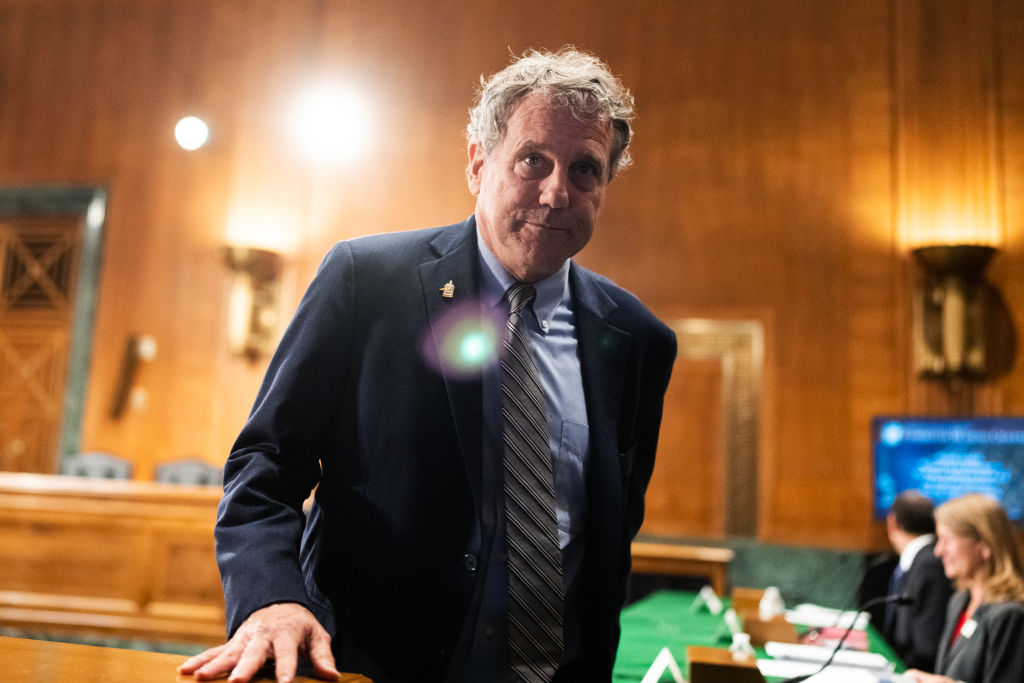
This brings us to the Senate: Senate Banking Committee Chair Sherrod Brown (D-Ohio) dumped cold water on the idea that his chamber would take up the House’s leading crypto legislation.
Multiple lawmakers have floated the potential for horse trading between Brown and McHenry’s respective committees. Brown’s got banker accountability legislation and cannabis reform that McHenry doesn’t really care for. McHenry’s crypto ideas have not been met with enthusiasm by Brown.
But what Brown told us in a recent interview is the clearest sign yet that House crypto reform might already be DOA in the Senate.
“We’re not going to pass an industry bill, and that’s what the House has,” Brown said. “I’m certainly willing to talk and negotiate. I’m not going to start with a bill written by the industry.”
That doesn’t sound like fertile ground for crypto reform. But Laura Peavey, a spokesperson for McHenry, said that the “bipartisan legislation passed out of our committee provides strong consumer protections and builds off the effective framework set by the state of New York.”
House Republicans are still holding out for potential negotiations in the Senate.
“Productive conversations continue with House and Senate Democrats, and the administration, to get this bipartisan legislation across the finish line,” Peavey said, adding that it was “time for the White House to meaningfully come to the table” of crypto bill negotiations.
Correction: The original version of this story identified Rep. Jim Himes (D-Conn.) as the most senior Democrat to vote to advance the House Financial Services Committee’s stablecoin bill in July. We forgot about Rep. Greg Meeks (D-N.Y.), who also supported the package and has served in the House since 1998. The original version also said Rep. Brittany Pettersen (D-Colo.) voted in favor stablecoin reform. She did not, and we regret that error.