

August 21, 2025



THE TOP
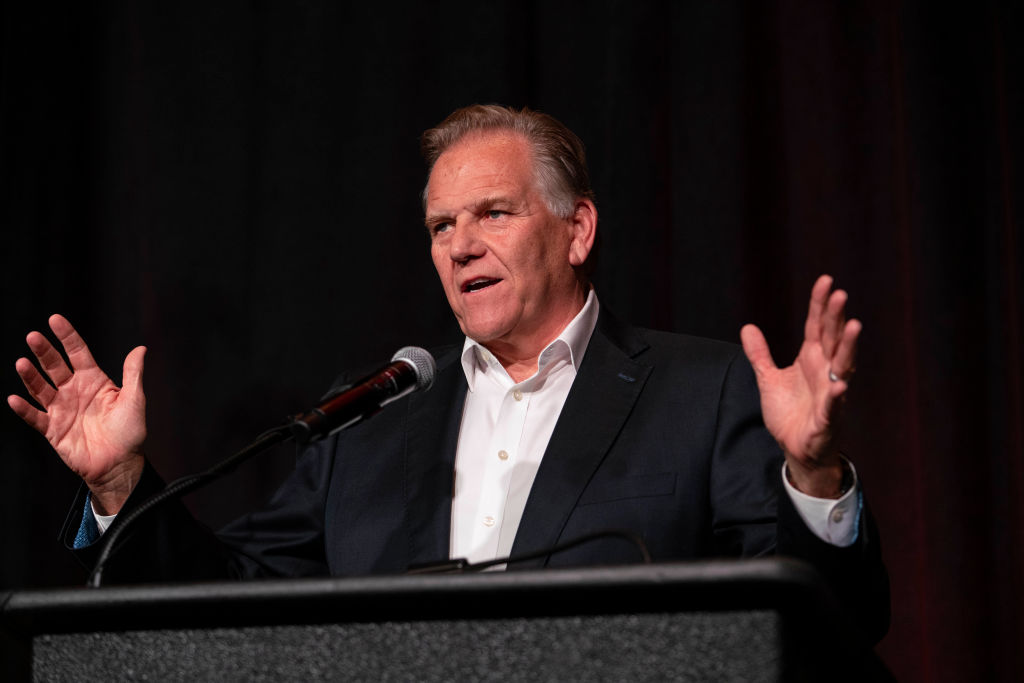
Rogers lost with Trump on the ballot. Can he win without him?
Happy Thursday morning.
WARREN, Mich. — Former Michigan GOP Rep. Mike Rogers lost his Senate race last year by just 19,000 votes, even as President Donald Trump captured the Wolverine State.
Rogers is seeking a do-over in 2026 and has some wind in his sails this time. Senate GOP leaders quickly backed Rogers following his April announcement, and he easily cleared the field while securing the crucial Trump endorsement.
But Trump won’t be on the ballot to help juice turnout. Yet while even that wasn’t enough to push Rogers across the finish line last November, he still sees a clear path to victory.
“Donald Trump’s policies will be on the ballot, for sure,” Rogers, 62, said in an interview as he touted new tax benefits created by the president’s “One Big Beautiful Bill.”
That’s music to Democrats’ ears as they grow increasingly confident in their ability to use the OBBB fallout — plus Trump’s broader agenda — to win key races in 2026. However, that playbook may be a bit more complicated in Michigan given the messy three-way Democratic primary that won’t be settled until a year from now.
The path for Rogers. Much of Rogers’ strategy at this stage involves sitting back and letting Democrats attack each other. Rogers hopes that whoever emerges from the primary next August is badly damaged as a result.
Rogers lost to Sen. Elissa Slotkin (D-Mich.) in part because thousands of Michiganders voted for Trump but left the down-ballot races blank. This was a problem for Republicans in three other states where Trump won and the GOP Senate nominee lost.
Rogers also faced carpetbagging allegations because he bought a home in Florida after leaving Congress more than a decade ago.
But Rogers projects confidence in his path this time around, noting that Trump’s campaign mastermind, Chris LaCivita, is using the same blueprint that turned out low-propensity voters for Trump in November.
Midterm-year turnout is always lower than in presidential election years. Rogers said that in order to win next year, he just needs 85% of those who voted for him in 2024 to do the same in 2026.
“That is a very different race than going out trying to figure out how you get people to vote for you for the first time,” Rogers said.
Rogers and Trump. The former House Republican feels as if he’s getting a head start this time. At this point last cycle, Rogers wasn’t even in the race and still had to deal with a primary.
More importantly, Rogers had to win over Trump. That wasn’t easy given his history as a more traditional Republican and his past mild criticisms of the president.
But Rogers has now morphed into an effective messenger for Trump. He says Michiganders are “fairly optimistic” about Trump’s tariff regime, touting General Motors’ announcement that some production lines are returning to Michigan from Mexico. Still, inflation and the cost of living are vulnerabilities for Republicans heading into 2026.
“[Trump] believes, and I believe, that the economy will be improving steadily throughout the year,” Rogers said.
Rogers insists it’s political malpractice for Democrats to trash the OBBB given the tax components, despite its broader unpopularity and the steep Medicaid cuts that are coming after 2026.
Yet in doing so, Rogers is capitalizing on the toxicity of the Democratic brand.
“[Democrats] are so focused on hating Donald Trump and trying to get people not to like Republicans versus any policy provision that we may have that’s good,” Rogers said as he rattled off tax wins like no taxes on tips and overtime. “This Democrat Party is so focused on the coasts that it forgot about working people in Michigan.”
The other side. The three major Democratic candidates are just as happy to run against the Trump agenda as Rogers is to tout it. But they have different ideas about how to frame a general election campaign against Rogers.
In an interview following a manufacturing-focused roundtable on Tuesday, Rep. Haley Stevens (D-Mich.) said it’s not just about the OBBB and tariff uncertainty.
“People are at a breaking point,” Stevens told us. “I’m certainly very eager to explain my differences with the administration and Mike Rogers on this legislation. But more so, it is that the average American, our Michiganders, are being pushed to the brink on rising costs.”
Stevens is a four-term member who flipped a Trump-won district in 2018 and later defeated a more progressive House Democrat in a redistricting-driven showdown. Stevens noted she’s shown how to win in “tough landscapes” by “championing the economic needs of our state.”
State Sen. Mallory McMorrow is running on the notion that Democrats have failed to successfully message their policies in swing states like Michigan, pointing to 2024 losses in those battlegrounds. In an interview, McMorrow said Democrats need to do more than just tie Rogers to Trump in order to win in 2026.
“There’s an opening to say to people, you have every right to be angry. And that’s different from what we heard in 2024,” McMorrow said. “It’s not just about fighting Donald Trump to restore the way that things were, but it’s recognizing he actually hasn’t delivered on bringing your costs down — quite the opposite.”
Abdul El-Sayed, the Bernie Sanders-endorsed physician, is campaigning on free universal health care, child care and senior care.
When it comes to Rogers, El-Sayed isn’t holding back.
“Mike Rogers is a weak-ass tool,” El-Sayed told us. “The man has zero political talent, he’s like a non-playing character in life. When you have to go to Mar-a-Lago because you’re a neighbor in Florida, and ask another man for his blessing to run for office and ask other people to clear the field for you, all that tells me is you’re a beta character.”
— Andrew Desiderio
T-Minus 14 Days … Preparing for takeoff: We’re excited to announce Meta as the launch partner for Fly Out Day, our new show debuting Sept. 4. Subscribe to Punchbowl News on YouTube to be the first to see unfiltered conversations with top-level lawmakers, administration officials and plugged-in reporters.


THE AGENDA
The non-shutdown legislative agenda
September on Capitol Hill will be dominated by the partisan clash over government funding and a possible shutdown.
But there’s also other legislation lawmakers are hoping can be taken up if the funding fight doesn’t poison the chances for any bipartisan action before year’s end.
Topping that list are the must-pass FY2026 defense authorization bill. There are also proposals to regulate college sports and an effort to rein in pharmacy benefit managers.
Yet the caustic politics of a shutdown could cause problems for these bills in several ways. One is simply whether there’s any chance for bipartisanship amid a shutdown fight. Then there’s the question of what – if anything – can be attached to the one or more continuing resolutions that will be needed in the fall to keep federal agencies open.
Here’s what to watch for beyond the government-funding showdown:
NDAA. The Senate will vote on its version of the National Defense Authorization Act when the chamber comes back on Sept. 2. The House hasn’t scheduled a floor vote for its version of the NDAA but will likely take it up in early September, according to an aide familiar with the legislation.
As in most years, the House and Senate differ on topline defense spending figures. The Senate’s version provides nearly $925 billion, a rebuke of the Trump administration’s $893 billion funding request. The House stuck to the White House proposal.
Congress has enacted the NDAA for 64 years straight. Both the House and Senate proposals received major bipartisan votes in their respective Armed Services committees. The NDAA will also become an attractive vehicle for other legislative priorities, but panel leaders will insist any policy hitching a ride on their bill won’t cost them votes in either chamber.
Bipartisan health package. Senate Republicans are trying to craft a bipartisan health deal centered around changes to pharmacy benefit managers.
Lawmakers on both sides of the aisle have been working for years to pass PBM price transparency measures but have frequently seen their plans foiled. Senate Finance Committee Chair Mike Crapo (R-Idaho) said PBM legislation is a top priority for end-of-year negotiations.
Yet it’s unclear how willing Democrats will be to make a PBM deal after the GOP’s “One Big Beautiful Bill” made major cuts to Medicaid.
College sports. House Republicans have been steadily pushing forward the SCORE Act – legislation that would help regulate college sports and how student athletes are compensated.
The bill cleared two key committees – House Energy and Commerce and Education and Workforce – before the August recess, and its supporters hope it will see House floor action in the fall with the college football season in full swing.
“With August recess ending and students coming back to campus, it’s time for the House to pass this bipartisan bill to protect Name, Image, and Likeness rights for student-athletes and stabilize college athletics,” House Education and Workforce Committee Chair Tim Walberg (R-Mich.) said in a statement.
While the legislation has support from some House Democrats, some Senate Democrats are more skeptical. Sen. Cory Booker (D-N.J.) has opposed the legislation, and the bill would need Senate Democrats to get on board for a chance of it becoming law this year.
– Samantha Handler


Sanders sees eye-to-eye with Trump on Intel
There’s at least one senator supportive of President Donald Trump’s negotiations to take a government stake in chip maker Intel: Bernie Sanders (I-Vt.).
The Trump administration revealed this week that it is working to turn CHIPS Act grants Intel received into equity in the company. Commerce Secretary Howard Lutnick told CNBC such a move will ensure the federal government gets “a good return for the American taxpayer instead of just giving grants away.”
Here’s the thing, though: this idea was first proposed by Sanders and Sen. Elizabeth Warren (D-Mass.).
When the CHIPS Act made its way through the Senate in 2022, the two senators offered an amendment that would have conditioned the funding on companies issuing a warrant or equity interest for the federal government. Sanders tried to get it adopted by unanimous consent but didn’t succeed.
Here’s what Sanders told us about Trump’s plan for Intel:
The agreement on how to treat Intel is an example of where the populist politics of Trump and progressive Democrats, particularly Sanders, can sometimes align. Like Sanders, Trump criticized the CHIPS Act early on, saying it was a bad idea to subsidize an already very rich industry.
Warren is skeptical. The Massachusetts Democrat wasn’t as supportive of Trump’s still-being-negotiated move. Warren said Trump “seems to have stumbled” on the idea pushed by her and Sanders.
Trump “just saying he wants the public to have a stake in a major company isn’t the same as having a real strategy” to promote “corporate accountability,” Warren said in a statement to us.
Not your father’s GOP. Trump has intervened in the private sector fairly often during his second term, including to secure a government cut of company profits in some instances. This is causing deep discomfort among traditional conservatives and laissez-faire thinkers. The Wall Street Journal editorial pages called a federal stake in Intel “corporate statism.”
Sen. Todd Young (R-Ind.), an original sponsor of what became the CHIPS law, is taking a cautious approach toward the negotiations with Intel. But Young, who takes a more traditional GOP view of the economy, doesn’t sound like a huge fan of the equity idea.
Young said in a statement to Punchbowl News that “the law has already unlocked over $450 billion in private sector investment commitments — which qualifies as more than a good return on taxpayer investment in my estimation.”
– Diego Areas Munhoz
CASH DASH
Takeaways from FEC filing day
When we looked at our calendars on Wednesday, we were so happy to see that it was already the 20th of the month — committee filing day.
The House. The DCCC outraised the NRCC — no huge surprise there. The DCCC raised nearly $7.6 million in July and ended the month with $40.4 million in the bank. The NRCC raised more than $6 million and has $37.6 million in the bank.
Of note, the NRCC donated $300,000 to the National Republican Redistricting Trust on July 22.
The DCCC has fairly consistently outraised the NRCC each month this year, except in June, when the NRCC raised $18.1 million to the DCCC’s $12.7 million.
The Senate. Republicans fared better in the Senate. The NRSC outraised the DSCC by about $1 million.
The NRSC took in nearly $6.2 million in July and ended with $7.9 million in cash on hand. The committee spent nearly as much as it raised last month.
Meanwhile, the DSCC raised $5.1 million and ended with $11.8 million in the bank. It spent $6.8 million.
Senate Democrats have a pretty sizable cash-on-hand advantage here, although they still have outstanding campaign debt. The DSCC has $2.3 million left to pay back from last cycle, while the NRSC has none.
The parties. There’s a massive, massive money gap between the national party committees, and it could have a big impact both this fall and in 2026.
The DNC raised $8.5 million and had less than $14 million in the bank at the end of July. Compare that to the RNC, which raised $13 million last month and had a whopping $84.3 million on hand.
– Jake Sherman and Ally Mutnick
THE CAMPAIGN
Redistricting news. The Texas House advanced the GOP’s redistricting proposal on Wednesday night after Democrats returned to the state to restore quorum.
The Texas Senate will need to pass the House version before it heads to GOP Gov. Greg Abbott’s desk. But this is moving at a brisk pace.
Recruitment watch. Immigration attorney Lisa Ramirez launched a run against Rep. Young Kim (R-Calif.) in Orange County. This district could become significantly tougher for Democrats if California Democrats jam through the proposed new congressional map for the midterms.
Iowa. There’s lots happening in the Iowa Senate Democratic primary! On Wednesday, the Teamsters Local 90 union endorsed state Sen. Zach Wahls’ campaign. Earlier in the week, state Rep. J.D. Scholten ended his bid and endorsed fellow state Rep. Josh Turek.
Des Moines School Board Chair Jackie Norris is also running for the Democratic nomination.
— Max Cohen and Ally Mutnick


Enter a new era of Punchbowl News with exclusive merch from our swag store. From t-shirts and quarter-zips to mugs, hats and even pickleball paddles, we’ve got you covered.

Crucial Capitol Hill news AM, Midday, and PM—5 times a week
Join a community of some of the most powerful people in Washington and beyond. Exclusive newsmaker events, parties, in-person and virtual briefings and more.
Subscribe to Premium
Special Projects
Explore our deep dives into the issues that matter the most today and will shape tomorrow's future, with expert reporting that goes beyond the headlines and into the heart of the Capitol.
Check it outEvery single issue of Punchbowl News published, all in one place
Visit the archive
Go deeper with a Premium+ membership to Defense, Tech, Vault OR all three. Access monthly briefings with reporters, paywalled content, breaking news texts in your coverage area and more, bringing you closer to the action.