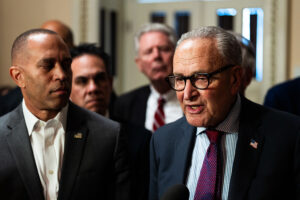


Democratic leaders on Capitol Hill are set to unveil their counteroffer to Republicans’ seven-week government funding bill later today. It’ll be the first time Senate Minority Leader Chuck Schumer and House Minority Leader Hakeem Jeffries are putting their demands on paper in an attempt to kickstart negotiations that Republicans have thus far shunned.
Yet there’s no indication that the proposal — a short-term CR filled with partisan policy riders — will make a bit of a difference in the push to prevent a shutdown.
The House is charging ahead with a GOP-drafted CR. And Senate Republicans are going to dare Democrats to reject it.
The counteroffer. While the text isn’t final, the centerpiece of the Democratic plan will be a permanent extension of the Obamacare enhanced premium tax credits, according to multiple sources briefed on it. There’s GOP interest in addressing the soon-to-expire subsidies, but Republican leaders have ruled out doing so on a short-term CR.
The Democratic proposal could also include rollbacks of the Medicaid cuts in the One Big Beautiful Bill Act, plus language to restrict further rescissions.
“That’s our view — that [Medicaid] never should have been cut,” Sen. Elizabeth Warren (D-Mass.) said in justifying Democrats’ demands.
Of course, there’s no chance Republicans would agree to tinker with their signature legislative achievement.
Schumer and Jeffries believe they need to take a hard line against Republicans’ CR. But they must keep their caucuses together to hold that line if they have any hope of forcing Republicans to negotiate.
Yet GOP leaders are digging in further and laughing off Democrats’ posture.
“I’m happy to sit down with [Schumer]. But I’d like to have a reason to do that. At the moment, I don’t think I do,” Senate Majority Leader John Thune told us.
Thune has been reprising Schumer’s oft-stated support for “clean” CRs. And a senior GOP aide quipped of Democrats’ proposal: “For anyone wondering what a partisan CR actually looks like, look no further.”
Full steam ahead. House Republicans are charging ahead with their Nov. 21 CR. The measure is relatively clean, meaning it doesn’t have partisan policy riders. Democrats seem to agree, because they’re attacking what’s not in the bill — health care provisions — rather than what is.
Speaker Mike Johnson is staying relatively calm during this episode, cautiously optimistic that he can get this bill across the finish line by Friday.
To be fair, this is a relatively simple CR. Many of the complaints from the rank-and-file are that they don’t know what the next play call is come Nov. 21. Will they get an omnibus? Will they get a package of pre-negotiated individual spending bills? These are fair questions that Johnson is going to want to answer before Friday.
House GOP opposition to the CR doesn’t seem terribly serious so far. But that could change on a dime.
Don’t be surprised if the CR comes up in the House today or Thursday. Johnson said he’d move “as there’s a consensus to move it.” And for Thune, the sooner the better. The Senate is bumping up against a recess and potential weekend scheduling conflicts for senators, including Charlie Kirk’s funeral in Arizona on Sunday.
Quick note on member security. The top Republican and Democrat on the Senate Rules Committee are at odds over a proposal to harden member security.
The panel’s chair, Sen. Mitch McConnell (R-Ky.), told GOP senators during their lunch meeting Tuesday that the Senate should pass a resolution authorizing the use of senators’ office budgets for security expenses. There isn’t a timetable for this effort.
Across the hall at the Democratic lunch, the committee’s ranking member, Sen. Alex Padilla (D-Calif.), was making the case against it. We’re told Padilla said that “simply repurposing existing funds” is insufficient, and that the Senate needs a “dedicated program” for member security with built-in oversight mechanisms.