


The election year blues. Election years are supposed to be predictable, filled with partisan messaging votes to divide the minority and bolster the majority’s political standing.
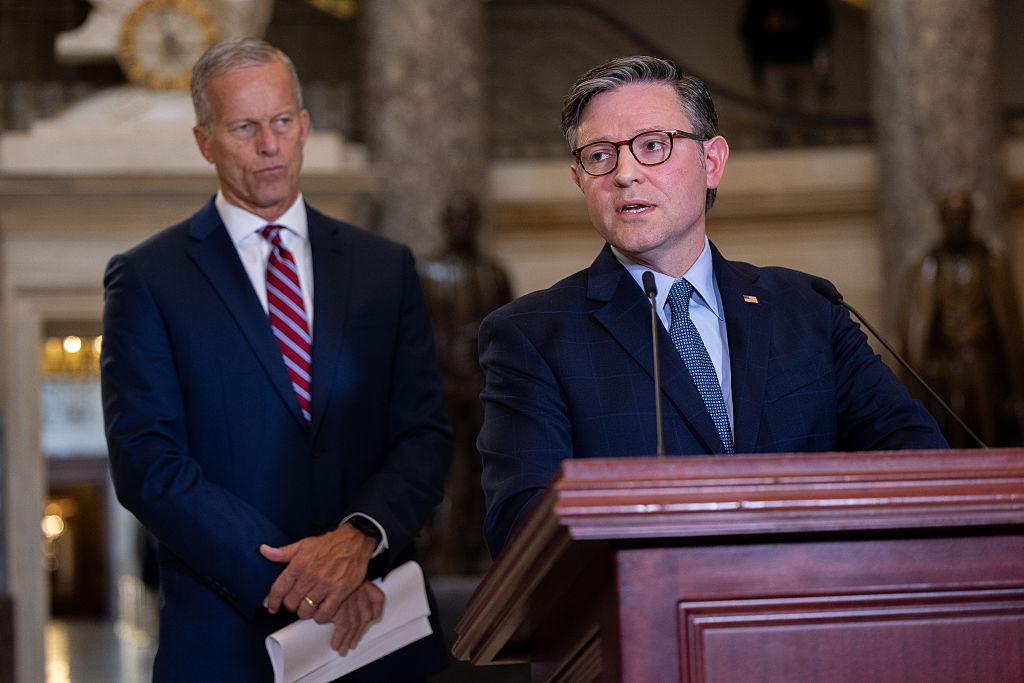
But nine days into the new year, Speaker Mike Johnson and Senate Majority Leader John Thune have been plunged into a series of uncomfortable — and in some cases, intractable — political problems. If this is the way 2026 is going to go, it could be a very long year for the GOP, especially the razor-thin House Republican majority.
And President Donald Trump is at the center of several of these Republican crises.
Washington x The World. Trump said he’s going to run Venezuela indefinitely — and five Senate Republicans voted Thursday to advance a resolution limiting any U.S. military action in the South American nation, a direct challenge to the president. Thune lobbied hard to head off Republican defections, to no avail.
A vengeful Trump said those five GOP lawmakers — Sens. Todd Young (Ind.), Susan Collins (Maine), Rand Paul (Ky.), Lisa Murkowski (Alaska) and Josh Hawley (Mo.) – should “never be elected to office again.” Collins is the most endangered Senate Republican and has the full backing of Thune’s multi-pronged political machine.
Thune tried to downplay Trump’s comments on Thursday, but a clearly displeased Collins warned that she’s the only one who can prevent a Democratic pickup in her state.
The Senate’s Venezuela legislation — a war powers resolution from Sen. Tim Kaine (D-Va.) — could also complicate Thune’s ability to bring a $180 billion House-passed spending bill to the floor next week. Enacting appropriations bills is a top priority for Thune, and getting back on track following last year’s disastrous shutdown is paramount for the South Dakota Republican.
Trump unbound. In a two-hour interview with the New York Times, Trump asserted the only limit on his global power play was his own “morality.” Congress has institutional checks on the presidential use of the U.S. military, but it’s largely abdicated that role in recent decades.
Trump and senior White House aides have also said he wants the United States to control Greenland, deeply splitting Republicans on Capitol Hill while infuriating key European allies.
There are some Republicans, such as retiring Sen. Thom Tillis (R-N.C.), speaking out quite strongly against this rhetoric. But at the same time, they haven’t banded together for an organized legislative response to the president.
Yet remember when then-Sen. Marco Rubio (R-Fla.) led legislation in 2019 requiring congressional approval for any presidential effort to withdraw the United States from NATO? That came amid Trump’s persistent threats to do so.
But this isn’t the first Trump administration, and Rubio is now Trump’s secretary of State and national security adviser. This time, even something as existential as blowing up NATO — which a Greenland takeover would effectively do — isn’t prompting a similar response from Hill Republicans.
Obamacare. Seventeen House Republicans bucked Trump and Johnson by voting for House Minority Leader Hakeem Jeffries’ three-year extension of enhanced Obamacare premium subsidies on Thursday. It was a stunning rebuke to party leaders that showed these members are more worried about voters in November than angering their own leadership.
Plus, it wasn’t just GOP moderates who voted for the bill, which Johnson lobbied heavily against. Reps. Derrick Van Orden (R-Wis.), Rob Wittman (R-Va.) and Mike Carey (R-Ohio) — all of whom have been mostly silent during the Obamacare subsidies debate — sided with Jeffries and against their own speaker.
The Obamacare debate now shifts to the Senate, where Thune is going to have to balance the priorities of GOP conservatives against the deal-seeking middle of his conference.
Even as a bipartisan group of senators are working behind closed doors to get a deal, Schmitt told us on Fly Out Day that he doesn’t think an Obamacare deal will come together. Schmitt wants Republicans to start crafting a reconciliation bill to overhaul the health care system.
ICE. Wednesday’s deadly shooting by an ICE agent in Minnesota, as well as a Portland, Ore., shooting on Thursday by a U.S. Customs and Border Protection agent, did nothing but increase the political tensions around Trump’s hugely controversial immigration crackdown. There could be spillover for Johnson and Thune from these incidents into the appropriations process.
As more and more federal agents pour into cities nationwide, protests are growing as well. Thune and Senate Majority Whip John Barrasso are leading a group of Republican senators to the Texas-Mexico border today (see below), yet the political struggle is in America’s cities, not there.
Permitting reform. Thune has some bipartisan legislative priorities for 2026, as he laid out to us in a recent interview. One of those is permitting reform.
But again, Trump is actively sabotaging bipartisan negotiations on that front. Democrats pulled out of the talks after Trump slashed five offshore wind projects. Sen. Shelley Moore Capito (R-W.Va.), hardly a Trump critic, said the move “killed our momentum” and was “terrible timing.”
Jan. 6. To cap it off, the Senate unanimously passed a resolution to hang a plaque honoring the U.S. Capitol Police and other law-enforcement officers who protected the building during the Jan. 6 attack. Johnson has refused to hang the piece, but now it will be displayed prominently in the Capitol.
One small victory for Thune, however, is that the House’s failure to override Trump’s vetoes of two non-controversial bills means the Senate won’t have to deal with them — and Thune won’t be faced with a contentious vote that splits his conference.