


January 23, 2026



PRESENTED BY

THE TOP
Dems cool to Duffy’s IndyCar Grand Prix

Happy Friday morning.
News: Transportation Secretary Sean Duffy is pushing to host an IndyCar race on the National Mall in August as part of the America250 celebration, according to multiple sources familiar with the effort.
The race would start at the Supreme Court and cover a full lap around the National Mall, including the Lincoln Memorial. “Pit Row” would be by the Lincoln Memorial Reflecting Pool. Organizers are targeting Aug. 21 for the event.
There’s only one problem: Congress has to approve legislation to make it happen. That seems increasingly unlikely since Democrats aren’t thrilled about the idea.
Congress needs to pass a bill for the race because there’s a ban on advertising on the Capitol grounds. IndyCar vehicles are famously adorned with lots of ads.
The Grand Prix idea has made its way to aides of the Big Four — Speaker Mike Johnson, House Minority Leader Hakeem Jeffries, Senate Majority Leader John Thune and Senate Minority Leader Chuck Schumer.
Democrats are worried about the strain it would place on both the U.S. Capitol Police and area roads. Plus, Democrats feel as if Republicans haven’t been helpful to them. Why should Democrats assist Republicans with this if the GOP has refused to hang any plaque honoring the victims of the Jan. 6 Capitol riot, one aide said to us.
Several Democrats told us that it seems absurd for Congress to OK an IndyCar race in D.C. when lawmakers won’t even extend health care subsidies for millions of Americans.
Here’s a DOT spokesperson:
A win for the leaders. On Nov. 12, the longest shutdown in U.S. history ended in a tidal wave of bitter recriminations and finger-pointing. Lawmakers then set up another funding deadline on Jan. 30. Many predicted another shutdown was possible, if not likely.
Yet instead, the opposite happened. On Thursday night, the House passed the final four appropriations bills for the year. The Senate is expected to approve the bills next week, though progressives will put up a fight over the Homeland Security funding bill.
It was a stunning turnaround in just nine weeks, a particular victory for Johnson and appropriators.
Somehow, despite the bitterly toxic environment on Capitol Hill and across official Washington, Johnson and Jeffries empowered appropriators to cut a spending deal that left aside the culture war issues that define both parties. It was in both Johnson and Jeffries’ interest to do so and bolstered their positions internally.
Shortly after he took the speakership, Johnson made a return to “regular order” and the end of omnibus legislating his chief political goal. Hardline GOP conservatives were sick of the massive 2,000 to 3,000-page packages negotiated in secret and dumped on them with a shutdown looming. For their part, appropriators needed to get away from CRs or their committee would no longer matter. And pretty much everyone wanted earmark money to spread back home.
Jeffries and House Democrats won here too. CRs give the Trump administration too much leeway in doling out federal dollars. From Democrats’ point of view, GOP appropriators came their way on nearly every issue, from topline spending numbers to eschewing “poison pill” policy riders.
“This is the most significant progress towards restoring regular order in this institution in many years,” Johnson told reporters following a huge bipartisan vote for the $1.2 trillion Defense-Labor-HHS-THUD package.
House Appropriations Committee Chair Tom Cole (R-Okla.) said Johnson’s support was critical for getting the FY2026 bills done at all.
“This speaker is the reason that these 12 bills happened,” Cole declared.
A long road. We’ll note that Johnson and Cole pushed huge spending cuts early in 2025 when DOGE was running Washington. It’s one of the many reasons why the whole appropriations process has dragged out until late January.
OMB Director Russ Vought called for more than $100 billion in discretionary cuts on top of the hundreds of billions of dollars cut from Medicaid and other mandatory programs in the One Big Beautiful. House GOP appropriators drafted partisan spending bills at the Vought-proposed level knowing Democrats and the Senate would never go along with it.
Hill Republicans also did nothing when President Donald Trump unilaterally shut down USAID and tried to dismantle the Education Department, all while laying off tens of thousands of federal employees.
But the record-setting 43-day government shutdown — which Democrats triggered in an epic clash over Obamacare subsidies — was a watershed moment for House and Senate appropriators.
With House and Senate leaders’ tacit approval, the Four Corners on the Appropriations panels — Cole, Rep. Rosa DeLauro (D-Conn.) and Sens. Susan Collins (R-Maine) and Patty Murray (D-Wash.) — began to quietly hash out spending deals. It was clear that the Vought-pushed spending level wasn’t going to work, and they drafted bipartisan bills accordingly.
Appropriators and party leaders desperately wanted to avoid another CR. It’s not hyperbole to say that this was a critical moment for the 160-year old House Appropriations Committee.
“We got the bills done, and we came out very well, you know, and that should be proof enough that we need to make the process work,” DeLauro said in an interview.
“But first and foremost, it is reaffirming the power of the purse, as the Constitution said, resides in the Congress, and there we are not just going to let Russ Vought, an unelected bureaucrat … go run roughshod over the appropriations process.”
— Jake Sherman, John Bresnahan and Samantha Handler
Join us on Wednesday, Feb. 4, at 8 a.m. ET for a summit focused on understanding the many factors shaping youth mental health. The event will kick off with a bipartisan panel interview, featuring Reps. Tony Gonzales (R-Texas) and Andrea Salinas (D-Ore.). Afterward, we’ll hold a fireside chat and an expert panel discussion. RSVP today!


FLY OUT DAY
Aguilar on Fly Out Day: I’m staying in the House and running for whip
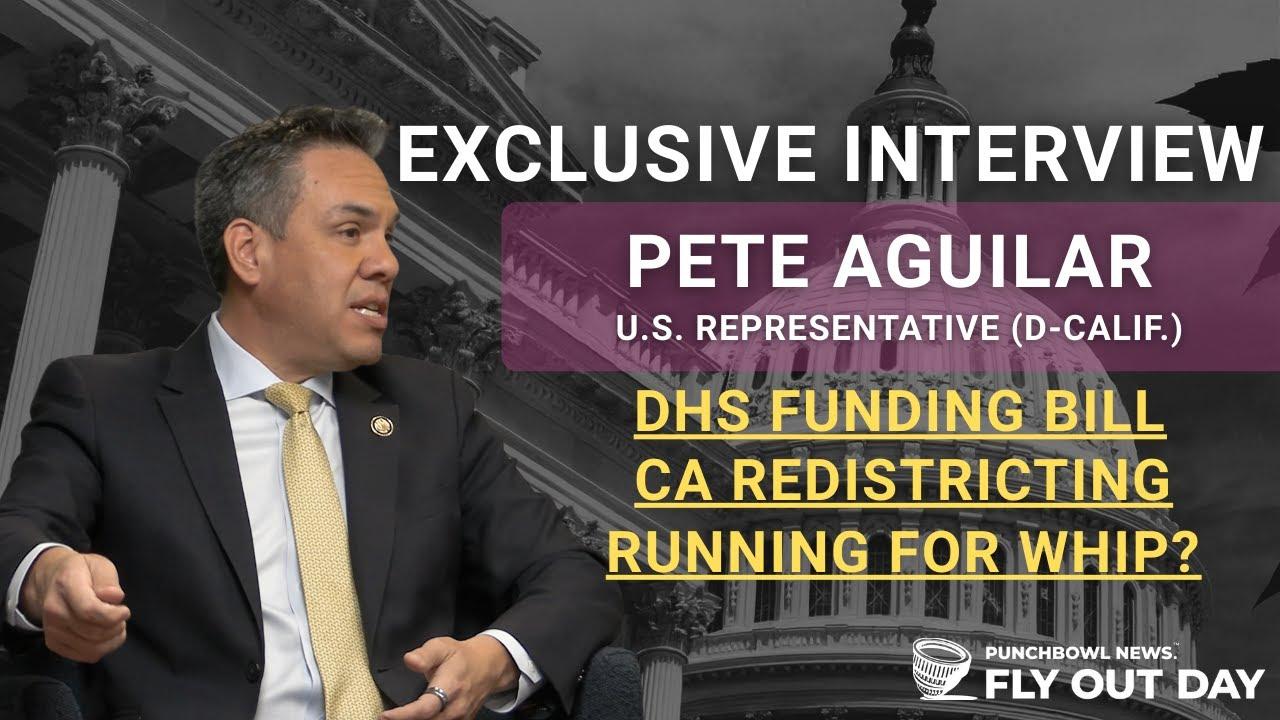
House Democratic Caucus Chair Pete Aguilar (Calif.) said he would run for whip if Democrats win the majority in November, and he vowed not to seek statewide office in California.
In a wide-ranging interview Thursday on Fly Out Day, live from the Punchbowl News Townhouse, Aguilar said “the plan” is to launch a run for Democratic whip if his party wins the majority.
“Hakeem Jeffries as speaker and Katherine Clark as leader,” Aguilar said of what the Democratic leadership would look like.
“We’re doing everything we need to do to help our members and win the majority,” Aguilar added. “And if we’re privileged enough to be in the majority, then I will ask the caucus to elevate me and vote for me for that job.”
Asked if he would ever consider running statewide, Aguilar gave a flat “no,” noting he’s “a House guy.”
Quite interestingly, Aguilar said he plans to endorse in the California governor race but “not in the near future.” Several former and current House Democrats are in that contest, including Rep. Eric Swalwell and former Reps. Katie Porter and Xavier Becerra.
“I’ll share with my community who I’m going to vote for, but I know them all, and there’s also a possibility that there could be two Democrats in the top two,” Aguilar said. “Democratic convention in California is coming up next month. We’ll see what happens.”
Watch the entire episode to hear Aguilar’s views on the appropriations process and what the Democrats’ message should be going into the 2026 election. Plus, his thoughts on term-limits for top Democrats on committees.
– Jake Sherman

HEALTH CARE
Congress looks beyond Obamacare battle
With a deal to revive the enhanced Obamacare subsidies hopelessly out of reach, Congress is beginning to turn the page.
Lawmakers are taking narrow health care wins where they can get them — for example, adding bipartisan measures to a must-pass government funding bill this week rather than waiting for a grand bargain on Obamacare subsidies. Meanwhile, Republicans are turning their focus back to some of the more partisan ideas to address surging health costs, including what President Donald Trump proposed last week.
“It’s turned out to be more challenging than I think we thought at the beginning,” said Senate Minority Whip Dick Durbin, who’s been involved in the Senate talks to renew expired Obamacare subsidies. Durbin views an agreement as “possible but not likely.”
The road ahead: The latest setback came this week when lawmakers agreed to a separate, narrow health care deal as part of the final FY2026 government funding package. It’s silent on the enhanced ACA premium tax credits.
The health committees have long sought to move a package along these lines, which includes measures to crack down on pharmacy benefit managers. It’s heavily bipartisan.
Tucking the PBM reforms into the broader funding package is the latest evidence that an Obamacare subsidy deal isn’t happening.
The Senate is scheduled to return on Monday but the bipartisan negotiating group is not currently planning to meet.
Remember, the House passed a three-year clean extension of the Obamacare credits and a narrow package of GOP health care bills. But neither have a path forward in the Senate.
Now House GOP moderates are looking at other options to tackle high costs, although this is problematic as well. Republicans would likely need to use the partisan reconciliation process to pass significant proposals, and it’s not clear the GOP can unite behind another large bill.
“The objective is to address the short-term issue of the subsidies but the larger, longer-term issue of health care costs in America is the biggest priority,” Rep. Mike Lawler (R-N.Y.) told us.
Inside the abortion fight. The clash over adding new language to restrict abortion funding has long been the biggest obstacle for the bipartisan Obamacare subsidy group.
Durbin credited Sen. Dan Sullivan (R-Alaska) with pushing behind the scenes to strike a compromise on the abortion language. Sullivan and other Republicans tried to argue to their GOP colleagues that they should be amenable to more generic language that doesn’t expand abortion services, Durbin said.
Sullivan is on the ballot this year, so his push is a sign of the political potency of the health care issue that Democrats have been spotlighting since Republicans passed the One Big Beautiful Bill. Sullivan even voted to advance Democrats’ proposal in December, which was a three-year extension of the Obamacare subsidies. Sullivan now has a formidable Democratic challenger in former Rep. Mary Peltola (D-Alaska).
But the more generic language on abortion that Sullivan and other Republicans have been pushing has been a tough sell for conservatives.
And Democrats, according to Durbin, have been skeptical of even that language because, “if it doesn’t change anything, why do you need this language?”
“It’s kind of hard to find the sweet spot in the middle,” Durbin added.
— Laura Weiss and Andrew Desiderio
PRESENTED BY NIKE

At Nike’s Oregon headquarters, there is no finish line to creating, designing and breaking limits to better serve athletes and make their dreams real.
HOUSE DEMS
Breaking: Hoyer endorses a successor
News: Rep. Steny Hoyer (D-Md.) is endorsing Maryland State Del. Adrian Boafo to succeed him in representing Maryland’s 5th District.
Boafo, 31, worked as Hoyer’s campaign manager before winning a seat in the Maryland House of Delegates in 2022. In the state legislature, Boafo serves as assistant majority leader. Boafo also occupied multiple local government roles in Bowie, Md., before running for the House of Delegates.
In an interview, Hoyer praised Boafo as a “savvy” politician who will “bring a real knowledge of municipal needs and Prince George’s County needs” to the House.
“I think that he will be able to be here for some period of time, obviously, and we’re losing 45 years of seniority,” Hoyer said of Boafo. “He will be able to hit the ground running because of his legislative experience.”
Endorsements don’t always matter much but Hoyer still has significant sway in his district and Maryland politics writ large. Just look at his recent record backing Gov. Wes Moore and Sen. Angela Alsobrooks in their Democratic primaries.
Other Democrats running in the crowded primary to succeed Hoyer include Prince George’s County Councilwoman Wala Blegay, health care executive Quincy Bareebe and state Del. Nicole Williams.
— Max Cohen
NEW DEMS
During a swing through D.C. this week, 2028 presidential hopeful Rahm Emanuel stopped by a New Dems dinner to weigh in on how Democrats can win back the House.
Emanuel told attendees at an event hosted by Rep. Lori Trahan (D-Mass.) that Democrats need to be laser-focused on the cost of living in 2026.
“Focus on groceries, not Greenland,” Emanuel said, per sources familiar with his remarks.
Emanuel, a former DCCC chair who oversaw the party’s successful 2006 midterm romp, also shared lessons from his tenure. Emanuel, also a former Chicago mayor and chief of staff to former President Barack Obama, has criss-crossed the country in recent months as he mulls a presidential run.
— Max Cohen and Ally Mutnick


Presented by Cencora

From accelerating innovation to powering the pharmaceutical supply chain, we reduce barriers to expand access to medications for millions of Americans at sites of care in their communities. Learn more

Crucial Capitol Hill news AM, Midday, and PM—5 times a week
Join a community of some of the most powerful people in Washington and beyond. Exclusive newsmaker events, parties, in-person and virtual briefings and more.
Subscribe to Premium
Special Projects
Explore our deep dives into the issues that matter the most today and will shape tomorrow's future, with expert reporting that goes beyond the headlines and into the heart of the Capitol.
Check it outEvery single issue of Punchbowl News published, all in one place
Visit the archive
Presented by Cencora
From accelerating innovation to powering the pharmaceutical supply chain, we reduce barriers to expand access to medications for millions of Americans at sites of care in their communities. Learn more