


February 13, 2026



PRESENTED BY

THE TOP
Why the DHS shutdown could drag on

Happy Friday morning.
Today is Friday the 13th. What could possibly go wrong?
Well, for one thing, the massive Department of Homeland Security is set to shut down at midnight.
On the last day before funding runs out, there will be no eleventh-hour votes on the House or Senate floor, no lawmakers seeking to make deals and no hope of a last-minute reprieve for DHS’ 260,000 employees.
Instead, both the House and Senate left town Thursday afternoon, a reflection of how far off a DHS funding deal remains. Senators departed for pre-planned travel, including a big trip to the Munich Security Conference, and they aren’t scheduled to return for 10 days.
House members can travel too, but Speaker Mike Johnson canceled official CODELs, so members and aides have to pay out of their own pockets. We still expect some members will make it to Munich (and maybe the Milan Cortina Winter Olympics too.) Lawmakers in both chambers are on notice to come back to Washington if a deal is imminent.
President Donald Trump and Senate Democrats will keep exchanging offers in an attempt to strike a deal on ICE reforms during the break. The next step is for Democrats to send a new offer back to the White House, which sent over its own proposal to Capitol Hill on Wednesday night.
There are some signs of progress. Democratic leaders and the White House are keeping details of the negotiations under wraps, which tends to indicate a serious effort. Although Democrats have said repeatedly that the White House doesn’t want a deal.
The funding fight also hasn’t devolved into the sort of personal grudge match that broke out during last fall’s brutal 43-day, full shutdown. GOP congressional leaders are letting the White House and Senate Minority Leader Chuck Schumer take the lead, generally staying out of the fray for now.
Even so, this battle over DHS funding could morph into another prolonged shutdown. Here’s why.
1) Schumer can’t give up much — if any — ground in the funding fight. House Minority Leader Hakeem Jeffries has taken an even tougher line.
The Democratic base was already pressuring party leaders to do everything they could to push back on the Trump administration over ICE’s activities nationwide. After federal agents shot and killed two people, Renee Good and Alex Pretti, in Minneapolis, that pressure increased exponentially. Democrats saw a moral and political need to take a stand on the DHS budget.
It’s telling that Senate Democrats have been incredibly united behind their ICE demands, more so than the fall fight over health-care. Only one Democrat, Sen. John Fetterman (Pa.), joined Republicans to support a failed procedural vote on a DHS funding bill Thursday.
“Our caucus is passionate about this,” Schumer said at a post-vote news conference on Thursday. “If you sat in on our caucus meetings, you’d see how strongly people feel. And you know who are among the strongest? Some of the very people who didn’t vote with us last time.”
2) The White House believes it’s past the worst of its political problems over ICE.
Following Pretti’s killing on Jan. 24, the White House and congressional Republicans quickly agreed to negotiations with Democrats, something they never really entertained during the Obamacare shutdown. It was a sign of the deep political and personal concern within the GOP over the crisis in Minneapolis.
But the two-week CR for DHS added some time between the initial uproar over Pretti’s death and the current negotiations. During that period, congressional Republicans have grown more critical of Democrats’ position.
Plus, the Trump administration has used the time to make its own changes to ICE’s operations, including sending border czar Tom Homan to Minneapolis. Homan announced this week that Minnesota operations will wind down — but not end entirely.
These changes won’t win over Democrats who’ve been clear that they need ICE reforms written into law because they don’t trust the administration. But Republicans say these steps show the Trump administration is operating in good faith.
3) There’s pressure on GOP leaders and the White House from immigration hardliners to reject Democratic proposals.
If there’s a deal, conservatives have their own priorities that they want in the mix, including targeting “sanctuary city” policies. They’re eager to turn the fight into a battle over immigration policy.
If conservatives win out on these sorts of demands, a deal could totally fall apart.
Also, here’s news. An attorney for Sen. Elissa Slotkin (D-Mich.), one of the six Democrats targeted by the Trump administration over the “illegal orders” video, sent a letter to Attorney General Pam Bondi and U.S. Attorney for the District of Columbia Jeanine Pirro demanding they confirm by the end of Friday that the investigation into her has ended.
The letter notes Slotkin — who said Thursday she’d heard prosecutors might try to indict the Democrats again today — would mount vindictive and selective prosecution defenses to any indictment. The Justice Department failed to secure indictments against the six Democrats earlier this week.
– Laura Weiss, Anthony Andragna, John Bresnahan and Jake Sherman


HOUSE DEMS
The ‘so-called’ minority leader so calls it
House Minority Leader Hakeem Jeffries really wants you to know he doesn’t view the Trump administration as legitimate.
Over and over again, Jeffries prefaces his references to anything Donald Trump-related with the phrase “so-called.” You can’t miss the dripping sarcasm here from the New York Democrat, who’s among the best orators in the House.
Jeffries’ “so-called” blitz stretches back years. From the debate over the 2020 presidential election (“so-called objections”), to the 2022 New York redistricting battle (“so-called public hearings”), to the GOP’s 2024 House chances (“so-called opportunities”), to Pete Hegseth in 2025 (“so-called secretary of Defense”) and to his description of Florida GOP Rep. Byron Donalds (“so-called leader”).
But Jeffries’ most frequent target is Trump. Jeffries has called Trump the “so-called president” for years.
The “so-called” trend reached a fever-pitch this week.
Reacting to Trump posting a racist video over the weekend, Jeffries derided him as the “so-called president” among other choice words.
“The so-called leadership of Donald Trump and Lee Zeldin at the Environmental Protection Agency is shameful,” Jeffries said of the administration’s changes to greenhouse gas regulations.
During the course of the DHS funding fight, Jeffries repeatedly labeled the White House response a “so-called offer.”
Jeffries called the GOP voter ID bill that passed this week the “so-called SAVE Act.”
To cap it all off, Jeffries used the “so-called” moniker four times at his Thursday press conference: to refer to Attorney General Pam Bondi, the White House counter-offer on DHS, absolute immunity for ICE officers and a Democratic primary challenge that never materialized.
Jeffries’ style. The House minority leader loves alliteration. Just check out this mouthful he delivered on Thursday while eviscerating Bondi’s DOJ: “partisan, pathetic, pitiful, petulant pettifoggers.”
Jeffries delivers his takedowns with no notes and doesn’t bring cards with him on the floor.
But he isn’t alone in developing his own catchphrases. Who can forget former Speaker Nancy Pelosi’s constant refrain of “for the children?” She only said it a billion times. At least.
— John Bresnahan and Max Cohen

FLY OUT DAY
Jordan dishes on DHS, FISA and more
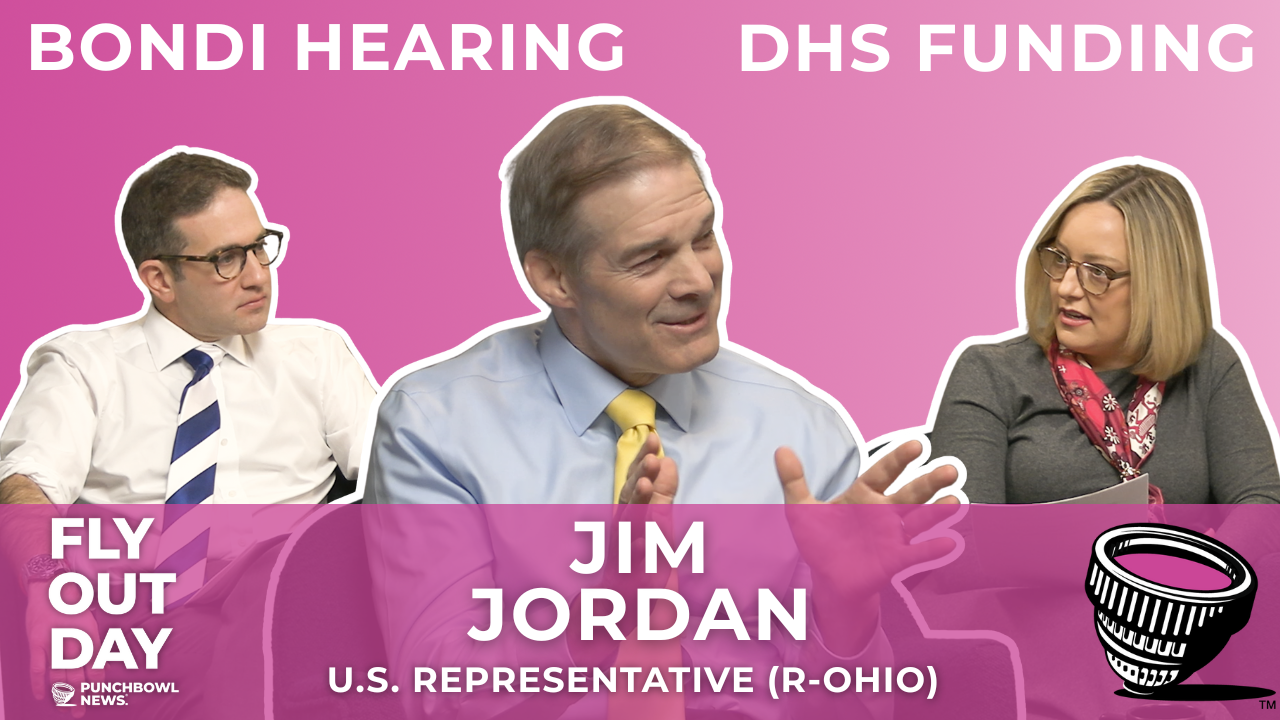
During his two decades in Congress, perhaps no House Republican has been more connected to the GOP base’s mood than Rep. Jim Jordan (R-Ohio).
So when we had Jordan at the Punchbowl News Townhouse for “Fly Out Day” Thursday, we were eager to hear what the Ohio Republicans thought about the debate over Democrats’ demands to overhaul the Department of Homeland Security.
His skepticism about the Democrats’ requests highlight just how hard of a sell it will be to change ICE’s practices in the wake of a pair of deadly shootings in Minnesota.
We asked Jordan what he thought of mandating the use of judicial warrants in federal immigration operations.
“We’re not talking about American citizens here,” Jordan said. “We’re talking about illegal migrants. I think that is a real problem, because … you don’t go get a judicial warrant unless there’s some other crime.”
How about barring federal agents from wearing masks?
“What these guys have had to endure,” Jordan said of ICE and CBP officers. “For the most part, we don’t want that with our law enforcement. But in this situation, they’ve been doxxed, they’ve been tracked, they’ve been spit on, they’ve been harassed. They were attacked with a shovel and a broomstick in Minneapolis.”
For what it’s worth, DOJ dropped the charges on Thursday night against the two men involved in this incident.
And what about allowing states to investigate use of excessive force? Jordan said that’s the federal government’s role, not the states.
In addition, Jordan said he wouldn’t even be willing to have a discussion about DHS reforms unless Congress overhauls laws for sanctuary cities.
“Does one-third of the country want to live in a jurisdiction where we’re letting the bad guys on the street when we could turn them over to federal law enforcement?” Jordan said. “You go ask those people in Minneapolis, you go ask them in Sacramento, you go ask them in New York City. They’d all say, no, that’s stupid.”
We talked to Jordan about a lot, including FISA, the Epstein Files and whether he has a future in House Republican leadership. Watch the episode now.
– Jake Sherman
PRESENTED BY COMCAST

Comcast introduces new technologies and immersive features that invite fans to personalize, explore and engage with NBCU’s coverage of the Olympic Winter Games like never before. Learn more
TRANSPO TALK
Tough road ahead for highway bill
Congress has until the end of September to reauthorize major highway, transit and infrastructure programs. It’s already looking like that won’t happen.
The record 43-day government shutdown last fall brought Washington to a standstill, including delaying key transportation markups. And if the current DHS funding talks blow up, there may be even less appetite from Democrats to negotiate a massive bipartisan highway bill.
“We’re talking back and forth. I mean, it’s a massive bill,” Senate Environment and Public Works Committee Chair Shelley Moore Capito (R-W.Va.) said. “We’re not at consensus but we’re asking for input from all our senators. It’s kind of slow right now.”
House Transportation and Infrastructure Chair Sam Graves (R-Mo.) expects to release bill text in March, a delay from his plan to mark up the legislation earlier this year.
Capito is also aiming to release a bill and have a markup in March, but she’s facing resistance from some Democrats. Top EPW Democrat Sheldon Whitehouse (R.I.) said Democrats have no incentive to negotiate if the Trump administration continues to halt renewable energy projects.
How this could be a slog. Lawmakers on both sides really want to get the bill done by September, but sheer will may not be enough. The political dynamics and calendar are working against them.
First, there’s not much time. Multiple committees, including Senate EPW, Commerce, Banking and Finance, plus House Transportation and Ways and Means, all have to weigh in.
The committees will then need to reconcile their parts of the bill and come to a consensus.
Lawmakers will have much of the summer to do that. But the big question is whether the problems that’ve plagued this Congress get in the way — like fraught government funding fights, repeated shutdowns and the House’s razor-thin margin. Not to mention a looming election where control of the House — and maybe the Senate — is on the line.
Then there’s the beleaguered Highway Trust Fund, the third rail underpinning federal transportation policy that lawmakers would be especially reluctant to address in an election year.
The panels still need an overall spending number from OMB. T&I Ranking Member Rick Larsen (D-Wash.) told us that they haven’t received one yet. That makes it trickier to make decisions about how to divvy up priorities in the bill.
Democrats may decide they can get a better deal next year if they win control of the House. Democrats would then have much more leverage over issues like permitting, electric vehicles and biofuels that are sometimes addressed in the reauthorization.
Still, Republicans are eager to get the bill done this year. Graves in particular is in his last year as chair of T&I, so he’s got an incentive to compromise and get the package done.
Where’s Commerce? Leaders of the Senate Commerce Committee, a key panel here, haven’t even started negotiations.
Senate Commerce Republicans plan to start trading paper with the panel’s Democrats soon. The committee is aiming for a spring markup.
“I wouldn’t say they’re underway, but they need to get underway,” Sen. Maria Cantwell (Wash.), the panel’s top Democrat, said.
– Samantha Handler and Laura Weiss
…AND THERE’S MORE
BDA PAC, an outside group allied with the Blue Dogs, is making its first ever independent expenditure to boost Bexar County Sheriff’s Deputy Johnny Garcia.
Garcia is running in Texas’ newly created 35th District in the greater San Antonio area. This is a district that President Donald Trump won by 10 points, but Democrats believe they can contest it with the right candidate.
The BDA PAC is spending $300,000 to run an ad touting Garcia’s background in law enforcement and his plan to lower costs. The spot will run in English and Spanish on digital and streaming platforms ahead of the March 3 primary.
The Democratic primary is crowded, but not many of the hopefuls have posted strong fundraising totals. Veteran John Lira is also running. If no candidate clears 50% then the race advances to a May runoff.
– Ally Mutnick


Presented by AstraZeneca

The 340B program is supposed to help vulnerable patients—but without strong safeguards, it’s siphoning away funds that could be used for free and charitable medicine. The 340B Rebate Model Pilot improves program integrity, preventing duplicate discounts and strengthening accountability. Urge HHS to implement the pilot today. Learn why it matters.

Crucial Capitol Hill news AM, Midday, and PM—5 times a week
Join a community of some of the most powerful people in Washington and beyond. Exclusive newsmaker events, parties, in-person and virtual briefings and more.
Subscribe to Premium
Special Projects
Explore our deep dives into the issues that matter the most today and will shape tomorrow's future, with expert reporting that goes beyond the headlines and into the heart of the Capitol.
Check it outEvery single issue of Punchbowl News published, all in one place
Visit the archive
Presented by AstraZeneca
The 340B program lacks transparency—making it hard to tell if it’s actually helping vulnerable patients. HHS can fix the problem by implementing the 340B Rebate Model Pilot, ensuring the program is transparent, compliant, and accountable. Learn more.