


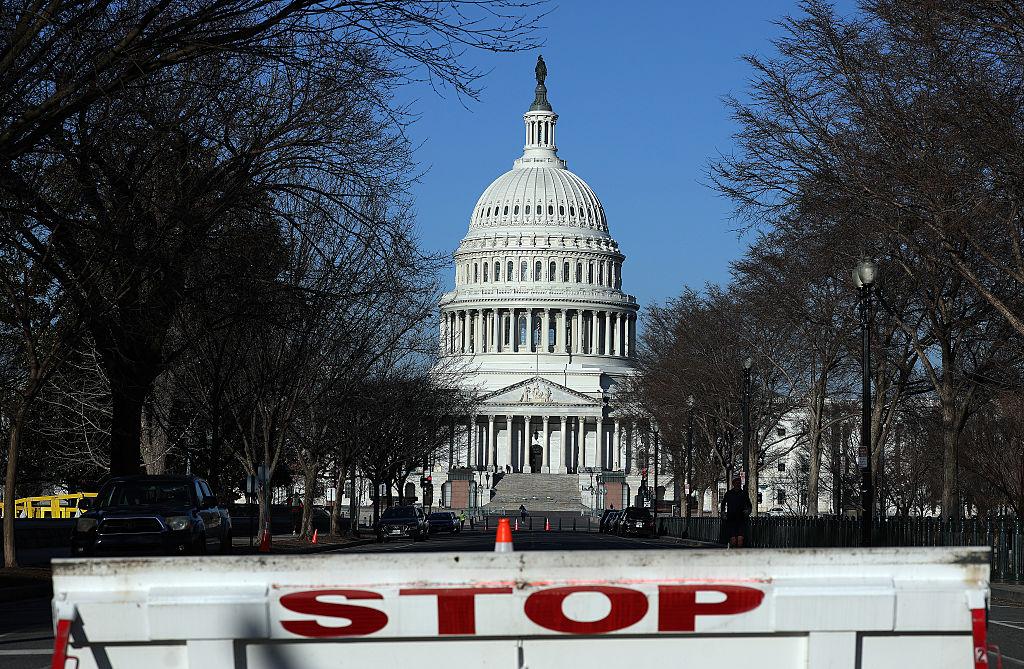
Congress now faces the war over the war.
With President Donald Trump plunging the United States into its riskiest military gamble in two decades — overthrowing the Iranian regime — Republicans and Democrats on Capitol Hill are locked in a struggle over every facet of the conflict: military, political and even moral.
The stakes here are extraordinarily high. Nearly every public opinion poll shows Americans are firmly opposed to a war against Iran. Yet Hill Republicans are lining up behind Trump, who began the war early on Saturday morning while huddled with aides at his Mar-a-Lago club in Palm Beach, Fla. Oil prices have spiked and global financial markets have slumped.
There are also significant factions of the MAGA movement outraged by Trump’s move. But they’re not in Congress, and the president seems to be ignoring them for now. Trump has been calling seemingly every White House reporter possible to give them quotes about the campaign.
The opening salvo of U.S. and Israeli attacks took out the Iranian supreme leader, Ayatollah Ali Khamenei, and numerous other military officers. Trump boosters hailed this as a huge achievement, and Iranians paraded in the streets from Tehran to Los Angeles.
However, Trump immediately undercut his own message by saying there could be significant American casualties during the operation. Trump declared that the U.S. bombing campaign could last a month or longer, shifting the grounds for the debate between Congress and the White House.
Although caught off guard by the size and scale of the initial attacks, Iran has been able to strike targets in Israel, Kuwait, Saudi Arabia, the United Arab Emirates, Oman, Qatar, Cyprus and Bahrain. Three U.S. service members were killed in the Kuwait attack, and nine more were injured. Several U.S. warplanes have crashed. Fighting between Hezbollah and Israel has resumed as well. There have been some civilian casualties during the attacks on Iran.
Democratic fury. So far, Democrats are making dueling arguments.
The first — and most poignant — is that Trump’s war against Iran is illegal because he didn’t seek congressional authorization before initiating hostilities. While Democratic leaders are calling for war powers votes in both chambers, we also expect much more forceful calls from rank-and-file Democrats to impeach Trump.
The political case Democrats are making should be more alarming to Republicans: a re-elected Trump was supposed to focus on bringing down costs for average Americans and boosting the U.S. economy. A military campaign seeking regime change in Iran does nothing to help Americans on either front.
Additionally, there was a serious act of domestic violence Sunday morning in Austin, Texas — a mass shooting allegedly carried out by a naturalized American citizen from Senegal wearing a t-shirt with the slogan “Property of Allah.” The Department of Homeland Security is shut down amid an impasse between the White House and Democrats over ICE reform, and this deadly incident will play into that debate.
House Republicans will force another vote on the already passed DHS funding bill this week (minus a key provision), a move designed to pressure Democrats. Some hardline Republicans are urging party leaders to attach the SAVE America Act to the bill, which is a fight the GOP leadership wants to avoid.
With the House not returning to vote until Wednesday and the Senate coming back tonight, Congress faces a slew of difficult questions.
The power. What leverage does Congress truly have to rein in Trump? Not much, given the lack of GOP support for doing so.
Lawmakers have ceded a tremendous amount of leverage on foreign policy and the use of military force to the executive branch over the last few decades. This didn’t start with Trump, but it’s certainly ramped up during his tenure. Republicans are simply unwilling to challenge him, even as Trump’s military adventurism over the past 13 months contradicts his “America First” doctrine.
But if the Trump administration needs more money to carry out its campaign against the Iranian regime, Congress will have to approve it. That will be incredibly difficult given the razor-thin margins of GOP control in the House and Senate. Trump could be forced to turn to Democrats for help.
The briefings. The Gang of Eight will get another briefing at 4 p.m. today from Secretary of State Marco Rubio and CIA Director John Ratcliffe. Chairs and ranking members of committees of jurisdiction — Senate Armed Services and Senate Foreign Relations — have been invited, too.
Rubio, Ratcliffe, Defense Secretary Pete Hegseth and Joint Chiefs of Staff Chair Gen. Dan Caine will be on the Hill Tuesday for a pair of briefings. The Senate will get briefed at 3:30 p.m., followed by the House at 5 p.m.
The votes. Both the House and Senate will have votes this week on war powers resolutions that serve as proxies for supporting Trump’s efforts.
The House’s measure, authored by Reps. Ro Khanna (D-Calif.) and Tom Massie (R-Ky.), will be up on the floor Thursday. It could pass. Democratic leaders came out strongly in support of this resolution during a Sunday night caucus call, although they may lose some of their own members during the vote.
Sen. Tim Kaine (D-Va.) said his bipartisan war powers resolution targeting Iran will likely be voted on Tuesday or Wednesday. With Sen. John Fetterman (D-Pa.) already a “no,” getting 51 votes would require at least five Republicans to defect. That’s difficult to see at this point.
Congress faces other questions on Iran. What is the legal justification for an extended operation? How much will it cost? How quickly — and which — administration officials will it demand to hear from? What is Iran’s future, and who will run the country? And most importantly, will the United States have a say?