


April 8, 2026



PRESENTED BY

THE TOP
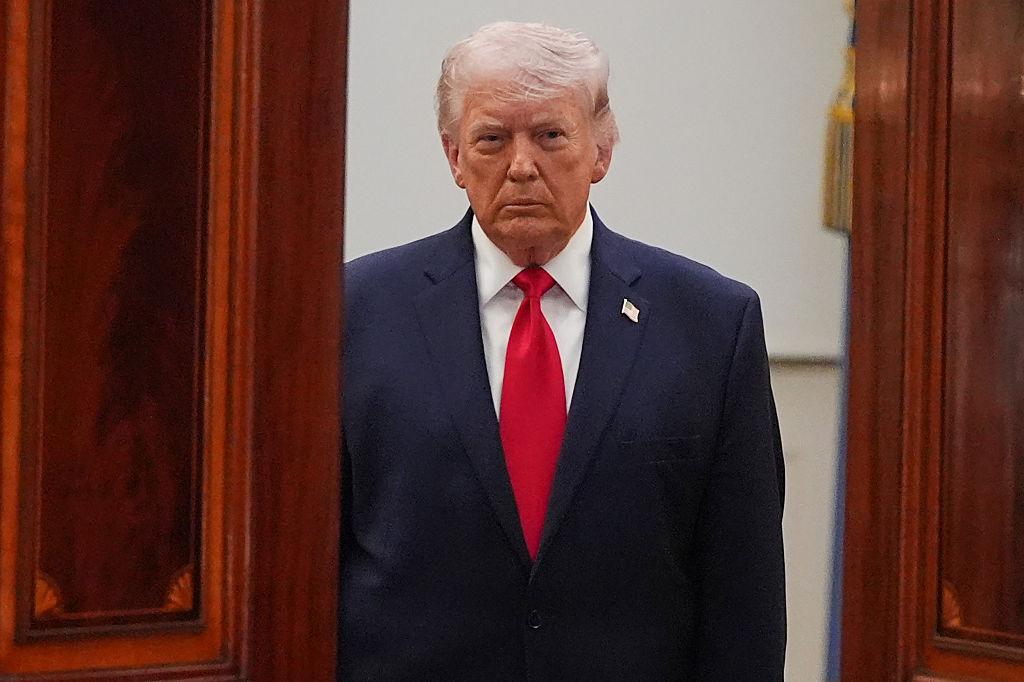
Trump’s 2 weeks starts now
Happy Wednesday morning.
President Donald Trump’s most recent will-he-or-won’t-he episode — in this case, destroying Iran’s economy, infrastructure and civilization — is on hold for at least two weeks. Trump agreed to a 14-day ceasefire with Iranian officials in exchange for reopening the Strait of Hormuz, although the waterway is still under Iranian control.
Whether this is a good deal for the United States remains to be seen. Tehran has declared this accord a massive victory, saying the United States will eventually withdraw its troops, ease sanctions, allow uranium enrichment and accept Iranian control of the Strait. U.S. and Iranian negotiators could meet in person in Islamabad, Pakistan, CNN reported.
Trump will benefit from the ceasefire, too. Oil prices have already fallen under $100 per barrel, which means gas prices back home will fall — although how far and how fast is unclear. Asian and European financial markets were up big overnight, and Wall Street seems ready to join in. Trump and Republicans desperately need that.
Defense Secretary Pete Hegseth will hold a news conference today, and you can expect him to talk up the prowess of U.S. military forces during this conflict. There will also be a White House press briefing.
Yet it’s also unquestionable that Trump and Hill Republicans have taken a serious political hit. Trump’s conduct during the war — particularly over the last 10 days — has left deep doubts about his judgment among lawmakers in both parties.
Trump’s statements saying “we’re blowing up the whole country” and sending “them back to the Stone Ages” shocked everyone in Washington. Trump openly berated some of America’s most important allies, including the United Kingdom, Germany, Japan and Australia. Several GOP lawmakers slammed Trump over his threats to destroy Iran.
The damage from this conflict, both inside Washington and beyond, isn’t going to be repaired overnight. With that in mind, NATO Secretary General Mark Rutte is scheduled to meet with Trump today.
The politics. Democrats breathed a sigh of relief at the ceasefire announcement. For Republicans, however, it’s a sign that the conflict is likely to drag on much longer than they hoped. You’ll recall that when the war began, GOP lawmakers said they expected this would be “weeks, not months.” A ceasefire is temporary and may not end the conflict. Israel is still at war with Hezbollah in Lebanon, and there were reports of some missile and drone attacks in the Gulf region despite the agreement.
With less than seven months until Election Day, House Democrats seem poised to move to impeach Trump. Dozens of Democrats — more than 70 — have said Trump should be removed from office for promoting genocide after threatening to order the destruction of Iran’s civilization.
Impeachment resolutions are privileged, so there’s not much Speaker Mike Johnson can do to prevent a vote. Every single House Republican seems certain to be put on the record about Trump’s wartime conduct. Republicans will say Democrats are held captive by their base and suffer from “Trump Derangement Syndrome.” But with Americans strongly disapproving of the war, it may not be an easy vote for vulnerable Republicans.
Sen. Lindsey Graham (R-S.C.), a close Trump ally, said he’d look for a Senate vote, “like we did with the Obama JCPOA,” on any full-blown peace deal — if one materializes. Graham wants all of Iran’s enriched uranium to be controlled by the United States. That won’t be accepted by Iranian officials, and Trump probably doesn’t want a Senate vote anyway. Plus, any U.S. attempt to seize the uranium would reignite the war.
More immediately, Democrats are going to force more war powers resolution votes. While these won’t have a practical impact, those votes also will be uncomfortable for Republicans. The White House legislative affairs team will need to expend valuable political capital while they’re also trying to get two reconciliation bills passed.
More broadly, the argument that Trump is unfit for office will reemerge as the background for the midterm elections. Democrats will hammer every GOP candidate by saying “A vote for them is a vote for Trump.” Trump’s approval ratings are underwater, hovering around 41%, with some surveys showing even lower.
GOP divide. Trump crossed rhetorical lines like no U.S. president has before. The Republican leadership, perennial supplicants to Trump, were nowhere to be seen amid Trump’s threats. Johnson and Senate Majority Leader John Thune were silent Tuesday. Johnson found time to tweet about men playing in women’s sports, but didn’t utter a word about the Iran crisis.
This episode has exposed a gigantic gulf inside the Trump administration as well. According to this revealing piece by Jonathan Swan and Maggie Haberman in the New York Times, Vice President JD Vance was strongly against bombing Iran.
The questions are almost too numerous for the administration to handle, but Trump and Republicans have to be considering just how many people in the president’s inner circle are leaking Situation Room conversations.
The bull case for the ceasefire. Iran — and its theocratic totalitarian regime — now know that Trump is serious about causing permanent economic and political damage to get what he wants.
Israeli warplanes killed Supreme Leader Ayatollah Ali Khamenei on the first day of the war, and dozens of other senior officials have been killed since. Iran’s air force and navy were destroyed. Scores of military sites across the country were obliterated. U.S. forces were able to rescue two pilots deep inside Iran. The degradation of the IRGC as a conventional military force is undeniable.
Yet Iran showed that even in its diminished state, it can still disrupt the global oil supply and trigger an international energy crisis. It can still hit targets across the Middle East. And it can, to a point, withstand a weeks-long U.S. bombardment. Iran lost every battle but it scored strategic points.
Winning the peace will be just as hard as the war.
— Jake Sherman, John Bresnahan and Andrew Desiderio
Questions about your subscription or account? Our team can answer questions about website access, billing, or upgrading for more coverage. Reach out to us at [email protected] or simply reply to this email.


DEFENSE
Armed Services Democrats target Iran war
House Democratic defense hawks are pressing for fuller scrutiny of President Donald Trump’s war in Iran, vowing to make oversight of the United States’ military operations abroad a top priority in the months ahead.
The push for greater transparency from the House Armed Services Committee’s Democratic members is a clear shot across the bow at Chair Mike Rogers (R-Ala.) and Republicans more broadly, who have declined thus far to hold public hearings on the Iran war.
“We’re over a month into Trump’s disastrous war of choice and we’ve yet to receive a clear strategy from the president despite the staggering costs,” Ranking Member Adam Smith (D-Wash.) said.
The comments were included in a broader list of priorities Smith is set to release Wednesday, a rundown that was first shared with Punchbowl News. The document, which has buy-in from all committee Democrats, is notably from a panel that is traditionally viewed as overwhelmingly bipartisan, particularly in how it legislates on the annual defense policy bill.
There’s more. The conflict in the Middle East is exposing more fissures along party lines. Democratic members, just a couple of weeks ago, called on Rogers to schedule a public hearing on the Iran operations, citing the “lack of transparency” and shifting rationale from the Trump administration.
The new document echoes many of those same frustrations while pointedly demanding that Congress “fulfill its duty to provide oversight” of a war that has killed at least 13 U.S. servicemembers and wounded more than 350 others, according to the latest Defense Department count.
“Congress must reestablish its authority and responsibility as a co-equal branch of government,” Smith said.
The rundown also offers a preview of sorts for future Democratic defense-hawk priorities, should the party retake the House in the midterm elections. The document underscores the need for “more frequent public events, congressional investigations and legislative action” as it relates to the Trump administration’s use of the military.
That includes military action overseas, the domestic deployment of U.S. troops, the politicization of the Pentagon and the renaming of DOD to the Department of War, Smith wrote.
Other priorities. Going forward, Smith said Democrats will work to refocus the Pentagon on “the military’s core missions” in the wake of “political” decision-making under the Trump administration.
The document also stressed support for NATO and the United States’ global alliances. Smith wrote that lawmakers need to “restore America’s position as a reliable lawful partner.”
Democrats plan to spotlight workforce retention efforts following Pentagon leaders’ dismissal of top military officials — most recently Army Chief of Staff Gen. Randy George.
On the NDAA front, Democratic committee members want to do more to strengthen the U.S. defense supplier base. While Smith didn’t explicitly reference the White House’s $1.5 trillion FY2027 defense budget request, he stressed the need to buy military equipment “in a way that is realistic both for industry and federal budget.”
— Briana Reilly

THE SPENDING BATTLE
Appropriators’ reconciliation nightmare
Lots of Hill Republicans are pumped about the possibility of getting two reconciliation bills done this year, allowing them to score some wins without needing Democratic support.
But appropriators are seething.
Appropriators are on the verge of ceding more of their power to the leadership, as Republicans eye funding for ICE, CBP and the Pentagon through party-line reconciliation bills in the coming months. In reconciliation, authorizing committees with jurisdiction over Department of Homeland Security agencies will get the pen instead of the spending panels.
That’s rattling GOP appropriators, even though they see no other option with the partisan split on government funding worse than ever.
“The Democrats have put us where we are, and we have to deal with it. We don’t have a choice,” Sen. John Hoeven (R-N.D.) told us. “We’ve worked these things out before. Why did they… force this situation?”
Objections at the top. During a House Republican conference call last week, House Appropriations Committee Chair Tom Cole (R-Okla.) vented frustrations about the plan to use reconciliation for ICE and CBP funding.
Senate Appropriations Committee Chair Susan Collins (R-Maine) has also said reconciliation isn’t her preferred approach to provide annual funding. Collins blamed Democrats, citing multiple shutdowns this Congress.
“Their refusal to fund ICE and Border Patrol leaves our borders and our country less secure and sets a precedent that they may one day come to regret,” Collins said in a statement.
Senate Majority Leader John Thune warned last week that Democrats’ refusal to agree to full-year DHS appropriations will have negative consequences “for the future of the appropriations process” and “the future of the Senate.”
Rep. Mike Simpson (R-Idaho), a House appropriations cardinal, even said he’d support funding all of DHS through reconciliation at this point. “It’s not the best way to do it, but, hell, what’s going on in the Senate right now is not the best way to do things,” Simpson said.
The fallout. Over the last few years, both parties have increasingly been using reconciliation to boost funding levels for certain agencies and programs. Democrats did this under former President Joe Biden and were warned by Republicans that it was a problem at that time.
Democrats say they aren’t happy with the trend either, and they reject the idea they’re at fault for the collapse of bipartisan funding efforts on DHS. Democrats were demanding ICE reforms in order to back a spending bill, but those talks kept stalling.
Democratic appropriators are also warning that Republicans are furthering a bad precedent by bypassing the annual appropriations process again.
“Doing it through reconciliation requires no compromise with the other party,” said Sen. Chris Coons (Del.), the top Democrat on the Senate’s defense appropriations subcommittee. “If that becomes the sole way that we fund core functions of government that is a bad idea.”
— Samantha Handler, Laura Weiss, Jake Sherman and Andrew Desiderio
PRESENTED BY UNITEDHEALTH GROUP

With innovative technologies and upfront pricing, UnitedHealth Group is helping make health care easier to afford, navigate and get.
SOMETHING SPECIAL
Dems overperform in Georgia special
Republican Clayton Fuller won a special election Tuesday to replace former Rep. Marjorie Taylor Greene (R-Ga.). But his margin of victory was much smaller than MTG’s 2024 win in yet another warning sign for the GOP heading into the midterms.
Fuller beat Democrat Shawn Harris by 56% to 44%. Greene won the district in northwestern Georgia by nearly 30 points in 2024 as President Donald Trump carried it by nearly 40 points.
Fuller had Trump’s endorsement and $1.5 million in support from GOP super PACs in the runoff. Fuller and his allies outspent Harris and ran ads touting his backing from Trump.
Harris still lost. But Democrats’ strong turnout in a deep-red district in a special runoff election in April signals a big enthusiasm gap.
It could also be a good sign for Sen. Jon Ossoff (D-Ga.), who will have to seek reelection in the state this fall.
Wisconsin. Democrats secured a real victory in Wisconsin’s Supreme Court race on Tuesday. Chris Taylor, the liberal candidate, trounced Maria Lazar, the conservative candidate. As of late Tuesday night, Taylor was up 20 points.
Democrats already had a majority on this court, so control doesn’t change. But Taylor won big in La Crosse and Eau Claire counties in southwestern Wisconsin. Both are in the 3rd District, where Democrat Rebecca Cooke is trying to knock out GOP Rep. Derrick Van Orden.
– Ally Mutnick
… AND THERE’S MORE
Fundraising news. Maine Gov. Janet Mills’ Senate campaign raised $2.6 million in the first quarter of 2026. Mills is in a competitive Democratic primary with Graham Platner.
Virginia. Republicans’ anti-redistricting group in Virginia got a $9 million infusion of cash this week from its allied nonprofit. That group, Virginians for Fair Maps, has reported raising $17 million ahead of the April 21 referendum.
But here’s the problem: Democrats’ main pro-redistricting group, Virginians for Fair Elections, has reported contributions totaling more than $49 million.
Democrats are hoping voters will let them redraw Virginia’s congressional map to create four new blue seats. Democratic leaders are all in. House Majority Forward, a nonprofit tied to House Minority Leader Hakeem Jeffries, has given the pro-redistricting group, Virginians for Fair Elections, nearly $30 million.
Republicans are just starting to fight back. Speaker Mike Johnson will attend a fundraiser this Saturday in Great Falls, Va.
— Max Cohen and Ally Mutnick


Presented by AstraZeneca

The 340B program is supposed to help vulnerable patients—but without strong safeguards, it’s siphoning away funds that could be used for free and charitable medicine. The 340B Rebate Model Pilot improves program integrity, preventing duplicate discounts and strengthening accountability. Urge HHS to implement the pilot today. Learn why it matters.

Crucial Capitol Hill news AM, Midday, and PM—5 times a week
Join a community of some of the most powerful people in Washington and beyond. Exclusive newsmaker events, parties, in-person and virtual briefings and more.
Subscribe to Premium
Special Projects
Explore our deep dives into the issues that matter the most today and will shape tomorrow's future, with expert reporting that goes beyond the headlines and into the heart of the Capitol.
Check it outEvery single issue of Punchbowl News published, all in one place
Visit the archive
Presented by AstraZeneca
The 340B program lacks transparency—making it hard to tell if it’s actually helping vulnerable patients. HHS can fix the problem by implementing the 340B Rebate Model Pilot, ensuring the program is transparent, compliant, and accountable. Learn more.