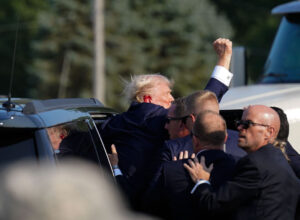


Now that the House established a bipartisan task force to investigate the attempted assassination of former President Donald Trump, we thought it would be a good time to check in with the top Republican and Democrat on the panel to hear their vision for the high-profile probe.
This investigation has become a top priority in the House, particularly among Republicans. But lawmakers on both sides of the aisle are eager to dig into the security failures and provide a full accounting of what went so horribly wrong in Butler, Pa., last month. One person was killed in the shooting, as was the shooter. A bullet grazed Trump’s ear, nearly killing the former president.
The task force, made up of seven Republicans and six Democrats, has yet to meet as a group. But the panel’s chair, Rep. Mike Kelly (R-Pa.), has checked in with most of the members by phone as he plots a busy few months ahead, even over the August recess. He also spent time with Trump at his indoor Pennsylvania rally this week.
Aside from staffing up and getting other logistical details sorted out — such as office space and budget — Kelly said he wants to schedule a visit to Butler to view the rally site. Kelly represents the district.
“Going there and visiting the site is important, so that they can understand geographically, where was this roof? What about the water tower? What about the surrounding perimeter?” Kelly said.
A lot of the panel’s work will take place behind the scenes as members interview witnesses and seek key documents. The task force has subpoena power, and Kelly said he won’t be afraid to use it.
But Kelly also anticipates holding some public hearings. He wants to be transparent throughout the process and reveal key information as the panel gets it. A final report with potential legislative recommendations is due no later than Dec. 13.
“It’s going to be a short but very intense effort because of the mid-December deadline,” Rep. Jason Crow (D-Colo.), the top Democrat on the panel, told us. “There’s going to be a lot of travel and time away for members with campaigning, so logistics will be challenging to make sure we finish by Dec. 13.”
Another hurdle they will have to overcome is the raft of conspiracy theories, on both the left and the right, about who was behind the assassination attempt. Officials have testified that the gunman acted alone. But Kelly hopes their final product will instill confidence in the public about what happened:
Kelly stressed repeatedly that task force members are decidedly not interested in seeking the limelight or fundraising off their work. Some House Republicans have griped about not being chosen for the commission.
“Nobody on here’s going to be running in front of a TV,” Kelly said.
Crow echoed a similar sentiment, saying they want to “avoid the political theater of past investigations.” When asked whether it was an issue to have Rep. Clay Higgins (R-La.), a controversial member who’s pushed Jan. 6 conspiracy theories, serving on the task force, Crow declined to weigh in.
“Leadership has selected who they think is right,” Crow said. “We’re going to do everything possible to work with them.”
One other interesting thing that stuck out to us: Kelly said he raised concerns about the venue choice to the Trump campaign prior to the rally but was largely dismissed. Kelly was particularly worried about the traffic influx and didn’t think local enforcement was incorporated enough in the planning process.
“I didn’t think that venue was the right one, and I was concerned about that from Day One,” Kelly told us.
The security preparations for the event, as well as the communication — or lack thereof — between local law enforcement and the Secret Service, will be some of the key investigative areas for the panel.