


December 11, 2025



PRESENTED BY

THE TOP
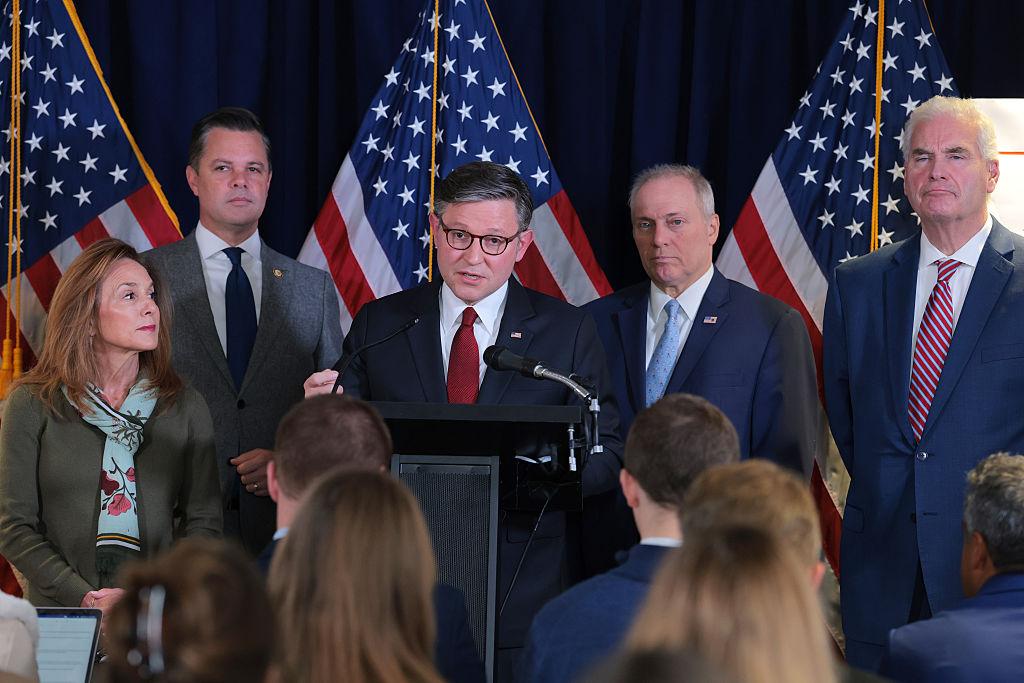
Republicans’ shaky grip on the House
Happy Thursday morning.
Four live discharge petitions. Being forced to bargain for GOP support during simple procedural votes. Calls to Cabinet secretaries from the House floor to help win over members. A prolonged debate on health care with a disengaged president. Potential retirements on the horizon.
This is the House Republican majority with less than 11 months until the midterm elections.
OK, we won’t say that the House is in total chaos. Total chaos is when members unleash censure resolutions against each other or a trio of House Republicans publicly claim Speaker Mike Johnson has no business running the chamber. That was last week.
But there’s a very tenuous reality for Johnson, House Majority Leader Steve Scalise and House Majority Whip Tom Emmer as they navigate the post-shutdown climate with a soon-to-be-even-thinner three vote margin.
Fear of President Donald Trump kept everyone in line earlier this year, especially on the One Big Beautiful Bill. Trump’s poll ratings have fallen, however, and Republicans took a bad beating in last month’s elections.
Members are retiring or running for other offices, meaning they have their own agendas. Most importantly, Republicans could lose the House next year, and GOP lawmakers are beginning to think more about their own political survival rather than what party leaders are selling.
There were a pair of episodes this week to demonstrate just how shaky the House GOP leadership’s control is.
House Republicans struggled for more than an hour Wednesday to pass a rule to begin debate on the NDAA, the typically bipartisan Pentagon policy bill.
In order to flip hardline conservatives, including Rep. Anna Paulina Luna (R-Fla.), Johnson had to call Secretary of State Marco Rubio from a room off the House floor. Rubio agreed to look into NGOs that are funneling money to the Taliban. This was just one of a trio of promises made to pass the rule.
Separately, GOP moderates wanted to hear from Johnson on whether he’d put a bill on the floor to extend enhanced Obamacare premium subsidies, a huge political and policy problem for Republicans. Unsatisfied with his answer, these Republican moderates dropped a discharge petition to go over Johnson’s head.
Live discharge petitions — which effectively strip power from the GOP leadership — have become more common than ever in Johnson’s House. The sheer number of successful discharge petitions is stunning and shows just how poor the outlook is for Johnson and his top lieutenants. Remember what happened with the Jeffrey Epstein vote.
Consider this:
— Rep. Jared Golden (D-Maine) will get a vote today on a bill overturning Trump’s executive order barring federal workers from collective bargaining rights. Five Republicans signed onto the petition. The measure will pass the House, delivering a rebuke to Trump, although it won’t pass the Senate. But we’ll see it come up again during January’s government-funding fights.
— Luna is among a bipartisan group of members pushing a discharge petition to institute a stock trading ban for members of Congress, their spouses and dependent children. Johnson disagrees with the bill and doesn’t want it to pass. The petition only has 41 signatures, including 14 Republicans. But during the NDAA standoff, Luna was able to extract a promise from Johnson to put a stock trading ban on the floor.
— Frustrated with Johnson’s inaction, Rep. Brian Fitzpatrick (R-Pa.) has a discharge petition to extend the enhanced Obamacare premium subsidies. Fitzpatrick, a swing-district centrist, has enough Republican signatories to win a floor vote. What Democrats do here remains to be seen, lending credence to the argument that the minority has major sway on the House floor.
— Five Republicans have already joined Rep. Josh Gottheimer (D-N.J.) on a different discharge petition for a bill that would extend the Obamacare subsidies for one year. That means this effort also has enough GOP backing to be successful if Democrats universally back it. The House Democratic leadership prefers this petition to Fitzpatrick’s.
This new petition or Fitzpatrick’s measure could feasibly reach 218 signatures, starving Johnson of his ability to set the party’s course on health care.
Johnson rightfully understands that the vast majority of House Republicans aren’t in favor of extending the Obamacare tax credits that have been at the heart of the House tumult over the last few months. But there are certainly enough House Republicans who could pair with Democrats to renew the subsidies at some point in the next few months.
Johnson, Scalise and Emmer are trying to create their own plan. They’ve given Republicans a menu of options from which he will build a bill for floor consideration next week. It’s not clear whether any package can pass. As Trump once said, health care is complicated.
What’s concerning many House Republicans in the GOP leadership: Johnson has said he will stretch the health care debate straight into the second quarter of next year. There isn’t any Republican who thinks it’s a good idea for the GOP to be talking about health care — their worst issue — during an election year.
Also. The Indiana Senate is expected to vote on the state’s new congressional map today. This is a big moment for the GOP and the 2026 midterms. The map that the Senate is considering wipes out two Democrats to give the GOP a clean, nine-seat sweep in the Hoosier State. It also could trigger Democrats to act in Maryland and potentially Illinois.
– Jake Sherman, John Bresnahan and Laura Weiss
Seeking real-time reporting and answers to your pressing questions? Upgrade your subscription today and save nearly 20% per month by opting for an annual membership that includes monthly virtual briefings and Q&A’s led by our editorial team that give you a front-row seat to the news shaping the country.


HEALTH CARE
Health care deal gets further out of reach
On Wednesday, we outlined the many reasons to be skeptical about a bipartisan Senate health care deal coming together in the new year. Now, President Donald Trump says Hill Republicans “don’t need” to pass a big legislative package in 2026 at all.
If that holds — and it’s a big “if” given Trump’s penchant for changing his mind — it would be yet another sign that Congress will be unable to address soaring health care costs, a major policy and political problem for Republicans.
Trump’s comments came on the eve of today’s Senate votes on dueling partisan health care plans, neither of which will get 60 votes. While many senators are hoping these failed votes will spur a bipartisan deal next year, the challenges here are immense.
The president’s general disengagement with the Hill on health care talks has effectively doomed chances of a deal before the Dec. 31 expiration of the enhanced Obamacare subsidies.
If Trump remains uninterested in a big legislative effort next year, that could also tank many Republicans’ hopes — however ambitious — for a second reconciliation bill.
Some GOP senators have been privately making the case to Senate Majority Leader John Thune — including during an Oct. 23 meeting — that reconciliation is the best way to address health care, arguing Democrats will never help provide 60 votes. This would allow Republicans to pass a bill without needing Democratic votes. Yet it’s unclear whether Republicans would even be able to muster enough support within their own ranks in both chambers.
Democrats dig in. Senate Democrats have been framing Thursday’s vote on their proposal to extend the enhanced Obamacare subsidies for three years as a “last chance” for congressional action on the issue.
They’re technically correct, as it’s likely the final opportunity for the Senate to address the cliff in some way before the year-end deadline.
“We just need 13 Republicans. That’s it,” Sen. Chris Murphy (D-Conn.) said. “It would be a pretty sad statement about where the Republican Party is today if there aren’t just a dozen that are willing to stand up and do the right thing.”
Republicans say the problem of rising health care costs in general can still be addressed in the new year, potentially tied to the Jan. 30 government-funding deadline. They’ve already said a clean extension is a nonstarter.
But pointing to comments like Murphy’s, Republicans also believe Democrats will see few incentives to help the GOP during an election year.
“I just don’t see much of a mood among the Democrats to solve this problem,” said Sen. Kevin Cramer (R-N.D.). “I think the problem is their leverage politically.”
There’s no doubt that some Senate Democrats, such as Sens. Jeanne Shaheen (D-N.H.) and Angus King (I-Maine), will still try to get a deal. But it’s difficult to see that group expanding by more than just a handful.
News: Sens. Ted Cruz (R-Texas) and Ted Budd (R-N.C.) are introducing a new health care bill called the COMPETE Act. The legislation is billed as an attempt to provide Americans with more options by extending the time period of short-term, limited-duration insurance plans.
— Andrew Desiderio, Laura Weiss and Max Cohen

DEFENSE
Calls grow for war powers vote after Venezuela escalation
President Donald Trump’s move to seize a Venezuelan oil tanker is injecting fresh urgency into efforts to require approval from Congress for any military operations in the region, as fears of an armed conflict grow.
House and Senate war powers resolutions requiring congressional authorization for military action against Venezuela ripen for floor action next week. And rank-and-file lawmakers in both parties say the White House hasn’t justified its escalating campaign.
“They need to come to Congress and say what they’re doing. We don’t know what’s going on. Nobody knows what the mission is in Venezuela,” Rep. Don Bacon (R-Neb.) said. “The president’s made zero case — and his team — for what they’re doing in Venezuela.”
Rep. Pramila Jayapal (D-Wash.), a cosponsor of one of the resolutions centered on actions against Venezuela, said the oil tanker seizure — video of which U.S. Attorney General Pam Bondi posted Wednesday — made it even more important to secure a vote this month. A bipartisan group of senators has introduced a similar resolution, which could be taken up next week.
“It’s a bipartisan effort, I think, to say, ‘No, we are not just unilaterally letting him declare a war on Venezuela,’” Jayapal said.
One of those GOP backers, Rep. Thomas Massie (Ky.), said of Trump’s escalating tactics against Venezuela: “I don’t think it’s ever really been about the drugs … they’re in front of their skis right now.”
Trump said his administration’s control of an oil tanker — the “largest one ever seized” — on Wednesday and that “other things are happening” in Venezuela, without elaborating.
Legislative divide. Yet not all lawmakers expressed concern about the action. House Foreign Affairs Committee Chair Brian Mast (R-Fla.) said he hoped for a briefing — he had a missed call from Secretary of State Marco Rubio — but was broadly supportive of Trump’s campaign.
Asked if he was concerned by the escalating U.S. military action in the region, Mast said he was “not in the slightest.”
“In fact, I encourage using our Article II authority,” Mast said, arguing U.S. Coast Guard forces can’t handle the drug threats without additional Navy and Marine resources in the area.
But Rep. Jason Crow (D-Colo.), co-author of a separate House war powers resolution focused on the targeting of terrorist organizations in the Western Hemisphere, demanded Congress “reassert itself.”
“This is how conflicts start and how they tumble out of control,” Crow told us.
— Anthony Adragna and Briana Reilly
PRESENTED BY WELLS FARGO

Wells Fargo has donated over $2 billion to strengthen local communities over the last 5 years. See how.
BATTLE FOR THE HOUSE
Another Baldacci inches toward House run in Maine
Democratic State Sen. Joe Baldacci, the brother of a former Maine governor, is moving closer to a bid for retiring Rep. Jared Golden’s (D-Maine) district.
Baldacci is serious enough about running that he commissioned a poll of the race. Baldacci has spoken with the DCCC and some of Golden’s former campaign staff about a potential bid.
Baldacci, an attorney and former Bangor city councilman, is a member of a prominent Maine political family. His brother, John Baldacci, was governor from 2003 to 2011 and represented the 2nd District before that from 1995 to 2003. (David Baldacci, a second cousin to John and Joe, is a successful novelist.)
Maine’s 2nd District is among the reddest held by a Democrat; President Donald Trump won it by nine points. The district spans northern Maine and is largely rural. Golden’s surprise retirement left Democratic recruiters nervous about finding someone as adept at winning over Trump voters as Golden. Baldacci briefly ran for the district in 2016 but dropped out.
Republicans have had no recruiting issue. Former Maine GOP Gov. Paul LePage is running.
The poll commissioned by Joe Baldacci found him trailing LePage by one point, 43% to 44%. The survey was conducted in late November and early December by Pan Atlantic Research, which included questions about the 2nd District for Baldacci while fielding a statewide poll.
The sample size is fairly small (387 likely voters) and the margin of error is +- 5.1%. But the fact that Baldacci paid to poll is notable and signals he is gearing up for a run.
Jordan Wood, a former congressional staffer, and state Auditor Matt Dunlap are also running in the Democratic primary.
One wildcard: Baldacci said he won’t run if former Maine Senate President Troy Jackson left the gubernatorial race to run for Congress. So far Jackson has not ruled out a House bid but said he believes he is the best candidate for governor.
— Ally Mutnick
AND THERE’S MORE
News: Senate Republicans clashed behind closed doors Wednesday over earmarks, we scooped last night, as tensions between GOP appropriators and conservatives reached a boiling point.
Sen. Markwayne Mullin (R-Okla.) went after Sen. Rick Scott (R-Fla.) over the latter’s opposition to earmarks, noting that Scott signed budgets as governor that contained similar funding mechanisms.
Scott responded by asserting that Mullin didn’t understand how Florida’s government works. Scott said he line-item vetoed many of the provisions in question.
Separately, Senate Appropriations Committee Chair Susan Collins (R-Maine) and Sen. Ron Johnson (R-Wis.), frequent foes on this topic, got into a heated argument.
Scott and Johnson are among the conservatives blocking consideration of a package of five funding bills.
News: Equality PAC is endorsing three Democrats in contested House primaries. In New York’s 17th District, the group is backing Cait Conley. In New York’s 12th District, the group is endorsing Erik Bottcher. And Equality PAC is supporting Mike Simmons in Illinois’ 9th District.
— Andrew Desiderio and Max Cohen


Presented by Cencora

From accelerating innovation to powering the pharmaceutical supply chain, we reduce barriers to expand access to medications for millions of Americans at sites of care in their communities. Learn more

Crucial Capitol Hill news AM, Midday, and PM—5 times a week
Join a community of some of the most powerful people in Washington and beyond. Exclusive newsmaker events, parties, in-person and virtual briefings and more.
Subscribe to Premium
Special Projects
Explore our deep dives into the issues that matter the most today and will shape tomorrow's future, with expert reporting that goes beyond the headlines and into the heart of the Capitol.
Check it outEvery single issue of Punchbowl News published, all in one place
Visit the archive
Presented by Cencora
From accelerating innovation to powering the pharmaceutical supply chain, we reduce barriers to expand access to medications for millions of Americans at sites of care in their communities. Learn more