


February 19, 2026



PRESENTED BY
THE TOP
The corporate money taking over 2026

Happy Thursday morning.
Iran floor vote coming. Reps. Ro Khanna (D-Calif.) and Thomas Massie (R-Ky.) will force a House floor vote next week on their Iran war powers resolution, as we scooped Wednesday night.
The vote comes amid heavy U.S. military buildup in the region, with CBS News reporting that American forces will be prepared to launch strikes on Iran as soon as this weekend. U.S. and Iranian negotiators met Tuesday in Geneva for mediated discussions over the Islamic State’s nuclear program. Iranian officials are reportedly preparing a framework for additional talks.
White House Press Secretary Karoline Leavitt was non-committal about a timeline for the diplomatic talks Wednesday. Leavitt said there are “many reasons and arguments that one could make for a strike against Iran.”
Previous efforts to claw back congressional war-making powers have come up short this year, most recently concerning the U.S. military operations in Venezuela.
Sens. Tim Kaine (D-Va.) and Rand Paul (R-Ky.) have another Iran war powers resolution ready for consideration in the Senate but have not said when they may force a vote.
DHS update — or not. The shutdown of the Department of Homeland Security is now entering its sixth day, with thousands of federal employees staying on the job but not getting paid.
There’s no movement on this issue that we can see, although high-level discussions continue. We warned you that a formal resolution for this crisis isn’t likely before Congress returns next week. The big question now is whether there’s some sort of agreement in place prior to President Donald Trump’s State of the Union address on Tuesday night. At this point, it seems like both sides are willing to keep it centerstage for the annual address to Congress.
The money wave. Corporate America is coming for the midterms.
An unprecedented number of free-spending super PACs — many backed by corporations and their top executives — are gearing up to influence the 2026 elections, pushing their preferred candidates and policies.
The most recent news dropped Wednesday in the New York Times. Tech giant Meta is gearing up to spend $65 million on state races to boost candidates who are “friendly to the artificial intelligence industry.”
In fact, the AI political-industrial complex is something to behold. With state, city and local governments pushing back against both AI companies and the nationwide data center boom, the ultra deep-pocketed corporations are responding by flexing their financial muscle.
Jobs and Democracy PAC, which is supported by AI company Anthropic, is boosting candidates who are favorable toward state regulations of AI.
This morning, the PAC will announce plans to spend $450,000 to support Democratic New York State Assemblymember Alex Bores, who is running in the crowded field to replace Rep. Jerry Nadler (D-N.Y.) in the Manhattan-based 12th District.
Jobs and Democracy PAC is part of Public First, an advocacy network that’s helping candidates who want to tackle AI safety and limit exports of advanced tech. Anthropic recently announced it was putting $20 million behind Public First.
Leading the Future has $39 million on hand. A16z, and OpenAI President Greg Brockman are supporting this group.
Leading the Future has a Democratic component: Think Big, which is backed by Silicon Valley stalwart Ron Conway, Brockman and his wife.
But AI is hardly the only player in the big money game right now.
Fairshake, the leading crypto PAC, raised $193 million for the midterm elections. The super PAC, backed by a16z and Coinbase, is already one of the most active players in boosting candidates friendly to the digital asset industry.
The Digital Freedom Fund PAC is another pro-crypto PAC backed by Cameron and Tyler Winklevoss. The Winklevoss brothers put $21 million into the PAC — in Bitcoin. As of the end of 2025, it reported just $723,361 in the bank.
Fellowship PAC has said it would spend $100 million on the midterms. Their most recent FEC filing showed that they had raised nothing and had no money in the bank. The group is linked to Cantor Fitzgerald, the investment bank that Commerce Secretary Howard Lutnick once ran. The American Growth Alliance, a collection of major banks, has a new 501(c)(4), which plans to spend in the election as well.
Elon Musk looks like he will be back spending on congressional races after pouring more than $250 million in the 2024 presidential campaign. Musk donated $20 million to GOP super PACs this cycle.
What does this mean? The rise of these industry-funded groups helps shift power away from the party committees and their chief allied super PACs: House Majority PAC, Senate Majority PAC, the Congressional Leadership Fund and the Senate Leadership Fund.
It also adds an element of uncertainty into the midterm landscape. The Fairshake network tries hard to balance out its spending between parties to ensure it can advocate for its industry’s interests no matter which party controls Congress. But will these new groups be as conscientious?
One other important question: Will these groups spend more in safe seats or competitive ones? A safe-seat win is cost effective. That member can be in Congress for decades. But House and Senate leaders in both parties will be most interested in the battleground races. Let’s say a pro-AI group comes in big for an endangered GOP member. That lets CLF redirect its resources somewhere else. It could have a huge domino effect across the map.
– Jake Sherman, Ben Brody, John Bresnahan, Anthony Adragna and Ally Mutnick
NEW SPEAKER ALERT: We’re excited to share more speakers for our March 10 Conference, including Johnson & Johnson Chair and CEO Joaquin Duato and Executive Vice President of Global Corporate Affairs Vanessa Broadhurst; and Covista’s Michael Betz and Megan Noel.
New panels: Leading the Future’s Zac Moffatt and Josh Vlasto will join us to talk AI, crypto and how the broader tech sector will approach the 2026 midterms. And, key area sports owners and execs like Mark Ein, Zach Leonsis and Jason Sinnarajah will close out the day with a future of sports in D.C. conversation. Join our interest list to be in the know about the Conference.


THE LONE STAR STATE
Hunt surge shakes up Texas Senate primary
DALLAS — When Rep. Wesley Hunt (R-Texas) entered the Texas Senate race, Republican leaders portrayed him as an egomaniac who’d needlessly prolong an already messy GOP primary with no chance of winning.
But less than two weeks out from the March 3 contest, Hunt has become enough of a threat that he’s drawn more than $9.3 million in attack ads from groups backing his rivals: Texas Attorney General Ken Paxton and incumbent Sen. John Cornyn (R-Texas).
“It really fires me up because I know that a couple of months ago, this was a vanity project. I didn’t have a chance and no one knew who I was,” Hunt said, referring to a NRSC memo on his campaign. “Now you’re spending money against me.”
Both rivals dismissed Hunt while campaigning this week.
“I’m not really focused on Wesley,” Paxton said. “My job is to take out Cornyn.”
“He won’t be a factor after March 3,” Cornyn said of Hunt. “He can’t win.”
But the spending indicates Hunt is a big factor at the moment.
3D Chess. Hunt’s presence in the race all but ensures no candidate will clear 50% in the March 3 primary. Top Senate Republicans were furious that their mission to stop Paxton will very likely extend into a May runoff.
The big question with Hunt’s bid was whether he would siphon more voters away from Cornyn or Paxton.
A credible case can be made for either. Hunt could pull the anti-incumbent vote away from Paxton, especially because Cornyn allies are bashing Paxton on TV.
But clearly Team Cornyn is growing concerned that Hunt could block the incumbent from the runoff.
One pro-Cornyn super PAC hit Hunt on TV in November. By February, Cornyn’s joint fundraising committee had aired anti-Hunt ads, as had a mystery outside group that hasn’t disclosed its donors.
Paxton’s super PAC is also airing an anti-Hunt ad this month. The most likely reason behind this: Paxton would rather face Cornyn in a runoff than Hunt.
“Both of them are aiming their guns at him, so that kind of tells you something,” said former Rep. Allen West (R-Fla.), the current Dallas County GOP chair who introduced Hunt at a meet-and-greet this week.
Sparks fly. The Hunt and Cornyn campaigns have reached a new level of vitriol, taunting each other daily. Cornyn allies have relentlessly slammed Hunt for voting in the 2008 Democratic primary, as well as his massive amount of congressional absences.
Hunt filed a police report this week accusing a top Cornyn aide of doxxing him by posting personal information about Hunt online.
“Let [Cornyn] go to the gutter and completely discredit himself,” Hunt said in an interview. Cornyn casts himself as “the honorable guy that’s running,” Hunt said. “But he is running a sewer campaign.”
Here’s something interesting: Hunt treads carefully with Paxton. He declined to say whether Paxton’s ethics scandals were disqualifying.
“People are less concerned about that,” Hunt said. “They’re actually more concerned about career politicians, and that’s exactly what he is.”
That’s an indication Hunt doesn’t want to completely alienate Paxton supporters he might need to peel off — if he makes a runoff.
– Ally Mutnick

CALIFORNIA WATCH
Campa-Najjar stands by memo his opponent called ‘hateful’
Democrat Ammar Campa-Najjar is defending a campaign memo that his Democratic primary opponent, Marni von Wilpert, slammed for containing “divisive, hateful rhetoric” targeting the LGBTQ+ community.
Campa-Najjar and von Wilpert are both vying for the chance to take on Rep. Darrell Issa (R-Calif.) in California’s 48th District. While the seat is a top red-to-blue flip opportunity, the primary infighting between Campa-Najjar and von Wilpert is complicating matters.
On Tuesday, the Advocate reported on a memo compiled by Campa-Najjar’s team and distributed privately to stakeholders who were considering supporting his campaign. One section in the seven-page document argues that von Wilpert doesn’t have a path to victory, saying von Wilpert is in “the same vein” as three previous Democratic candidates who had an “inability to reach voters beyond Palm Springs.”
Von Wilpert is LGBTQ+, as are the three Democrats named in the memo: Will Rollins, Christy Holstege and Lisa Middleton.
Von Wilpert told the Advocate that “the last thing we need in a Democratic primary is this kind of divisive rhetoric that questions whether LGBTQ+ candidates are worthy and can win.”
In an interview, Campa-Najjar said the memo wasn’t intended to imply that an LGBTQ+ candidate couldn’t win.
“I’ve spoken to members of LGBTQ community, and I asked them about this memo and if it was offensive to them. Those that I talked to said they understood the point I was making was about geography, not demography,” Campa-Najjar said. “If anybody was offended by it, I want them to know that was not my intention.”
The Campa-Najjar campaign also released an entirely new memo rebutting von Wilpert’s accusations.
Campa-Najjar pointed to the fact that Rep. Robert Garcia (D-Calif.) — one of the highest-ranking LGBTQ+ officials in the House — recently endorsed him.
“Democrats aren’t going to be fooled: strong LGBTQ candidates like Marni can win everywhere and Ammar Campa-Najjar can’t win anywhere,” Dan Rottenstreich, a consultant for von Wilpert, said in a statement.
The candidates. Campa-Najjar mounted two unsuccessful House bids in 2018 and 2020. Von Wilpert is a San Diego city councilmember first elected to the position in 2020.
The California congressional delegation is split between the two contenders, but more members are supporting Campa-Najjar. Wilpert is backed by Reps. Mark Takano (D-Calif.), Gil Cisneros (D-Calif.) and Julia Brownley (D-Calif.). Campa-Najjar has 11 California House Democrats in his column, including House Democratic Caucus Vice Chair Ted Lieu.
— Max Cohen

PUNCHBOWL NEWS EVENTS
Kennedy on Georgia Senate race, tort reform
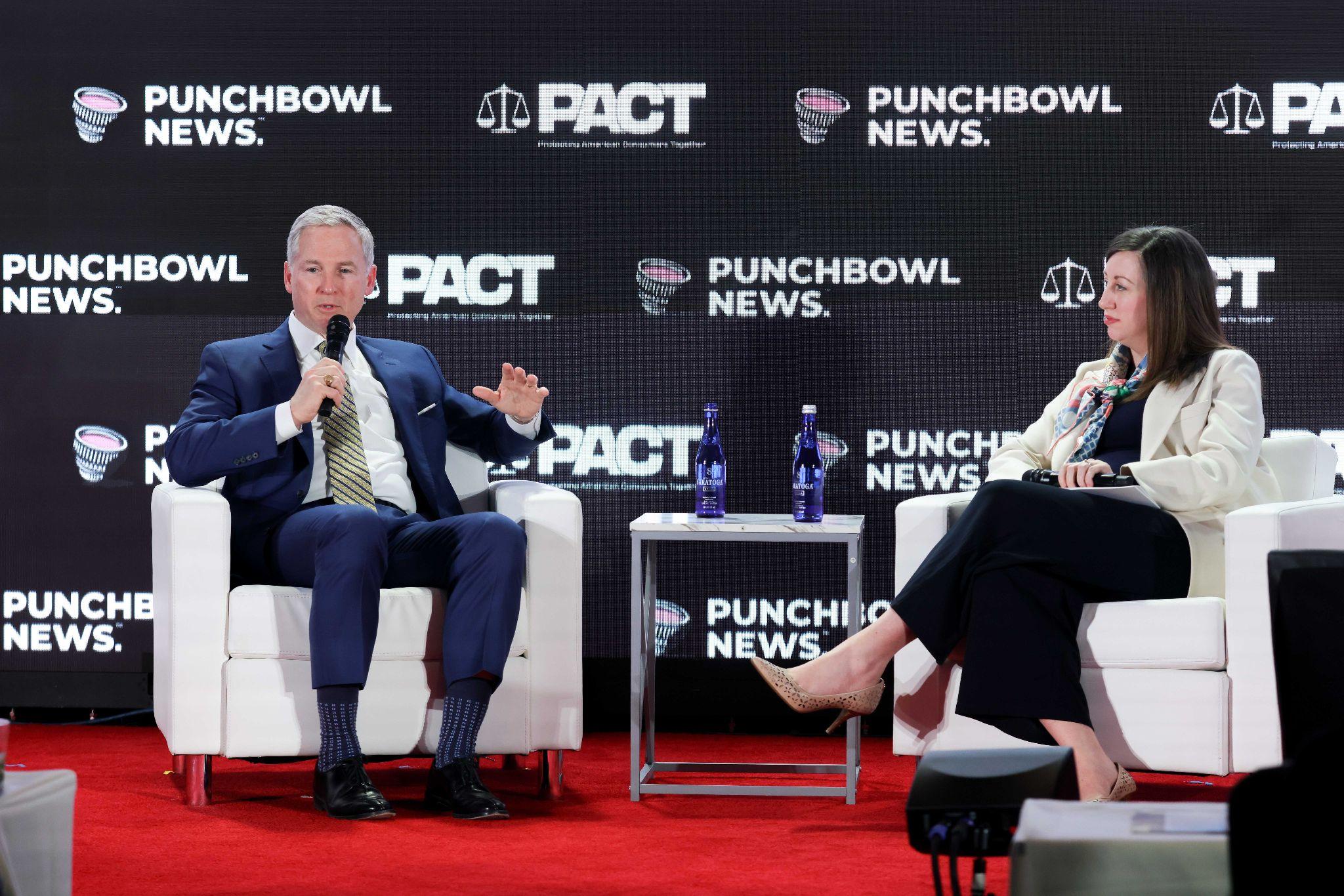
Former state Sen. John F. Kennedy (R-Ga.) said he hasn’t made an endorsement for a GOP candidate in the high-stakes Senate race against incumbent Sen. Jon Ossoff (D-Ga.).
Kennedy, who is running for lieutenant governor in Georgia, said he needs to focus on his own race, though he said Republicans can win the Senate seat.
Kennedy joined Punchbowl News on Wednesday at a Protecting American Consumers Together Summit in Washington, where he spoke on tort reform.
Tort reform. Kennedy said a combination of residents suffering from an increased tort tax and businesses leaving Georgia due to a competitive market led to the enactment last year of legislation — SB 68 — that makes it harder to launch certain lawsuits in the state.
As a result of the law, Kennedy said, major auto insurers are reducing their rates, and insurance companies are reentering the market in Georgia.
“You’re seeing businesses that literally were looking to leave the state of Georgia, not only remain in Georgia, but expand their footprint in Georgia,” Kennedy said.
States’ issue. Kennedy said states need to take the lead on overhauling the laws governing liability rather than waiting for the slower national process.
“I would encourage states to look at it, be thoughtful, put your legislators in the position so that they can articulate to constituents why this is something that’s needed,” Kennedy said.
Fireside chat. Adam Blinick, head of public policy and communications for the U.S and Canada at Uber, continued the conversation by saying there’s a need for other states to follow Georgia’s steps on changes to the ability to bring lawsuits.
“The tax that people are paying as a result of this is hidden and it is completely unnecessary,” Blinick said. “And you absolutely can structure the best of all worlds.”
Blinick said it’s important for corporations to prioritize working on tort reform, while making it clear to lawmakers that this is an affordability and public safety issue.
You can watch the full recording here.
– Shania Shelton
… AND THERE’S MORE
Ad news: Majority Forward, the Senate Majority PAC-aligned group, is airing a new buy of roughly $400,000 in Maine. The spot accuses Sen. Susan Collins (R-Maine) of “giving ICE even more power” and “allowing ICE to raid schools and hospitals.” Notably, the ad features a clip of Collins in the Oval Office with President Donald Trump.
Hearing news: The House Homeland Security Committee is holding a hearing on Feb. 24 focused on how local governments and private sector partners are working with federal agencies to prepare for massive events this year, including the FIFA World Cup and America’s 250th anniversary celebrations.
Tax news: Americans for Tax Reform’s Grover Norquist and 30 other conservative groups are pressing Trump to index capital gains to inflation, calling it a “simple matter of fairness.” The groups say in a new letter that the Trump administration should use executive authority to make the change in how capital gains taxes are calculated.
— Max Cohen and Laura Weiss


Presented by Cencora

From accelerating innovation to powering the pharmaceutical supply chain, we reduce barriers to expand access to medications for millions of Americans at sites of care in their communities. Learn more

Crucial Capitol Hill news AM, Midday, and PM—5 times a week
Join a community of some of the most powerful people in Washington and beyond. Exclusive newsmaker events, parties, in-person and virtual briefings and more.
Subscribe to Premium
Special Projects
Explore our deep dives into the issues that matter the most today and will shape tomorrow's future, with expert reporting that goes beyond the headlines and into the heart of the Capitol.
Check it outEvery single issue of Punchbowl News published, all in one place
Visit the archive
Presented by Cencora
From accelerating innovation to powering the pharmaceutical supply chain, we reduce barriers to expand access to medications for millions of Americans at sites of care in their communities. Learn more