

March 27, 2026



PRESENTED BY

THE TOP
Senate votes to end DHS shutdown, House next
Happy Friday morning.
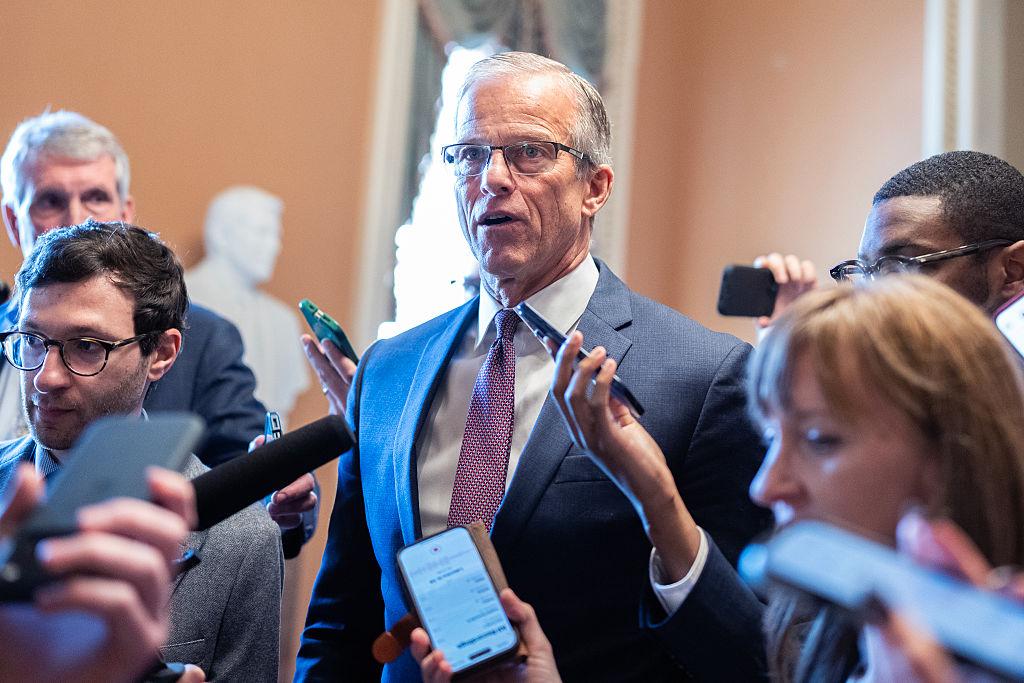
After 41 days, the Senate voted early Friday morning to fund most of the Department of Homeland Security, excluding ICE and CBP, ending a bitter impasse that laid bare the inability of both parties to close out an agreement.
In a near-empty chamber, senators approved the funding by voice vote at 3 a.m. Senate Majority Leader John Thune, Majority Whip John Barrasso and other senior Republicans spent hours late Thursday night into Friday morning calling and cajoling their colleagues to support the measure — or at least not to object.
The fight over ICE and CBP will be pushed to reconciliation, where Republican leaders can funnel the two agencies even more money. This will likely be coupled with Iran war funding and possibly the SAVE America Act, the GOP’s photo ID and proof-of-citizenship bill that senators have been debating for weeks. It will be a party-line vote that will put Republicans under further pressure.
The White House signaled that President Donald Trump — who had declared a national emergency on Thursday in order to pay TSA employees — was supportive of this approach.
Following the anti-climactic Senate endgame, action now shifts to the House.
The House leadership isn’t sure when the chamber would take this up, but we expect it will be today or Saturday.
This package should be a prime candidate for consideration under suspension of the rules, a fast-track process that requires a two-thirds majority on the House floor. But that would mean dozens of House Democrats have to vote yes, a major hurdle. Either way, this bill should pass the House before the end of the weekend at the latest. More on that in a moment.
No winners. Who won the Senate standoff? No one, in truth. Nothing really changed. Both sides wanted to have this fight, so it happened. It was another example of how little moderation is left in the Trump era, where the first instinct is to go to war.
But at some point, everyone just exhausts themselves. And that’s exactly what happened late Thursday night as senators were staring down a two-week recess.
The result is that there are few, if any, changes to ICE’s enforcement operations or Trump’s broader immigration crackdown, the reason Democrats began this confrontation. There’s new leadership at DHS and ICE is out of Minneapolis. But Trump’s detention and deportation agenda is continuing full steam ahead.
Let’s talk about Democrats. They got what they’ve been asking for all week: DHS funding minus ICE and CBP. But that was supposed to be step one of a two-step process, with the intention of negotiating separately around a set of demands to rein in the ICE and CBP.
Democrats got none of that and came away with zero. Democrats gave up their last bit of leverage by agreeing to this deal.
“That ship has sailed. They kissed that opportunity goodbye by failing to provide funding for those agencies,” Thune told reporters early Friday morning.
Yet this outcome is somewhat positive for Senate Minority Leader Chuck Schumer, who didn’t have to deal with a split caucus. Schumer avoids the near-certain backlash from the left he would have gotten for negotiating a deal that didn’t go far enough to restrict ICE.
“Throughout it all, Senate Democrats stood united — no wavering, no backing down,” Schumer said. “We held the line.”
Democrats were also able to object on the floor overnight to GOP efforts to fund ICE via unanimous consent. But again, Democrats didn’t extract a single significant concession from Republicans, so this was nothing more than a political exercise.
Now, Republicans. For several days, GOP leaders resisted Democrats’ calls to fund the rest of DHS except for ICE and CBP. Yet that’s exactly what they did, cutting off ongoing bipartisan negotiations in the process.
“Time is up,” Barrasso said late Thursday. “The Democrats are completely unable to come to an agreement to help the American people, and we see that with a lack of leadership from Chuck Schumer.”
Barrasso and Thune spoke with Trump about the plan just minutes after the president announced he’d be signing an executive order to move money around to pay TSA agents.
After railing for days against the idea of voting to “defund” ICE and CBP, conservatives fell in line too. After all, both agencies are already pre-funded through last year’s reconciliation bill. They didn’t get the SAVE America Act either — something they vowed to fight for.
And Senate GOP leaders are now finally behind “Reconciliation 2.0,” which means Republicans will eventually — but not with 100% certainty — get what they want. They’ll use reconciliation to plus-up funding for ICE and CBP for multiple years, a prospect that conservatives are giddy about, but one that comes with real challenges.
“Sure, we got what we wanted. But we have to do reconciliation again, so that’s our punishment,” quipped a GOP senator.
Next steps. If Speaker Mike Johnson can muscle the legislation through his chamber, it will end the six-week-long partial shutdown.
Johnson’s House should be able to pass this bill, although Trump may have to weigh in.
House Democrats are a bit of a wildcard here. Not winning any policy changes from the GOP will leave House Democrats sour at Schumer — a dynamic that has come to define the 119th Congress. Still, there are enough moderates who will see this as an adequate way to reopen DHS ahead of a two-week recess. Again, this is what they asked for.
Distracted by a difficult war in Iran, Trump hasn’t been much of a factor during this impasse. He refused to publicly back the Republicans’ position over the last few days. Trump kept complicating the situation by saying he wanted Republicans to fight for ID and citizenship requirements for voting, as well as a ban on mail-in balloting that is unpopular with Republicans. Plus, there were repeated, futile presidential broadsides against the filibuster.
But Trump’s move on Thursday to unilaterally pay TSA agents during the shutdown by declaring a national emergency — somewhat inexplicably — helped end the standoff. It was also something Trump could’ve done days ago.
Ethics latest. A special panel of the House Ethics Committee met for seven hours on Thursday in the case of embattled Democratic Rep. Sheila Cherfilus-McCormick (Fla.). The Ethics Committee will announce as early as today whether its approved a 27-count Statement of Alleged Violations against Cherfilus-McCormick or have more hearings.
— Andrew Desiderio, Jake Sherman and John Bresnahan
✈️ Fly Out Day is live! Rep. Jim McGovern (D-Mass.) talked about Iran, the DHS shutdown, how the House runs — and more. Check it out.
ICYMI: We held our agriculture summit yesterday, focusing on the complexity of the farming and food supply systems. Rep. Nikki Budzinski (D-Ill.) discussed the future of agriculture in the U.S. and called for a renegotiation of the farm bill. You can read more about the summit here.


HOUSE DEMS
DeGette at risk of getting knocked off ballot
Rep. Diana DeGette (D-Colo.) faces a chance of failing to qualify for the primary ballot, a shocking predicament that could end the 15-term incumbent’s career.
Later tonight, Democrats in Colorado’s 1st District will caucus to nominate candidates for the primary ballot. DeGette, who’s facing a challenge from first-time candidate Melat Kiros, needs to clear 30% to make the ballot.
The delegate pool for this caucus was determined earlier this month. DeGette’s allies insist she will be fine. But March brought a wake-up call. DeGette only narrowly cleared that 30% threshold, with Kiros dominating 63% to 35% in a delegate preference poll at a county assembly in mid-March.
Since DeGette didn’t attempt to gather petition signatures to qualify for the ballot, she needs to qualify via the caucus process. And if all the delegates attend, DeGette can only lose a handful of votes to hit the necessary threshold.
The veteran Democratic isn’t fazed by the process and insists she’ll prevail in the June 30th primary.
“I’ll be on the ballot and I’ll win my primary,” DeGette told us.
DeGette’s team points out that delegates rarely flip in this stage of the primary process. They also note the caucus process reflects the most hardcore Democratic activists and isn’t representative of the larger primary electorate.
DeGette has personally spoken to nearly all of the 81 delegates who indicated support for her at the county assembly, even going door-to-door to talk with some of them, per a person close to her campaign. The DeGette team has also been helping with logistics to ensure all of them are able to attend the virtual vote on Friday.
Kiros’s take. Kiros, a Justice Democrats-backed lawyer, told us she’s been lobbying delegates to vote for her on Friday.
DeGette, 68, first won election to her solidly blue Denver-area seat in 1996. DeGette is a member of the Congressional Progressive Caucus and has the support of the CPC PAC and Rep. Alexandria Ocasio-Cortez (D-N.Y.) for her reelection.
Kiros is a democratic socialist and her strength could be a major warning sign for Democrats nationwide about a serious anti-incumbent fervor brewing. DeGette supporters insist she will make the ballot, but it’s highly unlikely she’ll claim the first spot because Kiros has far more total delegates.
House Democrats we spoke to for the story said they’re concerned that DeGette isn’t taking Kiros’ challenge seriously. But none wanted to go on the record.
“The congresswoman was nowhere to be seen,” Kiros said of the caucus process. “We have two candidates that are asking for their votes. One of them actually put in the work to earn their vote, and the other one did not.”
— Max Cohen and Ally Mutnick


Vault: W&M duo drop crypto tax bill
News. Reps. Max Miller (R-Ohio) and Steven Horsford (D-Nev.) are unveiling their bipartisan proposal to set tax rules for digital assets.
The 26-page discussion draft tackles some of the big issues that crypto companies are eager for action on. Horsford and Miller both sit on the House Ways and Means Committee, so they’ll have a chance to weigh in with their priorities as the panel’s Republicans work on a product as well.
{if (profile.vars.Memberful_punchbowlnews_Plan_Premium_Policy_The_Vault_I_121828 == true || profile.vars.Memberful_punchbowlnews_Plan_Premium_Policy_The_Vault_I_103061 == true || profile.vars.Memberful_punchbowlnews_Plan_Premium_Policy_The_Vault_II_121827 == true || profile.vars.Memberful_punchbowlnews_Plan_Premium_Policy_The_Vault_II_103417 == true || profile.vars.Memberful_punchbowlnews_Plan_Premium_Policy_The_Vault_III_121826 == true || profile.vars.Memberful_punchbowlnews_Plan_Premium_Policy_The_Vault_III_103418 == true || profile.vars.Memberful_punchbowlnews_Plan_Premium_Policy_The_Vault_14_Day_Trial_121832 == true || profile.vars.Memberful_punchbowlnews_Plan_Premium_Policy_The_Vault_14_Day_Trial_103643 == true || profile.vars.Memberful_punchbowlnews_Plan_Punchbowl_News_Premium_Portal_The_Vault_Tech_121727 == true || profile.vars.Memberful_punchbowlnews_Plan_Punchbowl_News_Premium_Portal_The_Vault_Tech_121821 == true || profile.vars.Memberful_punchbowlnews_Plan_Punchbowl_News_Premium_Portal_Premium_Policy_The_Vault_121726 == true || profile.vars.Memberful_punchbowlnews_Plan_Punchbowl_News_Premium_Portal_Premium_Policy_The_Vault_121823 == true || profile.vars.Memberful_punchbowlnews_Plan_Punchbowl_News_Vault_Tech_126214 == true || profile.vars.Memberful_punchbowlnews_Plan_Punchbowl_News_Vault_Tech_126263 == true || profile.vars.Memberful_punchbowlnews_Plan_Punchbowl_News_Premium_Portal_The_Vault_Tech_Defense_138992 == true || profile.vars.Memberful_punchbowlnews_Plan_Punchbowl_News_Vault_Tech_Defense_136971 == true || profile.vars.Memberful_punchbowlnews_Plan_Punchbowl_News_Vault_Tech_Defense_138990 == true || profile.vars.Memberful_punchbowlnews_Plan_Punchbowl_News_Defense_Vault_136973 == true || profile.vars.Memberful_punchbowlnews_Plan_Punchbowl_News_Defense_Vault_138989 == true || profile.vars.Memberful_punchbowlnews_All_Access_Pass == true)}
Miller and Horsford are calling their bill the Digital Asset PARITY Act. Sound familiar? They’re aiming to formally introduce it this spring.
The measure would make it so that some mandates that apply for other financial transactions also apply to crypto, including wash sale and constructive sale rules. It would grant tax benefits for charitable donations of digital assets and address the lending of crypto. The proposal also creates a safe harbor for taxpayers trading for their own account and excludes certain stablecoin transactions from taxes.
What comes next. Separately, Ways and Means Committee Chair Jason Smith (R-Mo.) has been convening Republicans to unite around a crypto tax bill ahead of a potential markup in the coming months. Committee Republicans are holding their latest “policy hour” session this morning.
Those talks have been partisan.
Horsford’s effort with Miller offers a glimmer of hope for a bipartisan deal on crypto tax, though the Nevada Democrat has been more motivated to work on the issue than some of his colleagues.
Senate Finance Committee leaders are also interested in working on crypto tax rules. Senate Republicans have been in touch with their House counterparts on the project.
The Miller-Horsford bill also notably reflects a lot of feedback from across the crypto industry. The pair view it as a starting point that could lead to more legislation down the line as well.
– Laura Weiss
{else}

{/if}
PRESENTED BY EXACT SCIENCES

This National Colorectal Cancer Awareness Month, learn how the Cologuard Plus® test can help detect cancer and precancer early.
MICHIGAN SENATE
Mike Rogers on rising gas prices: ‘We’re gonna be fine’
Former Rep. Mike Rogers (R-Mich.) downplayed the impact of the Iran war on gas prices during a recent Senate campaign stop.
“We’re gonna be fine, we got plenty of oil,” Rogers told an attendee who was concerned about spiking gas prices and Iran’s closure of the Strait of Hormuz.
“You’ll get your oil, because we’re going to pump our oil right here in America, and we got plenty,” Rogers added, per audio we obtained.
Rogers was speaking at an Oakland University College Republicans event on March 17.
It’s revealing to see how Republican candidates on the ballot this November are messaging on gas prices amid the Iran war. During former President Joe Biden’s administration, Republicans made high gas prices a top campaign issue.
The average nationwide gas price right now is nearly $4 per gallon, according to AAA.
Rogers also said during the same exchange that he’s “disappointed” that the United States’ NATO allies haven’t done more to help clear the Strait of Hormuz.
“This is a reminder of how critical energy independence truly is. It’s past time we unleash American energy and dismantle Biden and the Democrats’ radical environmental hurdles,” Rogers said in a statement when we asked about the remarks.
Rogers, the party’s unsuccessful 2024 nominee for Senate, is running again this fall and has been endorsed by President Donald Trump.
— Max Cohen
AND THERE’S MORE
Johnson’s parting gift. The House is leaving for recess as early as today, and Speaker Mike Johnson will give $5 million to members and candidates this morning. Patriot members will get an average of $193,237 and candidates will get an average of $150,496. Johnson has given more than $18 million to incumbents this cycle.
Ad news: Majority Forward, a Senate Majority PAC-aligned group, is airing a $400,000 ad buy attacking Sen. Susan Collins (R-Maine) for siding with President Donald Trump on health care.
Endorsement news: Blue Dog PAC is endorsing state Rep. Shannon Bird in the Democratic primary for Colorado’s 8th District. Bird’s main rival is state Rep. Manny Rutinel, who is running to the left of Bird.
— Max Cohen



Enter a new era of Punchbowl News with exclusive merch from our swag store. From t-shirts and quarter-zips to mugs, hats and even pickleball paddles, we’ve got you covered.

Crucial Capitol Hill news AM, Midday, and PM—5 times a week
Join a community of some of the most powerful people in Washington and beyond. Exclusive newsmaker events, parties, in-person and virtual briefings and more.
Subscribe to Premium
Special Projects
Explore our deep dives into the issues that matter the most today and will shape tomorrow's future, with expert reporting that goes beyond the headlines and into the heart of the Capitol.
Check it outEvery single issue of Punchbowl News published, all in one place
Visit the archive
Go deeper with a Premium+ membership to Defense, Tech, Vault OR all three. Access monthly briefings with reporters, paywalled content, breaking news texts in your coverage area and more, bringing you closer to the action.