

April 14, 2026


PRESENTED BY

THE TOP
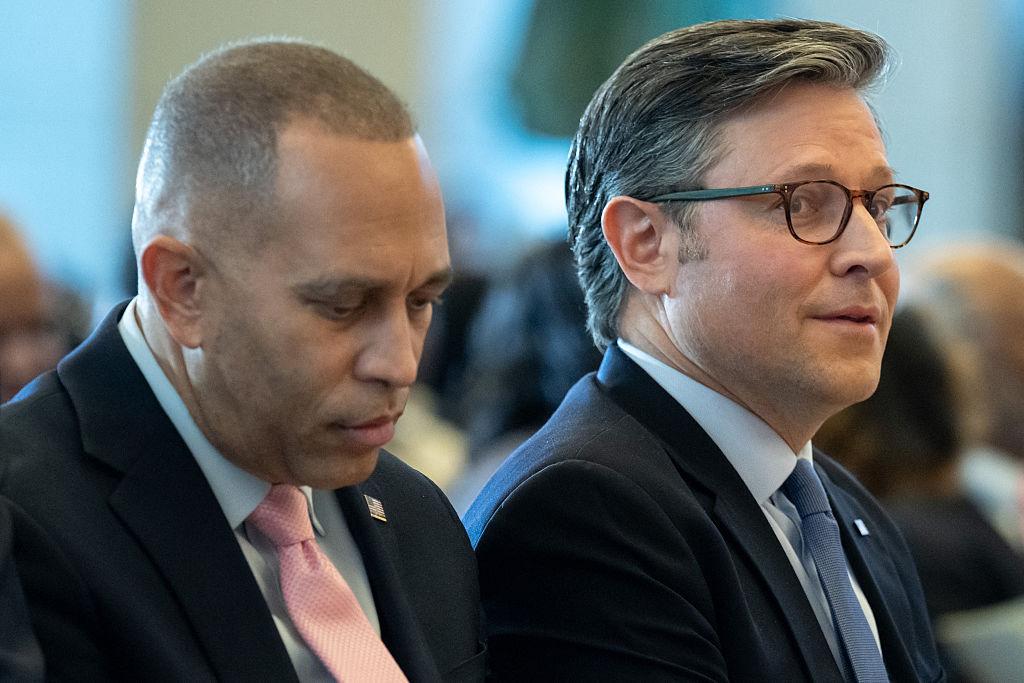
How Johnson and Jeffries handled their ethics problems
Happy Tuesday morning.
In the span of 55 minutes Monday evening, Reps. Eric Swalwell (D-Calif.) and Tony Gonzales (R-Texas) both announced their resignations from the House, a double-barreled political blast that rocketed across official Washington.
Swalwell and Gonzales each faced potential expulsion votes this week. Members and aides warned that the two lawmakers could be removed from office even though the House Ethics Committee was still conducting investigations into their cases.
There are a few dynamics we want to explore this morning that say a lot about what Congress has become, and how it’s still sadly the same as it ever was.
1) In this case, House Republican and Democratic leaders handled their respective scandals dramatically differently. The situations are similar yet far from identical, while the two parties’ disparate identities and internal politics drove the speed of the response.
As recently as last week, Swalwell was the leading Democratic candidate for California governor. On Friday, the San Francisco Chronicle and CNN published bombshell stories filled with allegations that Swalwell sexually assaulted a former staffer.
House Minority Leader Hakeem Jeffries, Minority Whip Katherine Clark and Democratic Caucus Chair Pete Aguilar — a fellow Californian — quickly released a statement calling on Swalwell to drop out of the gubernatorial race. But the Democratic leadership trio pointedly didn’t say Swalwell should resign.
Jeffries steered clear of Swalwell since the scandal broke. The two didn’t speak, according to multiple sources familiar with the matter.
Jeffries’ handling of this is an interesting window into his leadership style. After the initial statement, he was mostly mum and preferred to see if the situation resolved itself. Jeffries also benefited from the fact that Congress was out of session. Jeffries didn’t have to face his colleagues on the matter.
Yet members on both sides of the aisle — especially women members — seized on the Swalwell and Gonzales scandals. They threatened to bring up expulsion resolutions this week, essentially pairing the removal of one Democrat with one Republican. The House Ethics Committee announced it would investigate Swalwell, but that didn’t quell the uproar. Democrats were the loudest voice against Swalwell.
Behind the scenes, some Democrats were privately pressuring Swalwell to leave.
Former Speaker Nancy Pelosi, one of Swalwell’s most important allies, spoke to Swalwell and urged him to leave office, sources said. Pelosi isn’t in Democratic leadership anymore but she’s still a powerful figure in the caucus.
“Oh, I think that was his decision,” Pelosi said of her conversation with Swalwell during a Monday interview at George Washington University. “I think it’s a smart decision to make. It’s the right thing to do, yes.”
More Pelosi: “If you have a challenge that you have to address, it’s best addressed not as a candidate for governor and not as a member of Congress.”
What Pelosi also said is that Democrats shouldn’t have to vote on this. Getting rid of Swalwell is a wise member-management move. Democratic leadership didn’t want to force its members to take a vote on expelling a colleague accused of sordid — and potentially illegal — behavior.
Pelosi strongly denied that Democrats were aware of allegations of sexual misconduct by Swalwell. “That’s not true,” Pelosi insisted. Asked if she’d heard any rumors about him, Pelosi said, “I had none whatsoever.”
Several top House Democratic sources in and around the leadership believe there will be more revelations coming out about Swalwell’s conduct in office.
GOP and Gonzales. On the other side of the aisle, Gonzales admitted to an extramarital affair with a staffer who later died by suicide. After months of public denials and an investigation by the Office of Congressional Conduct, Gonzales eventually copped to the allegations.
Speaker Mike Johnson has repeatedly said that he believes every lawmaker who has been accused of wrongdoing should be afforded the chance to go through an investigation. The Ethics Committee also announced it had begun an investigation.
Johnson did call on Gonzales to drop his bid for re-election after the Texas Republican admitted to the affair with Regina Santos-Aviles, his deceased former staffer. Gonzales dropped his bid that day.
But the speaker didn’t call on Gonzales to resign even though the Texas Republican admitted to the wrongdoing. Of course, losing Gonzales would also narrow Johnson’s already razor-thin governing margin.
Gonzales announced that he would “file my retirement from office” on Tuesday. Gonzales didn’t specify when his resignation would be effective.
2) Remember that this doesn’t end the expulsion bonanza. The House Ethics Committee will hold a sanction hearing for Rep. Sheila Cherfilus-McCormick (D-Fla.) next week. The committee has found her guilty of numerous charges and Republicans have vowed to force an expulsion vote. Democrats have vowed to move against Rep. Cory Mills (R-Fla.), as well.
3) Congress still hasn’t changed as much as it needs to regarding congressmen and their behavior toward women staffers, despite the Me Too movement.
A California Democratic campaign consultant posted in December that Swalwell allegedly was improperly involved with staffers, but his gubernatorial campaign kept going. Gonzales was publicly linked to Santos-Aviles a few weeks after her September death, although nothing really happened until a San Antonio Express-News story in mid-February.
NOTUS reported in Feb. 2025 that Mills was under police investigation for allegedly assaulting a woman. While no criminal charges were filed, the Ethics Committee decided to look into the matter as part of a broader investigation of Mills. That case is still pending.
– Jake Sherman, John Bresnahan and Heather Caygle
NEXT WEEK: Join us on Tuesday, April 21 at 8:30 a.m. ET for a conversation with Rep. Julie Fedorchak (R-N.D.) as we sit down to discuss the news of the day and American leadership in wireless, spectrum and AI. RSVP now!


WASHINGTON X THE WORLD
GOP clamors for Iran exit strategy
President Donald Trump is officially on the clock among Senate Republicans to wind down his military campaign against Iran. This comes even as Trump has launched a new naval blockade of Iran and is considering launching more military strikes unless a peace deal is reached.
From the Republican leadership to the rank-and-file, GOP senators say they’re eager for the White House to find an off-ramp as political and economic fallout from the war is mounting. Particularly, skyrocketing gas prices and the danger it poses for Republicans in the looming midterm elections.
Senate Majority Leader John Thune on Monday pointed to several “inflection points” in the coming weeks that could ramp up pressure on the Trump administration. This includes a potential Pentagon funding vote, as well as debate over Democratic-forced war powers resolutions and the upcoming 60-day deadline mandated under the War Powers Act.
“I think people are going to be looking for signs of progress,” Thune told us, adding that the “permanent” reopening of the Strait of Hormuz should be the priority. The U.S. military operations against Iran “have been very effective and successful, but… they need a plan for how to wind this down, how to get an outcome.”
The South Dakota Republican described the U.S. blockade of Iranian ports as a way to put economic pressure on the Islamic Republic to return to the negotiating table after failed peace talks in Pakistan over the weekend.
But Thune acknowledged the economic pain being felt here at home, too, especially in his agriculture-reliant home state. Much of the world’s fertilizer passes through the Strait of Hormuz.
“It’s a big deal,” Thune said. “We’re in planting season. So if you didn’t buy fertilizer ahead of time, you’re really feeling it. And obviously, fuel is a critically important part of production [in] agriculture.”
War powers push. Senate Democrats will again force a vote this week on an Iran war powers resolution likely Wednesday or Thursday, according to Sen. Tim Kaine (D-Va.). The Senate rejected the last three war powers resolutions on 47-53 votes and, despite the turbulent news cycle, it doesn’t look like that will change this week.
Instead for some Republicans, the real political clash over the war is still looming. Its trigger point is the deadline for Trump to seek congressional approval for a conflict that lasts beyond 60 days.
“The 60-day target is what I’m looking at,” Sen. Thom Tillis (R-N.C.) told reporters. That deadline is less than three weeks away.
Sen. Lisa Murkowski (R-Alaska) has already begun drafting a formal authorization for the Iran conflict, but Democrats appear reluctant to support such a move. It’s also not clear how many Republicans would back it.
This isn’t a vote that Republicans want to make, fearing backlash in November if they back an unpopular war that’s exacerbating the affordability problems nationwide.
Sen. John Curtis (R-Utah), who previously announced he wouldn’t support extended military action without a declaration of war, said the exact mechanism for congressional action remains “to be determined.”
Sen. James Lankford (R-Okla.) said that “they should” seek congressional authorization after 60 days, referring to the White House. “It’s the law,” Lankford added.
Thune demurred when asked about an AUMF vote at the 60-day marker, saying Trump can trigger a unilateral extension for 30 days. While presidents can extend operations beyond that 60-day window without congressional sign-off, the law requires that lawmakers be notified in writing of continued military action.
Dems double down. Senate Democrats, meanwhile, are leaning into their strategy of forcing war powers votes, vowing to compel weekly debates on the conflict. Senators announced Monday that they’ll be introducing six more resolutions, which will ripen in the coming weeks.
“Until this president is reined in, we will continue to force these votes,” Sen. Tammy Baldwin (D-Wis.), flanked by a group of 10 other Senate Democrats, said Monday night.
— Andrew Desiderio, Briana Reilly, Anthony Adragna and Laura Weiss
PRESENTED BY ANTHROPIC

Anthropic will cover electricity price increases from its data centers and invest in grid optimization tools, helping keep prices lower for ratepayers.
RECONCILIATION 2.0
Senate GOP’s big day for DHS’ future
Senate GOP leaders’ sales pitch to the rank-and-file on their plan to end the Department of Homeland Security shutdown begins today.
Most critically, the Republican leadership has to get GOP senators on board with a “very, very skinny” reconciliation bill, according to Senate Majority Leader John Thune. The quickest way to ensure failure is if the bill balloons into a GOP wish list.
“If [Thune] starts making deals with other senators to get their stuff in there, you’re talking to another senator that’s going to want his stuff in there,” Sen. John Kennedy (R-La.) told reporters, adding he’d want to see elements of the SAVE America Act included.
That’s precisely the kind of spiral that Republican leaders are worried about.
“To execute on it and do it with any kind of speed, you’ve got to keep it really tight,” Thune said Monday night.
The framework. The Senate GOP leadership’s plan is to pass a reconciliation bill with three years of ICE and CBP funding — and absolutely nothing else. They’ve got President Donald Trump’s blessing. The new spending wouldn’t be offset, and the rest of the DHS budget would come in a bipartisan bill that the House is still sitting on.
The pitch to fiscal hawks will be that the package contains funding that’s normally part of the annual appropriations process, which isn’t paid for. That’s convincing for some of those Republicans, though others are skeptical.
“I can understand the argument but I think we ought to pay for everything,” Sen. Rick Scott (R-Fla.) said. “We’re running $2 trillion deficits.”
Thune pushed back by saying that Sen. Ron Johnson (R-Wis.), another deficit hawk and close Scott ally, is on board with the zero-offset plan.
Top Senate Republicans are particularly concerned about making sure the Senate Finance Committee isn’t involved in the reconciliation bill because it would open the vote-a-rama to politically sensitive issues like health care.
Sen. Bernie Moreno (R-Ohio) said the Senate’s DHS funding efforts before recess dragged past 2 a.m. because Republicans needed Customs funding to be in the bipartisan package. If that were left to reconciliation, the Finance panel would have to be involved.
The sprint. Top Senate Republicans are already preparing to move quickly on reconciliation and get a budget resolution to the floor as soon as next week.
Senate Budget Committee Chair Lindsey Graham (R-S.C.) told reporters he doesn’t know yet whether he’ll hold a markup of the budget resolution that kicks off the process. The House Budget Committee could also skip that step, proceeding to the Rules Committee and then the floor.
Speed is essential as Senate Republicans try to convince their House counterparts to finally pass the bipartisan Senate-approved funding bill for the rest of DHS. Thune will have his weekly meeting today with Speaker Mike Johnson, who’s facing all sorts of objections from his members.
— Laura Weiss and Andrew Desiderio
PRESENTED BY ANTHROPIC

Al data centers shouldn’t raise your bills.
📆
What we’re watching
Senate Majority Leader John Thune and Speaker Mike Johnson will meet privately today for their weekly sit-down. It comes as the GOP leaders navigate high-stakes efforts to fund the Department of Homeland Security and renew FISA.
Senate. Senate Republicans and Democrats will each hold their weekly party lunches this afternoon, followed by the leadership news conferences around 2 p.m.
The Senate Commerce Committee will hold a markup at 10 a.m. on measures related to social media warning labels, the National Quantum Initiative reauthorization and satellite security, among other issues.
House. House Republican and Democratic leadership will huddle in private leadership meetings this evening before votes.
The House will then vote on suspensions at 6:30 p.m. Rep.-elect Clay Fuller (R-Ga.) will be sworn in.
— Laura Weiss and Max Cohen
MONEY GAME
News: Q1 numbers from Speaker Johnson, SMP and Majority Forward
News: Speaker Mike Johnson raised $34 million in the first quarter, his best fundraising quarter ever.
Team Johnson says this is the largest election-year quarter ever by a GOP speaker or minority leader. Johnson has doled out $18 million to incumbents and nearly $30 million to the NRCC.
Johnson’s 2025-26 cycle total is now more than $116 million raised.
News: Senate Majority PAC and Majority Forward, the Democratic super PAC’s affiliated nonprofit group, raised a combined $70.4 million in the first quarter of 2026. Senate Majority PAC ended the quarter with $74.8 million on hand.
SMP raised $31.3 million and Majority Forward raised $39.3 million.
Per SMP spokesperson Lauren French, the tally represents “the largest first-quarter fundraising haul in Senate Majority PAC history.”
We’ll note that SLF and One Nation, the GOP counterparts to SMP and Majority Forward, raised a combined $115 million in Q1. SLF has $167 million on hand and also unveiled $342 million in ad reservations across eight battleground states.
— Jake Sherman and Max Cohen
AND THERE’S MORE
Former Texas Rep. Will Hurd (R) is the new president of ICON Prime, a defense and space tech offshoot of the 3D printing construction company.
Hurd, who served three terms in the House and briefly ran for president in 2024, will focus on the company’s efforts to modernize military construction, develop robotic systems to help build infrastructure and establish buildings on the Moon.
Also: Matthew Brooks, the longtime CEO of the Republican Jewish Coalition, is joining Brownstein Hyatt Farber Schreck as a senior strategic adviser. Brooks will continue in his role as CEO of the RJC and Jewish Policy Center.
Money Game: Rep. Marcy Kaptur (D-Ohio), one of the House’s most endangered incumbents, raised $1.6 million in Q1 of 2026. Kaptur has $3.1 million on hand.
Ad news: Democrat Denise Powell, who’s running in Nebraska’s 2nd District, is out with a new $45,000 buy where she says she carries her passport with her “to prove I’m here legally.”
The Congressional Hispanic Caucus BOLD PAC is also airing an ad in support of Powell, as part of a $1 million total push from groups backing Powell over state Sen. John Cavanaugh in the primary.
Endorsement news: Former Rep. Tim Ryan (D-Ohio) is endorsing Brian Poindexter in Ohio’s 7th District. This seat is currently represented by Rep. Max Miller (R-Ohio).
SALT latest: Rep. Josh Gottheimer (D-N.J.) is announcing a new bill later today that would get rid of the so-called “marriage penalty” for the state and local tax deduction. It would allow married couples to deduct $40,400 each for 2026, essentially granting them double the amount for single filers. Notably, blue-state House Republicans have bashed the marriage penalty in the past.
— Anthony Adragna, Jake Sherman, Max Cohen and Laura Weiss


Enter a new era of Punchbowl News with exclusive merch from our swag store. From t-shirts and quarter-zips to mugs, hats and even pickleball paddles, we’ve got you covered.

Crucial Capitol Hill news AM, Midday, and PM—5 times a week
Join a community of some of the most powerful people in Washington and beyond. Exclusive newsmaker events, parties, in-person and virtual briefings and more.
Subscribe to Premium
Special Projects
Explore our deep dives into the issues that matter the most today and will shape tomorrow's future, with expert reporting that goes beyond the headlines and into the heart of the Capitol.
Check it outEvery single issue of Punchbowl News published, all in one place
Visit the archive
Go deeper with a Premium+ membership to Defense, Tech, Vault OR all three. Access monthly briefings with reporters, paywalled content, breaking news texts in your coverage area and more, bringing you closer to the action.