


April 2, 2026


PRESENTED BY

THE TOP
Tension grows as Republicans pursue reconciliation
Happy Thursday morning.
Iran. Facing strong public opposition to the war in Iran, President Donald Trump all but declared victory in the U.S. campaign against the Islamic Republic, saying that American military objectives will have been met “shortly, very shortly.”
Yet Trump also said U.S. forces will continue to attack Iran over the next several weeks even as peace talks continue. And the president spoke repeatedly about the need to prevent Iran from building a nuclear weapon.
“We’re going to hit them extremely hard over the next two to three weeks,” Trump declared. “We’re going to bring them back to the stone ages where they belong.”
However, Trump neither mentioned the use of U.S. ground troops to reopen the Strait of Hormuz nor criticized NATO. This is despite negative public comments that he and other top administration officials have made about the alliance since the conflict began.
Trump said other nations — especially those purchasing oil from Persian Gulf countries — will be responsible for keeping the vital waterway open. He didn’t discuss the soaring cost of gas in the United States, saying oil prices will fall “naturally” once the war is over.
“So to those countries that can’t get fuel, many of which refused to get involved in the decapitation of Iran – we had to do it ourselves — I have a suggestion,” Trump said. “Number one, buy oil from the United States of America. We have plenty, we have so much. And number two, build up some delayed courage — should’ve done it before, should’ve done with us as we asked — go to the strait and just take it. Protect it. Use it for yourselves.”
Democrats slammed the speech as “rambling” and “divorced from reality.” Asian and European markets are down following Trump’s remarks, and oil prices rose. Financial markets want a clear timeline for ending the conflict, which Trump didn’t give.
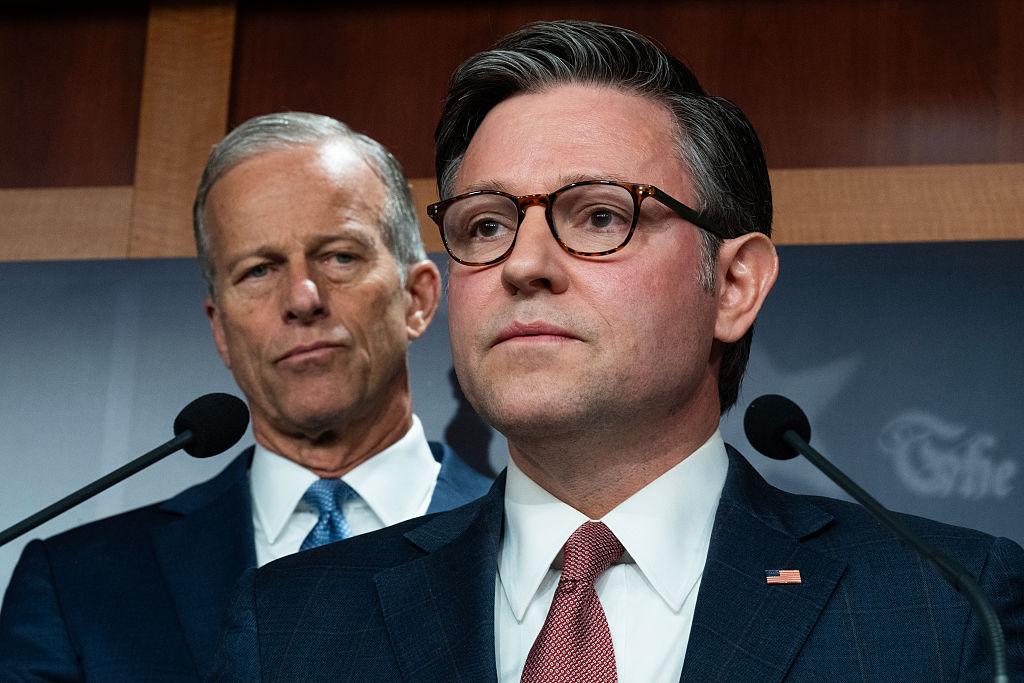
The new DHS play. It took an extra five days, but Speaker Mike Johnson finally caved to Senate Majority Leader John Thune’s plan to end the DHS shutdown.
A Truth Social post from Trump on Wednesday set the plan in motion, aligning the two top Hill Republicans after Johnson rejected the Senate-passed bill last week. This measure funds all of DHS minus ICE and CBP, which Republicans plan to address via budget reconciliation.
Thune and GOP leaders are expected to use the Senate’s 7 a.m. pro forma session today to trigger a procedural motion to send the Senate-passed DHS funding bill back to the House.
But House Republican leaders aren’t committed to bringing members back next week to vote on the Senate-passed measure. They recognize that GOP rank-and-file members hate this bill. That means GOP leaders may wait until the chamber returns on April 13 to pass it.
Yet it seems like an unsustainable position to wait another week. Plus, Johnson has to pass a FISA reauthorization by April 20, and that’s a tough vote too.
Reconciliation. Once Congress passes the Senate version of the DHS funding bill, Johnson and Thune will embark on what amounts to a risky legislative experiment: trying to pass a reconciliation bill just months before Election Day. Trump says he wants the package on his desk by June 1.
The goal here is to bypass Democrats and lock in three years of funding for ICE and CBP. The price tag will be somewhere between $45 billion and $75 billion. This would keep the agencies on autopilot until Trump’s term ends in 2029, GOP insiders say, even if Democrats win control of the House and/or Senate in November.
This is Johnson and Thune making the best of a bad hand. Democrats won’t vote for ICE and CBP spending, and it’ll only get harder for Congress to approve the agencies’ funding if the GOP loses in the midterms.
Removing ICE and CBP from the DHS spending bill also ends a decade or more of hard-fought policy riders that have limited the agencies’ operations, Republicans say.
But it won’t be easy. There are serious tension points worth keeping in mind.
The White House wants to keep this reconciliation bill limited to only funding for ICE and CBP. Republican leaders agree.
“It’s what you can get 50 for and 218 for,” Thune said after the Senate initially passed its DHS funding bill. “So this will be fairly narrowly focused in dealing mostly with [ICE and CBP].”
Yet many House and Senate Republicans will see this package as the last big bill with a chance of being signed into law before Election Day. There’s a desire within the rank-and-file to do something big politically.
For example, following the bitter Obamacare subsidies fight of last fall, Johnson promised he’d spend the first half of this year on health care. We’ve heard nothing about this for weeks, but GOP lawmakers won’t forget about it.
Plenty of Republicans will want to use the legislation to try to pass the SAVE America Act or something resembling it. While policy changes can’t be enacted in a reconciliation bill if they have no budgetary impact, Republicans can provide grants to states that follow certain election practices.
There will also be defense hawks who want to plus-up Pentagon spending amid the Iran war. And budget hawks will want steep cuts to social safety-net programs.
— Jake Sherman, Andrew Desiderio and John Bresnahan



Tech: Left, right groups urge tech antitrust push
A left-right coalition of Big Tech skeptics is pushing the Senate Judiciary Committee to revive its work on expanding antitrust requirements for platforms like Amazon.
Groups including the Digital Progress Institute, the Article III Project and Demand Progress urged the panel’s leaders on Thursday to reintroduce the American Choice and Innovation Act as a way to tackle cost-of-living issues.
You can read the letter to Chair Chuck Grassley (R-Iowa) and ranking member Dick Durbin (D-Ill.), who have long supported AICOA, exclusively here.
“We respectfully urge the Committee to reintroduce AICOA and move it to markup without delay,” the 17 groups from across the political spectrum wrote. “Pro-competitive reforms that lower costs for consumers and protect small businesses should not be a partisan issue.”
Back in 2021, before artificial intelligence and efforts to protect teens on social media, lawmakers focused their bipartisan anger on Big Tech’s economic power.
Of the bills that emerged, AICOA, which was led by Sen. Amy Klobuchar (D-Minn.), took up the most attention. The bill aimed at allegations of self-preferencing, like Amazon giving plum positioning to its own brands or Apple installing its apps as defaults while rival services fought for downloads.
An outside alliance of progressives and populist conservatives, many of whom signed the new letter, helped AICOA along.
One last job. Despite the support, the bill fell short in 2022. Industry lobbying and iffy support from Grassley and Klobuchar’s colleagues doomed the proposal.
Since that time, the success of some lawsuits against major tech players suggested old laws still have teeth when it comes to modern markets. Klobuchar is likely on her way out of Congress, too, due to her gubernatorial run.
But the letter says tech is still “one of the most significant remaining gaps” when it comes to how law enforcement and the Hill are tackling competition and affordability.
Among the most prominent groups on the letter is the Article III Project and the Internet Accountability Project, both led by Mike Davis. The former Grassley staffer has both argued for stepped-up antitrust enforcement against tech while also working to help mergers get approved by the Justice Department.
Davis allegedly threatened the job of then-Justice Department antitrust division chief Gail Slater as part of his work on a Hewlett Packard Enterprise deal last year. The merger went through, and Slater was fired in February.
The Trump-allied American Principles Project also signed, as did left groups like Public Citizen and the Open Markets Institute.
The signers also urge moving AICOA with bills on antitrust issues for app stores and online ads.
— Ben Brody


K Street: Newsom is next Dem leader
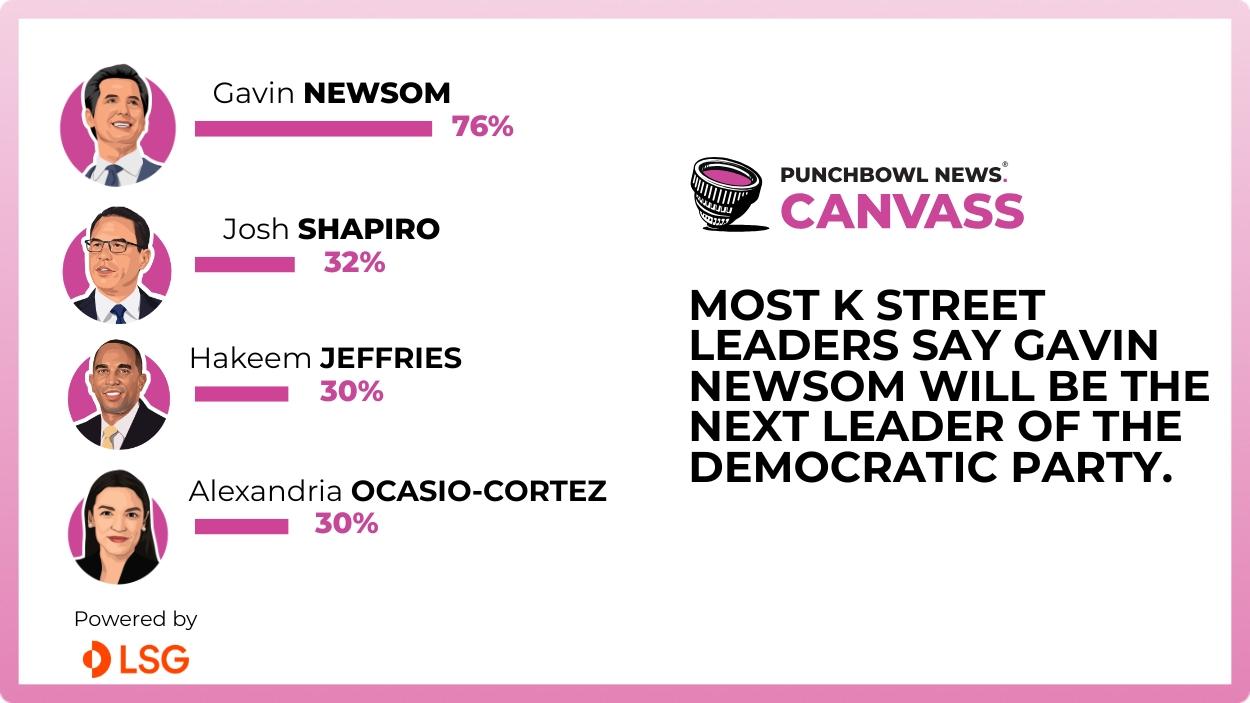
A majority of K Street leaders say that California Gov. Gavin Newsom is best positioned to lead the Democratic Party during President Donald Trump’s second term, according to our latest Canvass survey. Newsom is a likely 2028 presidential contender and has said he’d consider a run for the White House after the midterms.
About three-quarters of Democratic and Republican respondents identified Newsom as their top choice to lead the Democrats, putting him well ahead of every other person tested in the survey.
Behind Newsom, about one-third of those surveyed said Pennsylvania Gov. Josh Shapiro would be the next leader of the party. Both House Minority Leader Hakeem Jeffries and Rep. Alexandria Ocasio-Cortez (D-N.Y.) garnered 30%.
The results are consistent with our November and October surveys. K Street leaders and senior Hill staff have repeatedly pointed to Newsom as the most likely leader of the Democratic Party in the second Trump administration.
Newsom has recently taken on a more visible national role, positioning himself against Trump on issues like the economy and immigration.
For example, Newsom jumped on Trump’s comment about oil prices following the U.S. attacks on Iran, a line the California governor is likely to use in future military operations.
Newsom was also key to Democrats’ successful redistricting effort in California. Winning the ballot initiative that effectively canceled out Texas Republicans’ redistricting moves has made Newsom a 2028 Democratic star and given Democrats a chance to win the House.
The California Democrat has recently spurred some controversy by going after conservative figures by calling them gay, comments that divide his allies.
The Canvass K Street was conducted March 2-20 in partnership with independent public affairs firm, LSG.
Want to take part in The Canvass? Our survey provides anonymous monthly insights from top Capitol Hill staffers and K Street leaders on key issues facing Washington.
Don’t miss out on your chance to be heard! Sign up here if you work on K Street. Click here to sign up if you’re a senior congressional staffer.
— Rachel Umansky-Castro
PRESENTED BY META

THE AI INNOVATORS
How AI is bolstering cybersecurity defenses

The latest installment in our series, The AI Innovators, launched today. In this edition, we explored how cybersecurity is becoming more sophisticated as artificial intelligence enables advanced defenses that can respond in a fraction of the time.
From real-time threat detection, automated incident responses and quick data analysis to identify anomalies, AI is already boosting cyber defenses in both government and private organizations.
But AI also complicates cybersecurity efforts by equipping malicious actors with new tools to outmaneuver defense systems.
The heightened risk of cybercrimes is not lost on policymakers as they seek the best way to regulate AI and protect the nation’s information systems and infrastructure.
This four-part series, in partnership with Google, is exploring the way AI is transforming society across different sectors, with a particular focus on health care, education, cybersecurity and the economy.
Read the full feature, and check back on The Daily Punch feed later this morning to listen to the accompanying podcast.
– Shania Shelton
AND THERE’S MORE
The Money Game. Former Rep. Elaine Luria (D-Va.) raised more than $1.75 million in Q1 in her comeback bid for her old House seat. Luria ended the quarter with $2 million in the bank.
Democrat Jonathan Nez, who’s running to unseat Rep. Eli Crane (R-Ariz.), raised $1 million in the first quarter of this year.
Manny Rutinel, who’s seeking the Democratic nomination in Colorado’s 8th District, raised $950,000 and has $1.75 million on hand.
Bridget Brink, the former U.S. ambassador to Ukraine, raised $600,000 in Q1 for her bid to oust Rep. Tom Barrett (R-Mich.).
Denise Powell, a Democrat running in Nebraska’s 2nd District, raised $432,000 in Q1.
Recruitment watch. State Del. Adele McClure is launching a run Thursday for Virginia’s proposed new 7th District. McClure is the 2025 recipient of the EMILYs List Gabrielle Giffords Rising Star award.
Personnel news. Sean Dillon will be the next GOP staff director of the House Small Business Committee. Dillon previously served as deputy chief of staff to Rep. Bill Huizenga (R-Mich.).
Report watch. Sen. Jon Ossoff (D-Ga.) and Rep. Jen Kiggans (R-Va.) are out with a bipartisan report that found that an increasing number of juveniles are being incarcerated because of a lack of foster care placements.
Endorsement news. The Bench, a group that backs rising stars in the Democratic party, is endorsing Johnny Garcia in Texas’ 35th District. Garcia, a Bexar County Sheriff’s deputy, is in a primary runoff for the Democratic nomination.
The Congressional Hispanic Caucus BOLD PAC is also endorsing Garcia, along with Bobby Pulido in Texas’ 15th District and Katy Padilla Stout in Texas’ 23rd District.
— Max Cohen, Brendan Pedersen and Ally Mutnick
PRESENTED BY META


Presented by Cencora

From accelerating innovation to powering the pharmaceutical supply chain, we reduce barriers to expand access to medications for millions of Americans at sites of care in their communities. Learn more

Crucial Capitol Hill news AM, Midday, and PM—5 times a week
Join a community of some of the most powerful people in Washington and beyond. Exclusive newsmaker events, parties, in-person and virtual briefings and more.
Subscribe to Premium
Special Projects
Explore our deep dives into the issues that matter the most today and will shape tomorrow's future, with expert reporting that goes beyond the headlines and into the heart of the Capitol.
Check it outEvery single issue of Punchbowl News published, all in one place
Visit the archive
Presented by Cencora
From accelerating innovation to powering the pharmaceutical supply chain, we reduce barriers to expand access to medications for millions of Americans at sites of care in their communities. Learn more