


April 6, 2026



PRESENTED BY

THE TOP
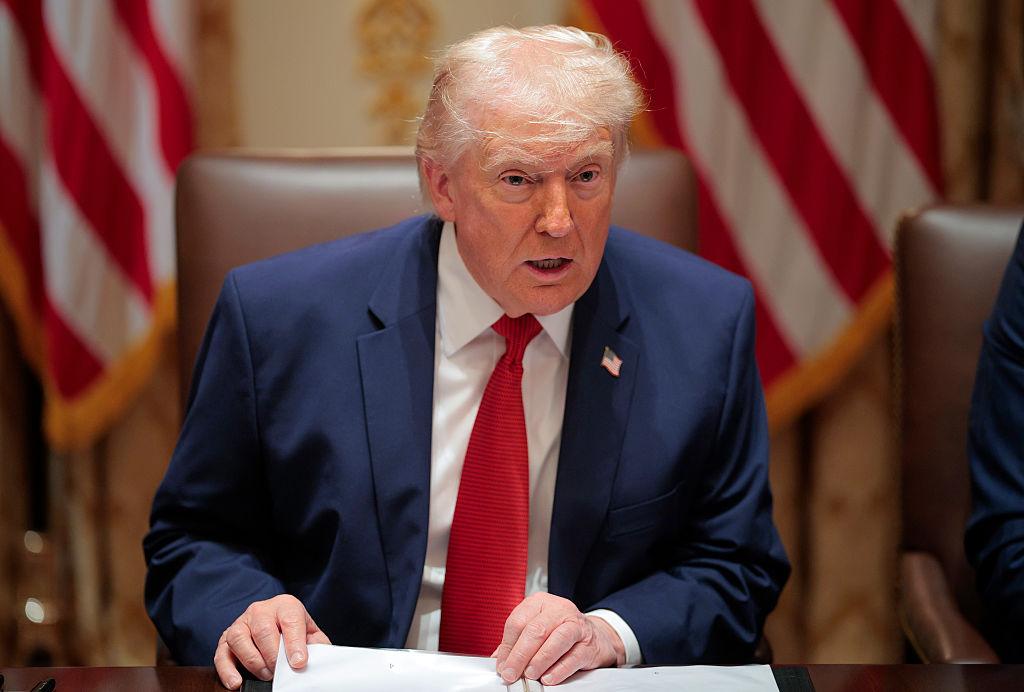
Trump drags GOP through Iran war
Happy Monday morning.
Welcome to the second week of congressional recess. Speaker Mike Johnson and Senate Majority Leader John Thune are lucky that Congress is out of session this week. The House has a pro forma session today at 10 a.m, while the Senate has one at 1 p.m.
President Donald Trump has scheduled a 1 p.m. press conference at the White House. Military officials will also attend.
The Department of Homeland Security is still shut down. It’s Day 51 for those keeping track, the longest agency shutdown in U.S. history.
House GOP leaders aren’t planning to come back into session until next week for action on a Senate-passed bill that would fund all of DHS except ICE and CBP. Trump issued an executive order on Friday paying all the DHS employees that he hadn’t done earlier with his TSA emergency order. This has eased the pressure among Republicans to get a long-term solution.
Trump Talk. Tracking and understanding Trump right now is very difficult, especially on the Iran war. It’s like trying to nail Jell-O to a wall. He’s all over the place on every issue — domestic policy, international affairs and Iran specifically — presenting Republicans with a political mess.
Had Congress been in town, every Republican would’ve been forced to respond to Trump’s threat to bomb Iran “back to the Stone Ages where they belong” during his White House speech last week. Or his shockingly angry Easter morning Truth Social post.
Yes, Trump isn’t judged by the same standards as his predecessors. But even for him, Trump’s statements during the last few days have veered wildly from presidential norms, especially on an issue as serious as a U.S. military conflict.
The Army’s chief of staff was suddenly replaced in the middle of a war, prompting pushback from some on the MAGA right. The White House is seeking an FY2027 Pentagon budget of $1.5 trillion, military spending on a scale not seen since World War II. Trump said it’s impossible for the federal government to pay for Medicare, Medicaid and day care because ”We’re fighting wars.” Meanwhile, gas is $4.11 per gallon and rising.
There’s now a new report of a possible ceasefire deal between Iran and the United States brokered by Pakistani officials, but the details remain unclear. Axios had earlier reported a potential 45-day ceasefire was on the table in discussions being led by U.S. envoy Steve Witkoff and Iranian officials. Vice President JD Vance has also been playing a role in efforts to end the conflict. However, Iran kept up attacks on Israel, Kuwait and other Gulf states overnight.
All this comes after Trump said Sunday morning that unless Iran opens “the Fuckin’ Strait” of Hormuz by Tuesday at 8 p.m., it would “be Power Plant Day, and Bridge Day, all wrapped up in one.”
“You’ll be living in hell,” Trump warned. And he closed with a gratuitous “Praise be to Allah.”
Shortly afterward, Rachel Scott of ABC News asked Trump if he expected a deal to end the war by Monday.
“There could be a deal, and there could also not be a deal,” Trump told Scott. “I don’t know.”
In the same interview, Trump said he would blow up “the whole country” if Iranian officials don’t reach an agreement quickly. Trump made similar comments to other reporters.
Democrats responded with outrage to Trump’s remarks, while GOP leaders stayed silent.
House Minority Leader Hakeem Jeffries slammed the “Disgusting and unhinged Easter message from Donald Trump.”
“Something is really wrong with this guy,” Jeffries added.
Senate Minority Leader Chuck Schumer complained that Trump was “threatening possible war crimes and alienating allies.”
Other Democrats said Trump’s Sunday threats would violate the Geneva Conventions if carried out.
The Trump administration did have very good news over the weekend. U.S. forces rescued two pilots from inside of Iran in a daring covert mission. Read this NYT story about the rescue, which involved U.S. commandos having to destroy two aircraft in Iran.
But the GOP-run Congress largely has been a mere bystander in this conflict — and only has itself to blame for this outcome.
There hasn’t been a single public congressional hearing about the war since it began Feb. 28. The Republican leadership hasn’t been probing the administration’s goals or strategy. GOP leaders have either lined up with Trump or ducked questions entirely, merely saying they “trust Trump.” Mostly they’ve been out of town.
Congress was always relying on a supplemental spending bill as a pressure point for the administration to explain its war strategy. Yet the Pentagon hasn’t submitted anything and doesn’t plan to as long as DHS is closed.
However, we’re beginning to see tension and even perhaps a breaking point with some Republicans. It’s worth remembering that many Republicans have said from the start that they hope the Iran operations are a short-term commitment.
Case in point: Sen. John Curtis (R-Utah) said he won’t support new funding without a formal declaration of war.
“I stand by the President’s actions taken in defense of our national security interests in the Middle East. But we must be clear-eyed about history and the Constitution,” Curtis tweeted on Friday. “While I support maintaining our readiness and replenishing stockpiles, I cannot support funding for further military operations without a formal declaration of war from Congress.”
— Jake Sherman, John Bresnahan and Andrew Desiderio
Questions about your subscription or account? Our team can answer questions about website access, billing, or upgrading for more coverage. Reach out to us at [email protected] or simply reply to this email.


THE MAJORITY
How reconciliation could go wrong
Senate Majority Leader John Thune and Speaker Mike Johnson’s plan to end the 51-day Department of Homeland Security shutdown hinges on Republicans’ ability to unite around a party-line reconciliation bill.
This is going to be very tricky. Not impossible. But tricky.
Top Republicans are envisioning multiple reconciliation bills with a spate of priorities stuffed into each.
Reconciliation 2.0. The Senate GOP leadership’s plan is to keep the initial package as narrow as possible, limiting it to only multi-year funding for ICE and CBP. President Donald Trump said he wants this on his desk by June 1.
The idea is for the Senate to move first on a budget resolution with reconciliation instructions and then bring that blueprint to the floor by the end of April.
The Senate will need to instruct the Homeland Security and Governmental Affairs Committee to spend money as part of the package because of the panel’s jurisdiction over the immigration agencies. The panel’s chair, Sen. Rand Paul (R-Ky.), created problems for Senate GOP leaders during last year’s reconciliation effort — and he could again. But the Senate Republican leadership can essentially go around Paul if necessary.
The biggest problems are coming from the House, where Johnson is dealing with furious rank-and-file members and a razor-thin margin.
A lot of House Republicans don’t want to approve any part of the Senate-passed DHS funding deal until they see what the Senate does on reconciliation. House conservatives are railing against the idea of separating ICE and CBP from the rest of DHS funding — the necessary first step of the process.
The reconciliation plan hinges on avoiding pay-fors. The GOP leadership will make the case that there’s no need to offset the ICE and CBP money because it’s intended as typical appropriations. That’s a plausible argument, and it could work.
But any demands for offsets or the addition of other priorities could blow up the whole effort by making it politically toxic for GOP moderates. If there’s too much pressure to expand the bill, it could just get too big for Republicans to quickly agree on anything.
Also worth noting: The anti-abortion movement is very focused on the expiration of the ban on Medicaid funding for Planned Parenthood. That expires July 4.
Even if GOP leaders can keep the second reconciliation bill limited, Republican moderates could wind up unhappy. Some centrists support limited ICE reforms in line with options the White House offered. That’s harder to do in reconciliation, and there’s little appetite among Republicans to include those policies now, Thune said.
Reconciliation 3.0. Johnson is already pointing to reconciliation 3.0 as the place where House Republicans will achieve other priorities. The Budget Committees are at work on a third bill that would target fraud, address priorities from the SAVE America Act and fund the war in Iran.
But conservatives will demand all their priorities be included in Reconciliation 2.0 since it’s abundantly clear 3.0 is far from a sure thing. House and Senate GOP leaders will have limited time to resolve any and all of these disputes.
— Laura Weiss

THE MINORITY
What House Democrats are up to
As we enter the last week of the House’s two-week recess, Democrats will gather for a virtual caucus meeting this evening to plot the path forward on Department of Homeland Security appropriations.
In truth, Democrats have taken a back seat during the ongoing DHS shutdown as Republicans internally squabbled. Democrats support the Senate-passed bill that funds the department without allocating any funds to ICE or CBP. And leaders don’t expect a ton of defections.
Who might vote against it? Progressives who are dismayed that the bill does nothing to rein in ICE, as well as Democrats with competitive primary challenges and those running for higher office.
Everyone on the left strongly opposes the GOP’s plan to fund ICE and CBP for three years through reconciliation. Nor will Democrats support the Reconciliation 2.0 or 3.0 effort, given it doesn’t include reforms to the controversial border enforcement agencies.
The Democratic leadership’s whereabouts. While some House members took the first recess week to relax, others stuck to business. Here’s what the top House Democrats have been up to since leaving town on March 27.
House Minority Leader Hakeem Jeffries spent the start of the recess in Dallas and Houston, where he attended three fundraisers for the DCCC. The New York Democrat also toured a construction site with LiUNA Local 350 in the Buffalo Bayou section of Houston.
Back in Brooklyn, Jeffries presented community project funding connected to public housing developments, attended church services and hosted an annual Easter hat pageant.
House Minority Whip Katherine Clark started out recess in New York City for fundraisers and an in-studio cable news appearance.
Back in the district, Clark took part in a veterans’ food distribution event in Revere, Mass., and delivered a $3.1 million earmark check at a Framingham, Mass., community center. Clark also met with representatives from the Union of Concerned Scientists on federal cuts to research and science funding.
House Democratic Caucus Chair Pete Aguilar met with officials in his district and held events on rising transportation and food prices with a local business.
— Max Cohen and Ally Mutnick
PRESENTED BY UNITEDHEALTH GROUP

With innovative technologies and upfront pricing, UnitedHealth Group is helping make health care easier to afford, navigate and get.
SOMETHING SPECIAL
Republicans pour money into special for MTG seat
President Donald Trump carried former GOP Rep. Marjorie Taylor Greene’s northwestern Georgia district by nearly 40 points in 2024. But that hasn’t stopped Republican super PACs from pouring money in ahead of a special election there on Tuesday.
Republican Clayton Fuller — endorsed by Trump — and Democrat Shawn Harris will face off Tuesday in a runoff to replace Greene, who resigned in January. In such a deep red seat, Fuller, a prosecutor and veteran, is the favorite.
That’s why it’s puzzling that Republican outside groups have dropped more than $1.5 million on TV ads, digital ads and mailers in the runoff. Conservatives for American Excellence, a group funded by GOP megadonors, spent roughly $900,000 in the runoff, per FEC records.
American Mission, a pro-AI group that supports GOP candidates, spent nearly $700,000 on runoff ads. American Mission is part of the Leading the Future super PAC network.
Most of the ads appear aimed at boosting Republican turnout, touting the special election date and noting that Fuller has Trump’s blessing.
But at least one spot attacks Harris as a “radical liberal,” suggesting there is at least some concern among Republicans that Harris could be a threat.
This race has flown fairly under the radar. Republicans do expect to win on Tuesday. But there’s clearly enough unease about the margin and the political environment to warrant such sizable spending.
Harris has spent just $277,000 on ads since the first round of the special primary on March 10 when he and Fuller advanced to the runoff.
– Ally Mutnick
… AND THERE’S MORE
A new super PAC has begun spending for Rep. Angie Craig (D) in Minnesota’s contentious Senate primary.
North Star Dawn is out with a new streaming ad that touts Craig for voting twice to impeach President Donald Trump and for introducing articles of impeachment against then-Secretary of Homeland Security Kristi Noem.
The group reported spending about $38,000 on a digital ad buy, which is not a large amount. But there could be more to come. North Star Dawn filed a statement of organization with the FEC in January and we know little about it.
Craig is locked in a primary battle with Minnesota Lt. Gov. Peggy Flanagan for retiring Sen. Tina Smith’s (D-Minn.) seat.
Downtown Download. Kalshi, the prediction market, has hired Resolution Public Affairs to lobby on “[d]evelopment of regulatory structures around prediction markets.” Lobbying for Kalshi will be Heather McHugh and Meghan Taira, both alumni of Senate Minority Leader Chuck Schumer’s office.
Kalshi also employs Squire Patton Boggs, Intersection, Miller Strategies, Lincoln Policy Group, Dow Solutions and has in-house lobbyists.
– Ally Mutnick and Jake Sherman


Presented by AstraZeneca

The 340B program is supposed to help vulnerable patients—but without strong safeguards, it’s siphoning away funds that could be used for free and charitable medicine. The 340B Rebate Model Pilot improves program integrity, preventing duplicate discounts and strengthening accountability. Urge HHS to implement the pilot today. Learn why it matters.

Crucial Capitol Hill news AM, Midday, and PM—5 times a week
Join a community of some of the most powerful people in Washington and beyond. Exclusive newsmaker events, parties, in-person and virtual briefings and more.
Subscribe to Premium
Special Projects
Explore our deep dives into the issues that matter the most today and will shape tomorrow's future, with expert reporting that goes beyond the headlines and into the heart of the Capitol.
Check it outEvery single issue of Punchbowl News published, all in one place
Visit the archive
Presented by AstraZeneca
The 340B program lacks transparency—making it hard to tell if it’s actually helping vulnerable patients. HHS can fix the problem by implementing the 340B Rebate Model Pilot, ensuring the program is transparent, compliant, and accountable. Learn more.