


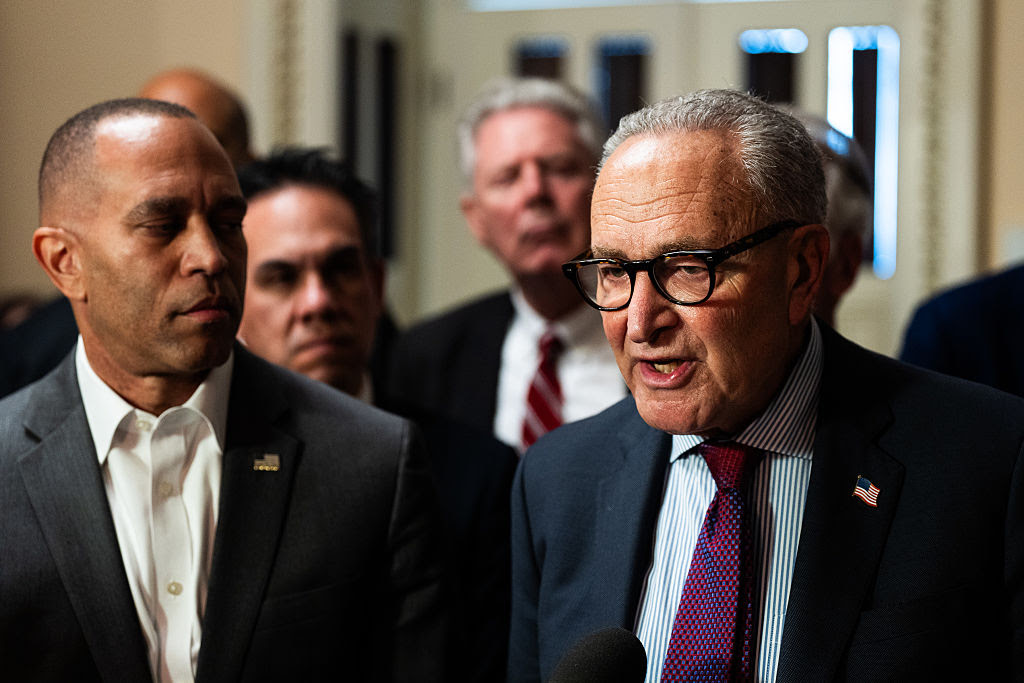
Senate Minority Leader Chuck Schumer and House Minority Leader Hakeem Jeffries have released their 10 demands for reforms to federal immigration enforcement — and Republicans are already pushing back. All of which doesn’t bode well for a deal on Department of Homeland Security funding.
Here’s the list. Democrats want to mandate judicial warrants for entering private property; a ban on masks; a requirement that agents identify themselves; no enforcement at medical facilities, schools, churches, courts and polling places; no racial profiling; new use-of-force standards; allowing local law enforcement to investigate “excessive force” complaints; mandatory use of body cameras; and regulation of the types of “uniforms and equipment” that the DHS uses.
“These reforms should apply to federal activity, whether funded by FY26 appropriations bills, the [One Big Beautiful Bill Act] or any other act,” Schumer and Jeffries said in their letter to Speaker Mike Johnson and Senate Majority Leader John Thune.
Schumer and Jeffries also called for the removal of Homeland Security Secretary Kristi Noem from her post, and a drawdown of federal agents in Minnesota, which has emerged as the key flashpoint in the immigration fight.
Many of these Democratic demands are non-starters for Hill Republicans, including requiring judicial warrants.
“This is not a time for political posturing,” said Sen. Katie Britt (Ala.), who’s been tapped as the lead Senate GOP negotiator. After the list was released publicly on Wednesday night, Britt slammed it as “a ridiculous Christmas list of demands for the press.”
But what Democrats are hoping for is that this list prompts negotiations with President Donald Trump. The White House anticipates having staff-level conversations with Democrats to explore whether a deal is actually possible. Although initial reactions from Republicans Wednesday night were not positive.
Chances of a deal receding. Congress’ track record on immigration policy — whether it’s border security, legalization or enforcement — is abysmal. The past few days have shown once again why.
There were signs last week of a potential opening for a bipartisan deal to rein in ICE.
After Senate Democrats threatened to block a massive FY2026 spending package, the White House agreed to split off DHS funding and pass a short-term funding patch to buy time for a renegotiation.
Trump adopted a more conciliatory posture after federal agents fatally shot Alex Pretti in Minneapolis. Republicans largely acknowledged Democrats’ concerns about ICE, saying they would discuss ways to tamp down Trump’s harsh immigration crackdown.
But just days later, lawmakers’ hopes for striking a deal have all but vanished. There’s real doubt about whether Congress can even agree to a short-term funding patch for DHS, leaving unrelated agencies in limbo.
Stalemate. House Democrats refused to provide the votes for the funding deal that Schumer negotiated with the White House. That came even as the Trump administration agreed to create a legislative path to address Democrats’ ICE demands on their two-week timeline.
Meanwhile, Trump’s MAGA allies on the Hill have urged fellow Republicans to hold firm against Democrats’ proposals and push for partisan initiatives of their own. Recent Senate GOP Conference meetings have turned more adversarial toward Democrats’ ICE push.
On Wednesday, Jeffries and Thune accused each other of not being serious about getting a deal.
Next steps. Thune told us he plans to decide today on how to address the Feb. 13 funding cliff for DHS. The majority leader needs to tee up a legislative vehicle before the Senate adjourns for the weekend in order to guarantee enough time to process a funding patch before next Thursday, when several senators are leaving town for the Munich Security Conference and other CODELs.
Senators from both parties believe a short-term stopgap for DHS can get the requisite votes, but only if enough progress has been made on bipartisan negotiations.