


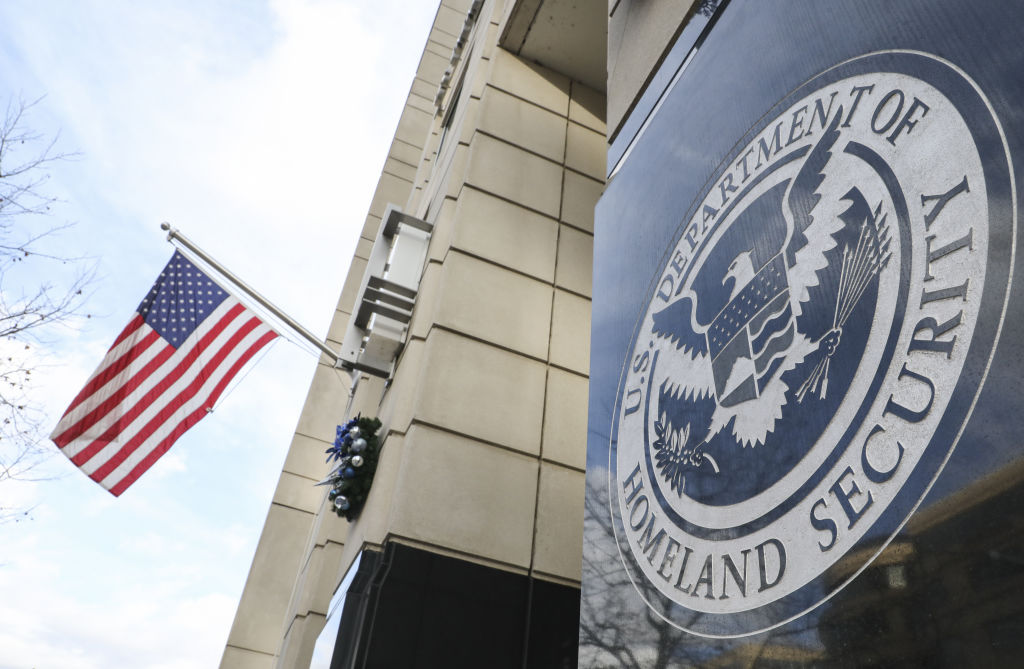
For the first time in more than a month, there’s optimism that the Senate and the White House can finally find a path to reopening the Department of Homeland Security. Key Senate Republicans returned from the White House late Monday with a noticeably upbeat demeanor over the state of the talks with President Donald Trump, who had just rebuffed a GOP-backed off-ramp.
The framework under discussion would fund all of DHS except for ICE’s migrant removal operations, and could eventually include some reforms that Democrats have been demanding.
Republicans would then try to fund the rest of ICE via a party-line reconciliation bill.
GOP leaders would also try to use reconciliation to enact elements of the SAVE America Act, which mandates photo IDs and citizenship verification for federal elections. Trump has called this bill his top legislative priority.
This framework is similar to the outlines of an agreement that Senate Majority Leader John Thune discussed with Trump on Sunday — a strategy that the president rejected. Trump has insisted on tying the SAVE America Act to DHS funding, complicating matters even further. Thune said this was “not realistic.”
It’s too early to say whether this DHS framework will satisfy Senate Democrats. There are several key details that still need to be ironed out. But many Democrats pointed to what they see as a sense of urgency to get something done, especially as nightmarish TSA security lines cause chaos for millions of air travellers.
Sen. Katie Britt (R-Ala.), a key negotiator who attended the White House meeting with Trump, said she planned to be “working through the night” to try to “land this plane.” We’re told that appropriators are actively discussing a path forward and were exchanging legislative text last night.
Another important dynamic: Senators are eager to leave Washington at the end of the week for the scheduled two-week recess, especially after being forced to stay in town all weekend. And Democrats have long been pushing to fund non-ICE portions of DHS, such as TSA, the Coast Guard and FEMA.
“This is significant movement,” Sen. Peter Welch (D-Vt.) said of the potential off-ramp. “We have a dispute about ICE practices. We don’t have a dispute about funding TSA. We don’t have a dispute about funding the Coast Guard or FEMA.”
A number of rank-and-file Republicans have echoed Trump’s message that they shouldn’t exit Washington until DHS is reopened. It’s now Day 38 of the DHS shutdown.
“We are not gonna leave this place until we have DHS funded,” Sen. James Lankford (R-Okla.) told us after last night’s Senate GOP leadership meeting.
In addition, there’s the question of how all this will impact the Senate’s current days-long floor debate on the SAVE America Act. Thune has said he’d eventually tee up a procedural vote that would effectively end that process. Conservatives and Trump have been pressuring Thune to keep the Senate in session and wear Democrats down.
The emerging framework. There’s enough in this proposed outline for everyone to hate. Hardline Republicans will say that their party has given up on taking the fight to Democrats on the SAVE America Act and failed to hold the line on DHS funding.
Democrats will gripe that the bulk of their list of more than a dozen demands to reform ICE has gone unfilled, and that funding the rest of DHS removes some of their leverage. This will be especially acute in the House, where Democrats have been let down by the Senate time and time again.
Yet Democrats are also certain to demand that they still get some low-hanging policy wins out of this fight, such as money for body cameras and enhanced identification for ICE agents.
“The folks in ICE who have been detaining people — I didn’t give them any more money,” Sen. Chris Coons (D-Del.) said of how he’d sell this type of deal to Democratic voters. “And I got A, B, C, D [reforms].”
A major implication of a potential deal here is that it nearly ensures that Republicans will have to pursue a second reconciliation package over the next eight months — much to the delight of Speaker Mike Johnson and hardline House Republicans.
Republicans will have a battle among themselves over the finer points of the package, which could include everything from a $200 billion defense spending package, the SAVE America Act, ICE funding and a hodgepodge of other Republican policies.
“It’ll take a little longer,” said Sen. John Kennedy (R-La.), who’s been pushing the reconciliation idea. “But we could do it. If you want to throw in the SAVE Act, I’m fine with that. I don’t know how feasible that is in terms of the whip count.”
Lankford noted that it takes “about a month” to do budget reconciliation, “so it’s not something you could start and do fast.”
Plus, there’s no guarantee of success. It’ll be up to the Senate parliamentarian — Elizabeth MacDonough — to OK the use of reconciliation to enact the voter ID and citizenship verification provisions in the SAVE America Act. Many Republicans privately view this as highly unlikely. It also raises the possibility of a vote to overrule the parliamentarian, though Thune has cast doubt on this idea in the past.
Confirmation vote: Mullin was confirmed by a 54-45 vote. Two Democrats — Sens. John Fetterman (Pa.) and Martin Heinrich (N.M.) — crossed the aisle to vote for Mullin, while GOP Sen. Rand Paul (Ky.) voted no. Sen. Ruben Gallego (D-N.M.) didn’t vote. Mullin’s successor in the Senate will be sworn in this afternoon. More on Mullin below.
War powers. Sen. Chris Murphy (D-Conn.) plans to force a vote on his Iran war powers resolution Tuesday evening. Debate is slated to begin around 5:15 p.m., followed by the vote — though the timing could shift. The move comes nearly a week after the Senate blocked a separate Democratic push to curb Trump’s ongoing military campaign against Iran.