After 41 days, the Senate voted early Friday morning to fund most of the Department of Homeland Security, excluding ICE and CBP, ending a bitter impasse that laid bare the inability of both parties to close out an agreement.
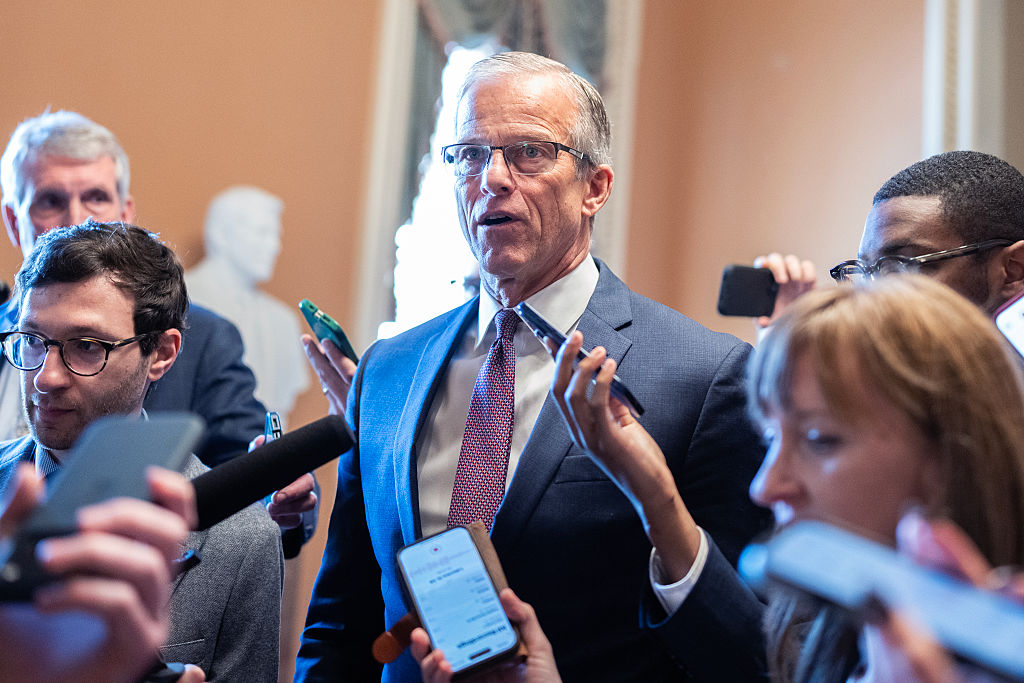
In a near-empty chamber, senators approved the funding by voice vote at 3 a.m. Senate Majority Leader John Thune, Majority Whip John Barrasso and other senior Republicans spent hours late Thursday night into Friday morning calling and cajoling their colleagues to support the measure — or at least not to object.
The fight over ICE and CBP will be pushed to reconciliation, where Republican leaders can funnel the two agencies even more money. This will likely be coupled with Iran war funding and possibly the SAVE America Act, the GOP’s photo ID and proof-of-citizenship bill that senators have been debating for weeks. It will be a party-line vote that will put Republicans under further pressure.
The White House signaled that President Donald Trump — who had declared a national emergency on Thursday in order to pay TSA employees — was supportive of this approach.
Following the anti-climactic Senate endgame, action now shifts to the House.
The House leadership isn’t sure when the chamber would take this up, but we expect it will be today or Saturday.
This package should be a prime candidate for consideration under suspension of the rules, a fast-track process that requires a two-thirds majority on the House floor. But that would mean dozens of House Democrats have to vote yes, a major hurdle. Either way, this bill should pass the House before the end of the weekend at the latest. More on that in a moment.
No winners. Who won the Senate standoff? No one, in truth. Nothing really changed. Both sides wanted to have this fight, so it happened. It was another example of how little moderation is left in the Trump era, where the first instinct is to go to war.
But at some point, everyone just exhausts themselves. And that’s exactly what happened late Thursday night as senators were staring down a two-week recess.
The result is that there are few, if any, changes to ICE’s enforcement operations or Trump’s broader immigration crackdown, the reason Democrats began this confrontation. There’s new leadership at DHS and ICE is out of Minneapolis. But Trump’s detention and deportation agenda is continuing full steam ahead.
Let’s talk about Democrats. They got what they’ve been asking for all week: DHS funding minus ICE and CBP. But that was supposed to be step one of a two-step process, with the intention of negotiating separately around a set of demands to rein in the ICE and CBP.
Democrats got none of that and came away with zero. Democrats gave up their last bit of leverage by agreeing to this deal.
“That ship has sailed. They kissed that opportunity goodbye by failing to provide funding for those agencies,” Thune told reporters early Friday morning.
Yet this outcome is somewhat positive for Senate Minority Leader Chuck Schumer, who didn’t have to deal with a split caucus. Schumer avoids the near-certain backlash from the left he would have gotten for negotiating a deal that didn’t go far enough to restrict ICE.
“Throughout it all, Senate Democrats stood united — no wavering, no backing down,” Schumer said. “We held the line.”
Democrats were also able to object on the floor overnight to GOP efforts to fund ICE via unanimous consent. But again, Democrats didn’t extract a single significant concession from Republicans, so this was nothing more than a political exercise.
Now, Republicans. For several days, GOP leaders resisted Democrats’ calls to fund the rest of DHS except for ICE and CBP. Yet that’s exactly what they did, cutting off ongoing bipartisan negotiations in the process.
“Time is up,” Barrasso said late Thursday. “The Democrats are completely unable to come to an agreement to help the American people, and we see that with a lack of leadership from Chuck Schumer.”
Barrasso and Thune spoke with Trump about the plan just minutes after the president announced he’d be signing an executive order to move money around to pay TSA agents.
After railing for days against the idea of voting to “defund” ICE and CBP, conservatives fell in line too. After all, both agencies are already pre-funded through last year’s reconciliation bill. They didn’t get the SAVE America Act either — something they vowed to fight for.
And Senate GOP leaders are now finally behind “Reconciliation 2.0,” which means Republicans will eventually — but not with 100% certainty — get what they want. They’ll use reconciliation to plus-up funding for ICE and CBP for multiple years, a prospect that conservatives are giddy about, but one that comes with real challenges.
“Sure, we got what we wanted. But we have to do reconciliation again, so that’s our punishment,” quipped a GOP senator.
Next steps. If Speaker Mike Johnson can muscle the legislation through his chamber, it will end the six-week-long partial shutdown.
Johnson’s House should be able to pass this bill, although Trump may have to weigh in.
House Democrats are a bit of a wildcard here. Not winning any policy changes from the GOP will leave House Democrats sour at Schumer — a dynamic that has come to define the 119th Congress. Still, there are enough moderates who will see this as an adequate way to reopen DHS ahead of a two-week recess. Again, this is what they asked for.
Distracted by a difficult war in Iran, Trump hasn’t been much of a factor during this impasse. He refused to publicly back the Republicans’ position over the last few days. Trump kept complicating the situation by saying he wanted Republicans to fight for ID and citizenship requirements for voting, as well as a ban on mail-in balloting that is unpopular with Republicans. Plus, there were repeated, futile presidential broadsides against the filibuster.
But Trump’s move on Thursday to unilaterally pay TSA agents during the shutdown by declaring a national emergency — somewhat inexplicably — helped end the standoff. It was also something Trump could’ve done days ago.
Ethics latest. A special panel of the House Ethics Committee met for seven hours on Thursday in the case of embattled Democratic Rep. Sheila Cherfilus-McCormick (Fla.). The Ethics Committee will announce as early as today whether its approved a 27-count Statement of Alleged Violations against Cherfilus-McCormick or have more hearings.