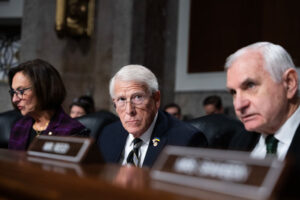


The Senate voted to approve its version of the FY2026 defense authorization bill in a flurry of late-night action Thursday, capping off weeks of fits and starts that nearly saw the must-pass legislation sidelined.
Before passing the NDAA on a 77-20 vote, senators amended the bill to repeal two old war power laws. They also adopted a series of amendments to authorize the Coast Guard, boost lawmaker security and target outbound investments.
The herculean push to get the Senate NDAA across the finish line involved weeks of behind-the-scenes negotiations that culminated in a tentative breakthrough deal in recent days. Leading senators worked systematically to quell protests — including one that broke through publicly on Thursday in the hours before votes began on the NDAA.
Sen. Tammy Duckworth (D-Ill.) had threatened to block consideration of the NDAA if she didn’t get a Defense Department briefing on National Guard deployments. Duckworth ultimately secured a commitment from Senate Armed Services Committee Chair Roger Wicker (R-Miss.) to hold a panel hearing on the topic “in the coming weeks,” she said in a statement.
On the floor. As part of the NDAA activity, senators backed an amendment from Sen. Tim Kaine (D-Va.) to repeal the 2002 Iraq War and 1991 Gulf War authorizations for use of military force (AUMFs). The House passed a similar measure alongside its NDAA. Including the provision in both versions increases the chances for a final bill to roll back the authorizations.
Another notable amendment from Sens. John Cornyn (R-Texas) and Catherine Cortez Masto (D-Nev.) targets U.S. investments in China — a perennial issue tied to recent NDAAs that often runs into jurisdictional roadblocks.
In the lead-up to Thursday’s votes, Sen. Maria Cantwell (D-Wash) had threatened to block the outbound investment language. But Cantwell ultimately got assurance that the plan would be tweaked during conference negotiations to address worries raised by Microsoft, Semafor first reported.
Cornyn told reporters Thursday night the Senate would “have to work out some slight differences with the House” once discussions begin, although he declined to elaborate.
Financial corner. The banking world emerged unscathed from Thursday night’s votes. Two amendments were top of mind, and both failed to get enough votes to be included in the final package.
The first, and most controversial, failed spectacularly. Sen. Rand Paul (R-Ky.) pushed for an amendment that would end the Federal Reserve’s practice of paying interest on bank reserves. Only 14 senators voted in favor, though one of them was top Banking Democrat Elizabeth Warren (D-Mass.), who warned this vote was “just the start of a bipartisan fight” to end the practice.
The second fell just short of being included in the Senate NDAA. Warren and Sen. Rick Scott (R-Fla.) pushed an amendment to make inspectors general at the Federal Reserve and Consumer Financial Protection Bureau appointed by the White House. A group of 53 senators backed the change, falling short of a 60-vote threshold.
Don’t miss out on the bigger picture. The NDAA manager’s package contains the ROAD to Housing Act of 2025. That’s a big ol’ bill! But there’s a better chance than not this massive housing reform package from the Senate Banking Committee is struck before final passage. The House has its own housing reform packages in the works.