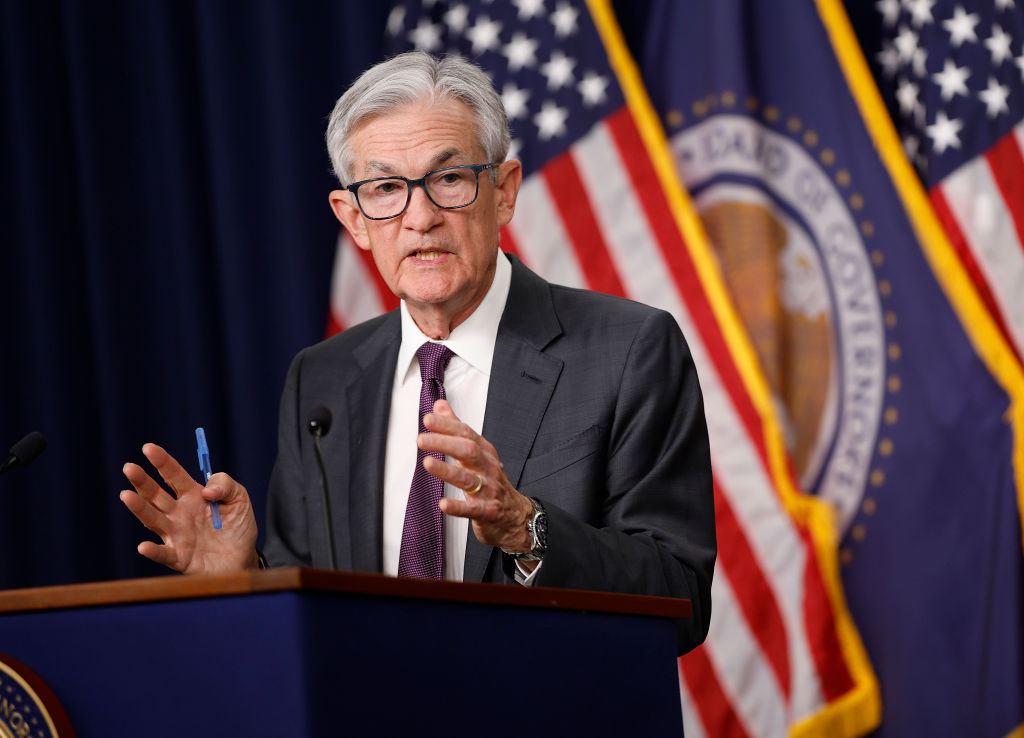
Are America’s top economic policymakers flying blind right now, or are things basically fine? We’ll hear Federal Reserve Chair Jay Powell’s take on the question this afternoon.
The Federal Open Market Committee will announce its next move in interest rate policy at 2 p.m., followed by Powell’s 2:30 p.m. news conference. The result isn’t much in doubt, with the vast majority of economists expecting a 25 basis point cut.
But the government shutdown will add a strange tilt to the day’s proceedings.
All month long, the Federal Reserve has been forced to contend with an incomplete data picture. The last U.S. employment report from the Bureau of Labor Statistics covered August. September’s report has been delayed indefinitely, and October’s may never exist. Economists have been sifting through private sector job reports since, which have shown a muddier picture.
The angle. Democrats have wasted no time this month attacking the Trump administration for this state of affairs.
“Thanks to Donald Trump’s refusal to release the job numbers, the Fed is now going to make interest rates like an airplane trying to land with only one wing,” Sen. Elizabeth Warren (D-Mass.) said.
Republicans aren’t quite so concerned. “They have ways of keeping their finger on the pulse of what’s going on in the economy,” Sen. Steve Daines (R-Mont.) said. “I’m hoping to see a rate cut.”
The vibe. And what about the state of the economy, anyways? The main threads we’ve been poking at over the last few months still hold, and the shutdown hasn’t had much of an economic impact nationally yet. Although not paying roughly 1.4 million federal employees for a month so far — and maybe far longer — is very painful to them.
Here’s your cheatsheet: Inflation has picked back up under the Trump administration. The labor market has slowed down significantly, but without actually increasing unemployment from around 4% so far. We won’t know the government’s latest GDP estimates on Thursday, thanks to the shutdown, but Q2 growth was a solid 3.8%.
“I think there’s a lot of confidence. That’s positive,” Sen. John Curtis (R-Utah) said. “The economy feeds on confidence.”
Yet consumers’ overall impression of the economy may be waning. The Conference Board’s consumer sentiment survey hit a six-month low this week. And the word “layoffs” is very much in the news this month, with major employers like Amazon (14,000 employees cut), UPS (48,000 cut), Target (1,800 cut), Nestle (16,000 cut), Novo Nordisk (9,000 cut) and Microsoft (6,000 cut) all announcing significant restructurings.
It’s worth remembering that members of Congress are all feeling the economy in different ways. Some states and municipalities are experiencing micro recessions. Moody’s Analytics estimates just under two dozen states are in or close to a recession. And it’s the states closest to the nation’s capital that have been some of the hardest hit.
“In Virginia, it’s bad. The GDP’s gone from 6.2% to 1.7% in the year before Trump to this year,” Sen. Tim Kaine (D-Va.) said. “We’re seeing higher prices, fewer jobs and slower growth.”