


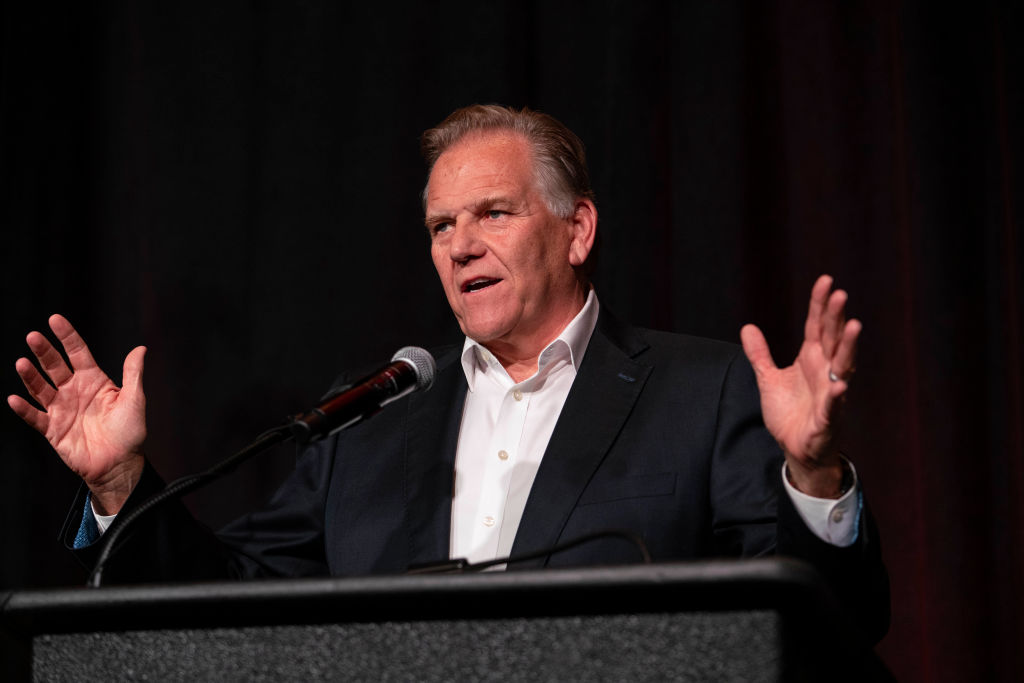
WARREN, Mich. — Former Michigan GOP Rep. Mike Rogers lost his Senate race last year by just 19,000 votes, even as President Donald Trump captured the Wolverine State.
Rogers is seeking a do-over in 2026 and has some wind in his sails this time. Senate GOP leaders quickly backed Rogers following his April announcement, and he easily cleared the field while securing the crucial Trump endorsement.
But Trump won’t be on the ballot to help juice turnout. Yet while even that wasn’t enough to push Rogers across the finish line last November, he still sees a clear path to victory.
“Donald Trump’s policies will be on the ballot, for sure,” Rogers, 62, said in an interview as he touted new tax benefits created by the president’s “One Big Beautiful Bill.”
That’s music to Democrats’ ears as they grow increasingly confident in their ability to use the OBBB fallout — plus Trump’s broader agenda — to win key races in 2026. However, that playbook may be a bit more complicated in Michigan given the messy three-way Democratic primary that won’t be settled until a year from now.
The path for Rogers. Much of Rogers’ strategy at this stage involves sitting back and letting Democrats attack each other. Rogers hopes that whoever emerges from the primary next August is badly damaged as a result.
Rogers lost to Sen. Elissa Slotkin (D-Mich.) in part because thousands of Michiganders voted for Trump but left the down-ballot races blank. This was a problem for Republicans in three other states where Trump won and the GOP Senate nominee lost.
Rogers also faced carpetbagging allegations because he bought a home in Florida after leaving Congress more than a decade ago.
But Rogers projects confidence in his path this time around, noting that Trump’s campaign mastermind, Chris LaCivita, is using the same blueprint that turned out low-propensity voters for Trump in November.
Midterm-year turnout is always lower than in presidential election years. Rogers said that in order to win next year, he just needs 85% of those who voted for him in 2024 to do the same in 2026.
“That is a very different race than going out trying to figure out how you get people to vote for you for the first time,” Rogers said.
Rogers and Trump. The former House Republican feels as if he’s getting a head start this time. At this point last cycle, Rogers wasn’t even in the race and still had to deal with a primary.
More importantly, Rogers had to win over Trump. That wasn’t easy given his history as a more traditional Republican and his past mild criticisms of the president.
But Rogers has now morphed into an effective messenger for Trump. He says Michiganders are “fairly optimistic” about Trump’s tariff regime, touting General Motors’ announcement that some production lines are returning to Michigan from Mexico. Still, inflation and the cost of living are vulnerabilities for Republicans heading into 2026.
“[Trump] believes, and I believe, that the economy will be improving steadily throughout the year,” Rogers said.
Rogers insists it’s political malpractice for Democrats to trash the OBBB given the tax components, despite its broader unpopularity and the steep Medicaid cuts that are coming after 2026.
Yet in doing so, Rogers is capitalizing on the toxicity of the Democratic brand.
“[Democrats] are so focused on hating Donald Trump and trying to get people not to like Republicans versus any policy provision that we may have that’s good,” Rogers said as he rattled off tax wins like no taxes on tips and overtime. “This Democrat Party is so focused on the coasts that it forgot about working people in Michigan.”
The other side. The three major Democratic candidates are just as happy to run against the Trump agenda as Rogers is to tout it. But they have different ideas about how to frame a general election campaign against Rogers.
In an interview following a manufacturing-focused roundtable on Tuesday, Rep. Haley Stevens (D-Mich.) said it’s not just about the OBBB and tariff uncertainty.
“People are at a breaking point,” Stevens told us. “I’m certainly very eager to explain my differences with the administration and Mike Rogers on this legislation. But more so, it is that the average American, our Michiganders, are being pushed to the brink on rising costs.”
Stevens is a four-term member who flipped a Trump-won district in 2018 and later defeated a more progressive House Democrat in a redistricting-driven showdown. Stevens noted she’s shown how to win in “tough landscapes” by “championing the economic needs of our state.”
State Sen. Mallory McMorrow is running on the notion that Democrats have failed to successfully message their policies in swing states like Michigan, pointing to 2024 losses in those battlegrounds. In an interview, McMorrow said Democrats need to do more than just tie Rogers to Trump in order to win in 2026.
“There’s an opening to say to people, you have every right to be angry. And that’s different from what we heard in 2024,” McMorrow said. “It’s not just about fighting Donald Trump to restore the way that things were, but it’s recognizing he actually hasn’t delivered on bringing your costs down — quite the opposite.”
Abdul El-Sayed, the Bernie Sanders-endorsed physician, is campaigning on free universal health care, child care and senior care.
When it comes to Rogers, El-Sayed isn’t holding back.
“Mike Rogers is a weak-ass tool,” El-Sayed told us. “The man has zero political talent, he’s like a non-playing character in life. When you have to go to Mar-a-Lago because you’re a neighbor in Florida, and ask another man for his blessing to run for office and ask other people to clear the field for you, all that tells me is you’re a beta character.”