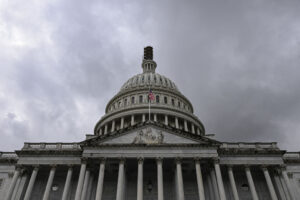
The Supreme Court appears ready to loosen coordination limits between candidates and party committees, shaking up the TV ad spending regime and mitigating a recent Democratic advantage.
The high court heard arguments Tuesday afternoon in NRSC v. FEC, a landmark campaign-finance case. Republicans are asking SCOTUS to allow party committees to coordinate freely with their preferred candidates and run ads in conjunction with them at the lower rate offered to candidates. This could save any party committee a ton of money.
Democrats are opposed, arguing that it would lead to donors using those committees to curry favor with candidates. Party committees can accept much higher donations than individual campaigns.
Most of the conservative justices seemed broadly supportive of Republicans’ argument that restricting coordination violates the First Amendment and that party committees shouldn’t be treated with the same onerous rules as a super PAC, which can take unlimited donations.
“I am concerned, as you said, that the combination of campaign finance laws and this court’s decisions over the years have together reduced the power of political parties as compared to outside groups with negative effects on our constitutional democracy,” Justice Brett Kavanaugh said before questioning Noel Francisco, an attorney for the NRSC.
The three liberal justices asked questions that indicated their strong opposition.
Inside the court. But multiple justices expressed concerns over the prospect that striking down the coordination limits could be a gateway to weaken more campaign finance laws. And the justices did not seem inclined to issue a broad ruling that would chip away at contribution limits that restrict what donors can give to party committees or candidates.
The questions focused largely on the merits and not the issues of standing.
The case was brought in 2022 by the NRSC, the NRCC and then-Senate candidate JD Vance. Vance is no longer a candidate for office, something that Roman Martinez, an attorney defending the spending limits, argued makes his claim moot.
“Restricting a party committee’s ability to support its own candidates is unconstitutional and a direct violation of the First Amendment,” NRSC General Counsel Blake Murphy said. “We’re grateful for the Court’s consideration and confident the justices will rule in favor of protecting freedom of speech and association.”
Timing. SCOTUS is expected to rule in the first half of next year, which is early enough to potentially impact the midterms.
This would affect both parties, but a ruling striking down the limits would benefit Republicans more because their candidates tend to raise less and they rely more on the party committees for advertising.
“I think this definitely has impacts of the tens of millions of dollars, if not potentially, hundreds of millions,” said Sen. Steve Daines (R-Mont.), who led the NRSC last cycle.