It’s Day 23 of the government shutdown. There’s no resolution to the crisis in sight. We will have James Blair, the White House deputy chief of staff, on Fly Out Day today. Subscribe to our YouTube channel.
The Senate is scheduled to vote today on Sen. Ron Johnson’s (R-Wis.) bill to pay “excepted” federal employees who’ve been forced to work without pay during the shutdown. Democrats are likely to filibuster the measure, believing it gives President Donald Trump and OMB Director Russ Vought too much authority over who to pay — or not to pay.
This is a tough vote for Senate Democrats, who will come under heavy criticism from Republicans for blocking a bill paying federal workers who obviously should be getting paid. Senate Majority Leader John Thune has indicated he’ll continue bringing these sorts of one-off bills to the floor to try to pummel Democrats.
Democrats plan to offer two bills of their own today from Sens. Chris Van Hollen (D-Md.) and Gary Peters (D-Mich.) to counter the Johnson measure. Each senator is serving as a co-sponsor for the other’s bill.
News: Van Hollen’s bill would pay all federal employees throughout the shutdown and bar any more layoffs by OMB. Peters’ narrower proposal would pay all federal employees up through the day the bill is enacted.
Democrats plan to offer both measures under unanimous consent before the vote on Johnson’s bill. Republicans will object, but it’ll give Democratic leaders an alternative to the GOP bill.
We’ll note that hundreds of thousands of federal employees — some of them already on food lines — will miss a paycheck on Friday.
Senators will convene at 12:30 p.m. for a rare bipartisan lunch, which was scheduled well before the shutdown. Then they’ll head home for the weekend and return on Monday.
For comparison, the House hasn’t been here since Sept. 19.
Senate Dems in the spotlight. We want to focus this morning on the mood inside the Senate Democratic Caucus.
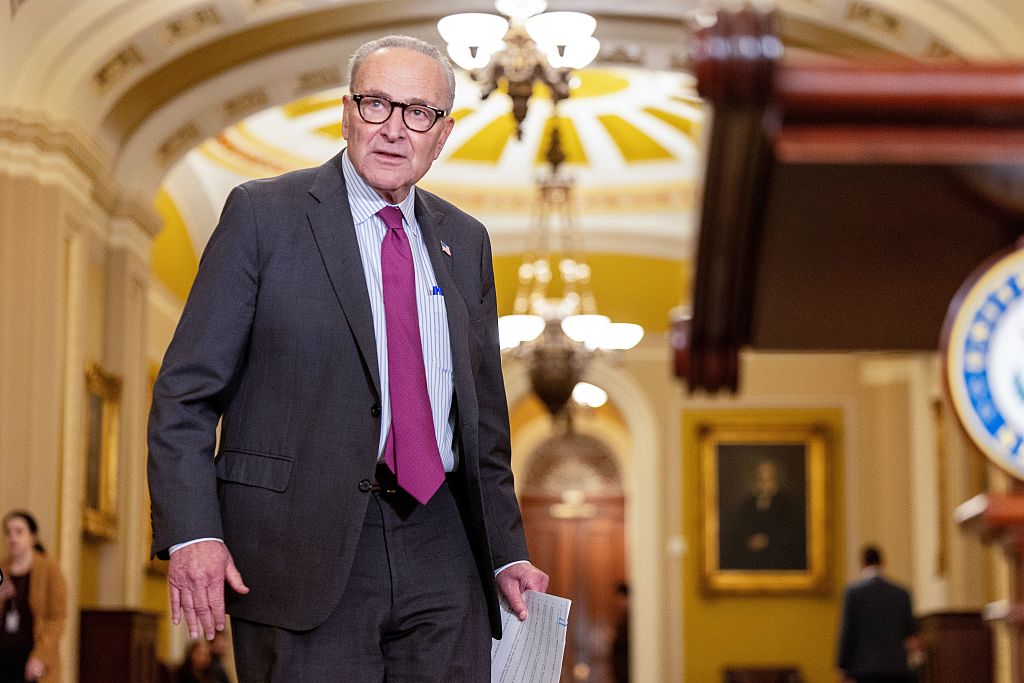
First, on the politics of the shutdown, Senate Minority Leader Chuck Schumer has gotten pilloried for telling us in an interview that “every day gets better” for Democrats. Republicans point to the remark as evidence that Schumer is focused on scoring political points while Americans suffer through the shutdown.
Yet it’s clear that Schumer has dramatically improved his standing within his caucus, especially after the March funding debacle. No Senate Democrats are publicly criticizing him. Plus, Democrats have elevated health care as a central issue for the 2026 midterms, an issue they feel exceedingly comfortable focusing on.
At the same time, some Democratic senators are anxious over the fact that there appears to be no clear escape hatch from this three-week-long shutdown. But in many ways, that’s not the point. Schumer deliberately hasn’t spelled out an endgame for Democrats, even in private. Instead, he’s letting the daily shutdown impacts plus public sentiment drive him, said sources close to the New York Democrat.
Naturally, this has led to some uneasiness within the caucus. According to more than a half-dozen Democratic senators, fewer and fewer colleagues are speaking up during caucus meetings. That’s a reflection of a few different dynamics, including the fact that many are afraid of crossing the party’s base and Schumer. Yet Democrats say they remain overwhelmingly behind the minority leader.
As for public sentiment, that seems to be on Democrats’ side — for now. But there’s no doubt that Americans are hurting. Federal employees, including senators’ own aides, aren’t getting paid. Essential services have been halted. WIC and SNAP are at risk (see below). There are growing problems with staffing for air traffic controllers. Farmers and small businesses aren’t getting loans.
Now let’s talk about Trump. The president is letting Thune and Speaker Mike Johnson run the shutdown, as well as top aides like Vought and Stephen Miller, the deputy White House chief of staff. Trump has made clear he doesn’t want to negotiate with Democrats until the shutdown is over.
Trump is even leaving the country for a trip to Asia on Friday night, his second foreign trip since the shutdown began. No other president would dare to take a foreign trip during a shutdown.
Yet that’s not stopping Democrats from continuing to insist that a Trump-facilitated negotiation is the only path to reopening the government — and that Trump will eventually feel pressure to do so.
“Trump is the off-ramp,” Sen. Tammy Baldwin (D-Wis.) said. “If he says to his Republican leaders in Congress, ‘Fix this,’ it’ll happen.”
“Donald Trump can ignore the American people for a long time, but not forever. The only solution is Trump,” Sen. Elizabeth Warren (D-Mass.) added.
When we noted Trump’s posture to Sen. Brian Schatz, the Hawaii Democrat responded: “If you don’t like the president’s position, just wait a few hours.”
The implication here is that Trump constantly changes his mind and will eventually see the light when it comes to the Obamacare subsidies. Schatz insisted Democrats shouldn’t shift their position until a negotiation has started.
But Democrats’ plan of trying to bring Trump into the fold simply hasn’t worked. Trump has also made things easier for Democrats by removing key pain points like paying members of the military.
Democrats say they’re prepared to ride it out — at least through Nov. 1.
Nov. 1 is a key date not only because of missed paychecks or WIC-SNAP funding. It’s also the start of open enrollment for health-care plans, which Democrats believe will turn up the heat on Republicans over rising premium costs. Alternatively, Democrats could use the start of open enrollment to declare victory and end the shutdown.
The Nov. 4 gubernatorial elections in Virginia and New Jersey — Democrats are favored in both — plus the California redistricting referendum will also play into the shutdown endgame.