


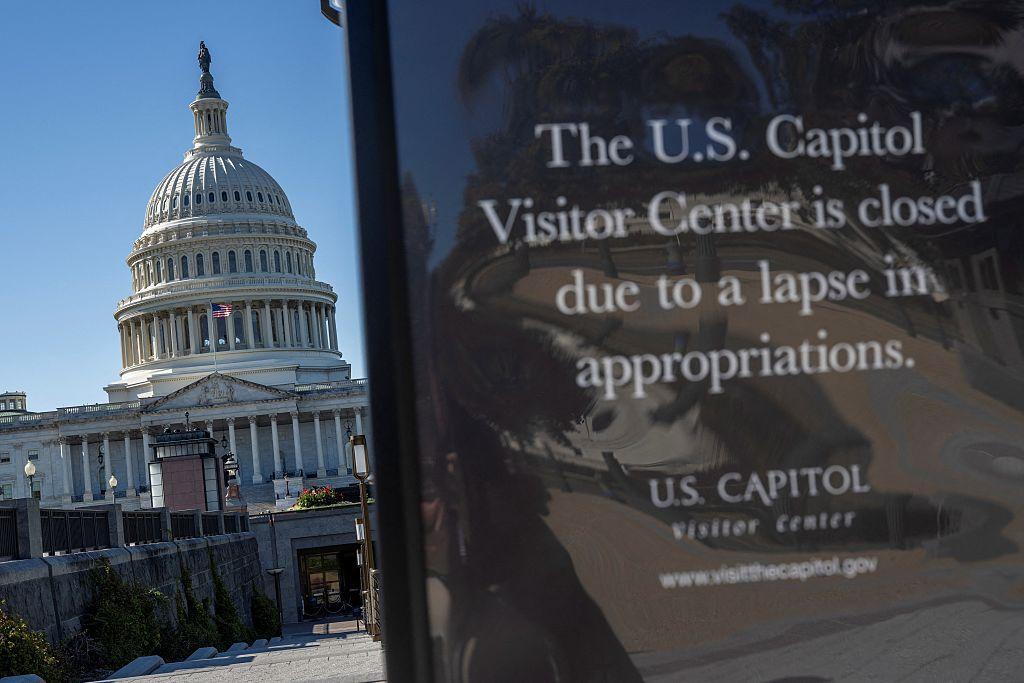
This is Day 27 of the government shutdown. There’s no resolution in sight to this crisis.
The House hasn’t voted since Sept. 19 (that’s 38 days). The Senate is spinning its wheels on nominations and doomed-to-fail funding votes that aren’t moving the needle. Committee work has completely stopped in the House. The annual appropriations process is nowhere. Speaker Mike Johnson refuses to swear in Rep.-elect Adelita Grijalva (D-Ariz.), who was elected more than a month ago.
Congressional leaders in both parties — locked in a cycle of defiance and denial — hold daily press conferences to blame the other side for the shutdown, which has been a disaster for Congress as an institution. President Donald Trump is on his second overseas trip since Oct. 1, this one a high-profile foray highlighted by an expected Thursday meeting in South Korea with Chinese President Xi Jinping.
Yet the political calculus is slowly changing. The fallout from the shutdown is growing worse by the day. The risk for Democrats is that these impacts begin to overshadow the health-care issues they’re trying to fix. For the GOP, it looks like they can’t govern.
Hundreds of thousands of federal workers missed a full paycheck last week, causing hardship for them and their families. Air traffic controllers, already dealing with staffing shortages leading to delays at major hubs, will miss a paycheck this week. More on this in a bit.
Trump mandated that military service members get paid on Oct. 15, but it’s unclear what will happen with this week’s paycheck. The Trump administration accepted a $130 million gift from a Trump donor to help pay the troops, although that’s only a fraction of what’s needed.
Now that SNAP benefits are slated to run dry Nov. 1 — and the White House doesn’t believe it can do anything to stop that — the shutdown is truly breaking through in local media. Look at this collection of front pages from the Sunday newspapers.
— Shreveport (La.) Times: “SNAP benefits to stop in Nov.” This is Johnson’s hometown paper.
— New Orleans Times-Picayune:“Shutdown’s impact looms on state’s horizon: Much of Louisiana hasn’t seen effects yet, but as stalemate continues, consequences will broaden”
— N.Y. Daily News: “Nearly 3 million New Yorkers face losing SNAP benefits in November”
— Utica (N.Y.) Observer-Dispatch: “SNAP benefit disruption shows local challenges”
— Independent Mail (Anderson County, S.C.): “Starving SNAP: Food pantries brace for more families as government shutdown threatens funds”
— The Pueblo (Colo.) Chieftain: “SNAP benefits for 40,000 Puebloans put on hold”
— Miami Herald: “New shutdown problem: Miami is the U.S. capital for seniors on food stamps.”
None of these headlines cast blame on one party or the other. The question becomes whether food stamps drying up — or something else — pushes Congress to a solution.
Rifle-shot bills. That brings us to our next point: The Senate’s potential votes this week on narrow funding bills to pay members of the military and air traffic controllers.
Senate Majority Leader John Thune has teased possible votes this week on those so-called “rifle-shot” bills.
An initial procedural vote on either bill could occur as soon as Wednesday, but Thune hasn’t made a final decision on whether to tee up these votes. The goal would be to try to make Democrats look bad for blocking them.
Senate Democratic leaders aren’t yet saying how they’d handle these votes. Democrats filibustered a GOP bill last week that would have paid federal employees who have been forced to work during the shutdown, arguing it would’ve given Trump too much power.
It’ll be harder to apply that argument to these two bills. Paychecks for air traffic controllers are especially urgent. While Trump has been actively looking for ways to pay troops, the same hasn’t been the case for air traffic controllers.
Since the shutdown began, five Senate Democrats have already voted for either the House-passed Nov. 21 CR or the GOP bill to pay non-furloughed federal workers. If all five support a “rifle-shot” bill, getting to 60 votes suddenly doesn’t seem impossible.
Plus, allowing either or both of these to pass could serve a political purpose for Democrats too — put pressure on Johnson to bring the House back. Last week, Johnson ruled out returning to pass an air traffic controllers bill, which undoubtedly factors into Thune’s decision-making. If the Senate sends Johnson a bill to pay these workers, he’d be hard-pressed to maintain that stance.
Something else to consider with these bills: Removing pain points only makes both sides more entrenched and doesn’t get them any closer to ending the shutdown. The White House doesn’t want Congress to send them these bills because they believe it’ll just bail Democrats out and shift the focus away from solving the shutdown.
Another thing to watch for this week. Sen. Chris Van Hollen (D-Md.) is working with Sen. Ron Johnson (R-Wis.) on potentially merging their two bills to pay federal workers. Last week, Democrats blocked Johnson’s, which covers non-furloughed workers. Van Hollen’s bill covers all federal workers and bars layoffs during the shutdown. Thune has said he’s open to a compromise.