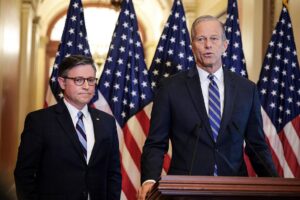


The partial government shutdown, all of three days old, is likely to end at some point this afternoon. It was a mostly fruitless exercise, and it sets Congress up for another, more politically charged funding cliff at the end of next week.
Later today, the House will take up and vote on legislation to fund critical departments such as the Pentagon, State, Health and Human Services, Transportation and others until Sept. 30. Funding for the Department of Homeland Security will be extended until Feb. 13 while the White House and Democrats try to work out a deal — if possible — on new restrictions for ICE and CBP.
There’s a real chance that Congress won’t be able to notch a deal, leaving DHS funding in a precarious position for the rest of the year.
In what’s become an-all-too-familiar pattern this Congress, President Donald Trump convinced Reps. Anna Paulina Luna (R-Fla.) and Tim Burchett (R-Tenn.) to drop their blockade of the funding measure. The pair — close political allies — were threatening to vote against the rule unless Speaker Mike Johnson attached a voter ID bill (the SAVE Act) to the funding package. Trump made clear that wasn’t going anywhere.
Anything can happen in the House these days, but clearing Luna’s objection should allow the chamber to adopt a rule and pass the funding package using a simple majority threshold. If and when the House adopts the rule, we expect the five underlying FY2026 funding bills to pass handily with dozens of Democratic votes.
But what you should really be focusing on is the mess that this entire process sets up next week, which we recently laid out.
In 10 days from now — right up against the Presidents Day recess — DHS funding will run out once again. That’s fine with lots of Democrats, who point out the department got tens of billions of dollars under the GOP’s One Big Beautiful Bill last year. They think it can keep going for a while if needed, maybe the rest of FY2026.
“I don’t like the 10 days,” South Carolina GOP Rep. Ralph Norman said of the DHS CR. “What’s going to change in 10 days? [Democrats are] going to dismantle ICE. They’re gonna shut it down, which is fine. I’d say, do it.”
The obvious hurdle here is that the two sides are nowhere near any kind of consensus on potential ICE reforms. Senate Majority Leader John Thune said he’s only had “preliminary conversations” on Democrats’ proposed changes to ICE operations. The White House will be taking the lead on the negotiation with Senate Minority Leader Chuck Schumer.
Even with a deal in hand today, it would take the Senate and House more than a week to get it passed. But any agreement is looking further off than ever.
Johnson said Monday that he wants the ICE negotiations to include the “unsafe law enforcement practices in some of these sanctuary cities.” Any conversation of new restrictions or mandates on sanctuary cities is going nowhere with Hill Democrats.
Meanwhile, Senate conservatives are already digging in against some of the ICE reforms Democrats are seeking, planning proposals to require judicial warrants and stop agents from wearing masks. In an even bigger challenge, hardline Republicans want to seize the moment to achieve their own priorities.
“If Democrats get anything, we have to demand all kinds of things,” Sen. Ron Johnson (R-Wis.) told us. “Ending sanctuary cities would be one. Shutdown Fairness Act would be another one. [The] SAVE Act.”
Some hardline conservatives are thinking ahead to attaching the SAVE America Act — the new voter ID law that replaced the SAVE Act — to the next funding bill.
Luna has suggested that the White House will push Thune to force Democrats to conduct a live, “standing” filibuster if they want to block the SAVE America Act. This would be akin to changing the rules of the Senate, the so-called “nuclear option.” We don’t think Thune is willing to go there, as he’s stated numerous times.
Thune has already said he plans on holding another vote on the SAVE Act at some point soon. So it’s unclear what exactly Luna is suggesting, or whether Thune has made any commitments to her or anyone else.
The South Dakota Republican appears more focused on next week’s DHS deadline — and he’s looking ahead to it with some skepticism.
Thune told us he wants to start those negotiations “right away” once the House clears the funding package, but said most of the specifics will be up to the White House and congressional Democrats. Thune added that the Senate will need to be “ready” to tee up another short-term funding patch for DHS given the short timeline and the unlikely prospect that both chambers will be able to meet the Feb. 13 deadline.
Senate Democrats are cautiously hailing what they called a “de-escalatory” move by DHS Secretary Kristi Noem on Monday when she announced that all federal agents in Minneapolis will wear body cameras. But they warned that this isn’t nearly enough.
Sen. Brian Schatz (D-Hawaii) said these kinds of moves are simply “a prerequisite to a negotiation, but the negotiation is about a statute. Executive action, at this point, gets them in the room.”