

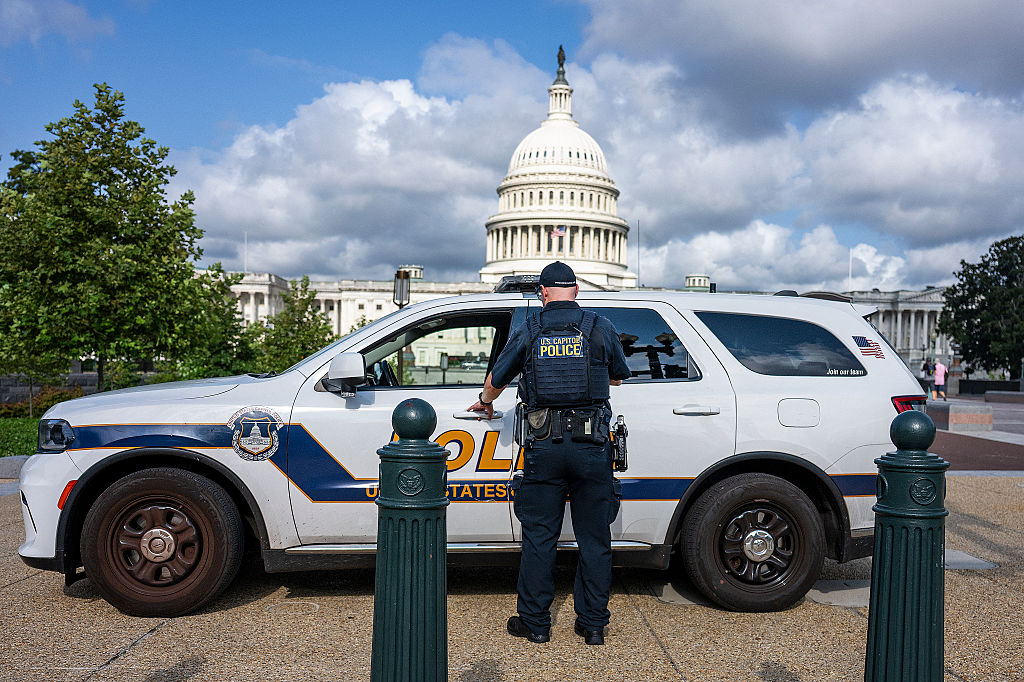
An 18-year-old wearing a tactical vest and carrying a loaded shotgun charged toward the West Front of the Capitol on Tuesday and was quickly arrested, U.S. Capitol Police Chief Michael Sullivan said.
The suspect, who hasn’t yet been named, didn’t live in the D.C. area and wasn’t known to police, Sullivan added. The suspect immediately surrendered when confronted by Capitol Police officers.
A possible motive hasn’t been revealed yet. As our readers know, Congress isn’t in session this week. But the incident was a reminder of the increasingly dangerous threat landscape for lawmakers and public officials, both in Washington, back home and everywhere in between.
A troubling trend. Capitol Police data published last month showed a major spike in threats toward members of Congress in 2025. Last year, the agency’s Threat Assessment Section investigated 14,938 “concerning statements, behaviors, and communications directed against Members of Congress, their families, staff, and the Capitol Complex.”
That’s an increase of more than 5,000 from the previous year — a jarring statistic. Yet the longer-term trends paint an even more concerning picture, according to a research firm.
The Institute for Strategic Dialogue conducted a study recently that focused on violent and threatening rhetoric toward lawmakers and prominent public officials on social media sites, including Reddit and YouTube. ISD compared the periods October 2021-September 2022 to October 2024-September 2025.
Among other findings, ISD said there was a 241% increase in violent threats between the two time periods. That spike was 124% for Democratic lawmakers and 364% for Republicans, with threats toward President Donald Trump accounting for nearly half of all threats in ISD’s database.
What to do about it. ISD CEO Sasha Havlicek said the study was “complementary” to the recent Capitol Police report because it shows a direct correlation between a spike in online threats and an increase in real-world targeting of lawmakers and prominent officials.
For example, violent rhetoric toward former President Barack Obama spiked last year on social media after Director of National Intelligence Tulsi Gabbard accused him of trying to “subvert” Trump’s 2016 election victory.
What’s more, ISD found that the individuals making the threats were primarily “partisan individuals” rather than people associated with terrorist or extremist groups.
Hostile foreign influence operations are also at play and have a direct interest in amplifying these sentiments.
“It’s seemingly becoming more random,” ISD’s threat analysis chief Katherine Keneally told us. “Finding the needle in the haystack is becoming much more difficult because the haystack is getting bigger and bigger.”
It goes without saying that the very same political polarization that’s driving these types of threats against lawmakers is making it more difficult for Congress to address. Social media in particular has enabled “echo chambers that have emerged as a result of the algorithmic distortions,” Havlicek said.
ISD says it works to share its data with local and federal law enforcement in real-time, but congressional action is long overdue in the social media space, as well as boosting security funding and resources for lawmakers.