


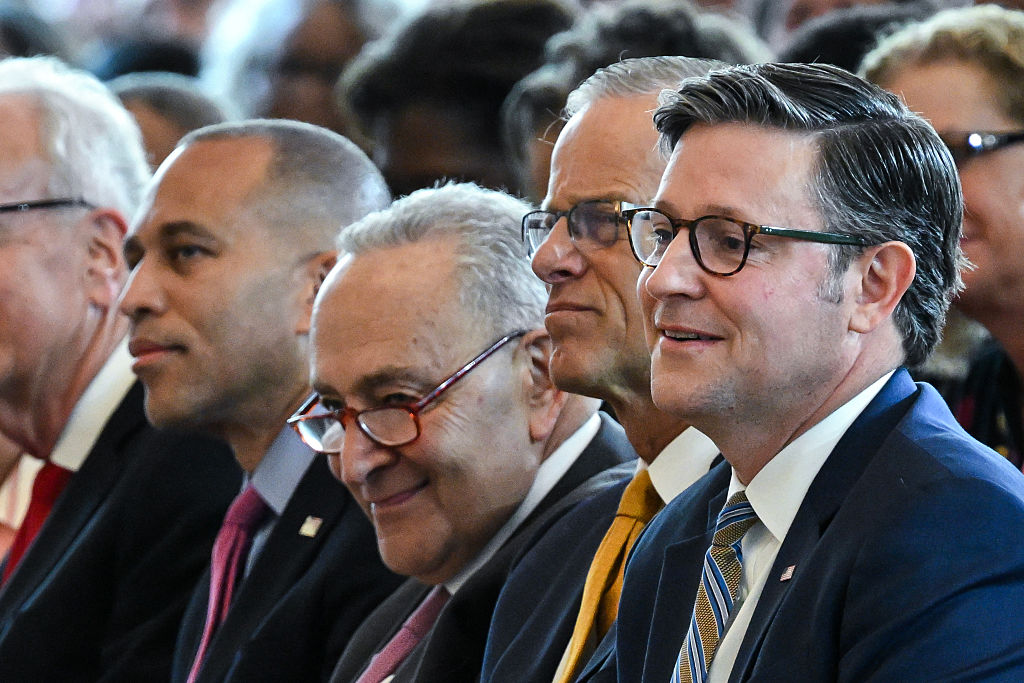
Congress is once again in a crisis. Funding for the Department of Homeland Security will run out one week from today, and Congress is miles from a solution.
The political dynamics surrounding the DHS funding fight are starting to feel a lot like those that played out during the disastrous 43-day full government shutdown in October and November.
While the current clash is more limited in scope, we’ve already seen Hill leaders retreat comfortably to their partisan corners. One of the reasons why last year’s shutdown lasted so long was because of a similar incentive structure.
Let’s dig into what’s happening and why.
Schumer and Jeffries. Senate Minority Leader Chuck Schumer reacted quickly to the Jan. 24 fatal shooting of Alex Pretti in Minneapolis, announcing just hours later that Senate Democrats wouldn’t provide the votes to pass a massive FY2026 funding package unless the DHS portion was stripped out. House Minority Leader Hakeem Jeffries — who previously has seen some of his members vote with Republicans on DHS funding — had a united caucus as well.
In the immediate aftermath of Pretti’s death, it was clear that Democrats had the upper hand. Republicans were largely acknowledging Democrats’ concerns, and even President Donald Trump made some conciliatory moves. That included agreeing to Democrats’ demand that the DHS funding bill be dealt with separately while negotiations began.
But once the reworked funding measure was kicked back to the House, Jeffries broke with Schumer and voted against the package. The Schumer-Jeffries split caused Republicans to question whether Democrats were actually serious about getting a DHS deal.
Schumer and Jeffries keep saying that they’re on the same page, although they need to do more than just say it, according to Republicans. The Democratic leaders’ insistence that the DHS measure could be renegotiated within just two weeks ignored the reality of how long it would take to agree to detailed legislative language and push it through both chambers.
Schumer and Jeffries pushed for the shorter timeline out of a belief that they needed to capitalize on the national momentum Democrats have following the Pretti shooting. That’s a fair consideration. Yet Schumer and Jeffries didn’t release their detailed list of demands for ICE reforms until less than 36 hours ago.
The more immediate issue facing Schumer and Jeffries is whether to help provide the votes for another short-term funding extension for DHS ahead of next Friday’s deadline.
While progressives have been clamoring for a DHS shutdown, it’s important to remember that ICE is already fully funded through the One Big Beautiful Bill Act. A DHS shutdown would only impact unrelated but critical services, such as TSA, FEMA and the Coast Guard.
Yet the Democratic base won’t like any deal that isn’t fully on Democratic terms, which is a big problem for Jeffries in particular. The pair of New York Democrats face some sensitive political maneuvering in the near term even as the overall political landscape favors them.
Thune and Johnson. Senate Majority Leader John Thune, Speaker Mike Johnson and the White House ultimately agreed to Democrats’ demand to separate DHS from the rest of the funding package, reasoning that it was better to isolate the shutdown fight to DHS and keep everything else open.
They also knew that public outrage over the shooting deaths of Pretti and Renee Good at the hands of federal agents threatened to undermine Trump’s harsh immigration enforcement agenda, and they needed to take some sort of action in response. The White House’s decision to split off the DHS funding bill — thereby creating a path for a negotiation over measures to rein in ICE — was a reflection of that political reality.
But it quickly became clear that Trump’s MAGA allies on the Hill would resist any attempts by Democrats to restrict the president’s mass deportation campaign. Johnson and Thune soon had demands of their own, including crackdowns on so-called sanctuary cities — policies that have long been non-starters for Democrats.
The ultimate concern for Johnson and Thune is that Trump may just decide to go his own way and cut a deal with Democrats. The president is clearly uninterested in a shutdown of any length. Democrats are gambling that Trump will abandon Thune and Johnson — just like he did when he agreed with Schumer to pass the two-week CR.
As for next Friday’s DHS funding deadline, Thune and Johnson will need to decide soon whether to pursue another short-term funding patch or try to jam Democrats with a year-long CR. Senate Democrats have all the leverage here.
While Republicans will slam Democrats for a TSA-FEMA-Coast Guard funding lapse, Thune and Johnson really don’t want a shutdown either. Remember, public polling showed during the last full government shutdown that Americans largely blamed Republicans even though it was Democrats who instigated the shutdown fight.
There are plenty of pitfalls ahead for Johnson and Thune. Johnson has a one-vote margin and will have to navigate choppy waters to even get a CR on the floor next week. And Thune has to get 60 votes in a Senate where Democrats feel emboldened to just say no.
Also. In our PM edition, we scooped that Trump offered to unfreeze money for the Gateway infrastructure project if Schumer would support naming Washington-Dulles International Airport and Penn Station after the president. Schumer said no, Trump can just do it on his own. Thousands of Gateway Program layoffs could start today.