


February 18, 2026



PRESENTED BY

THE TOP
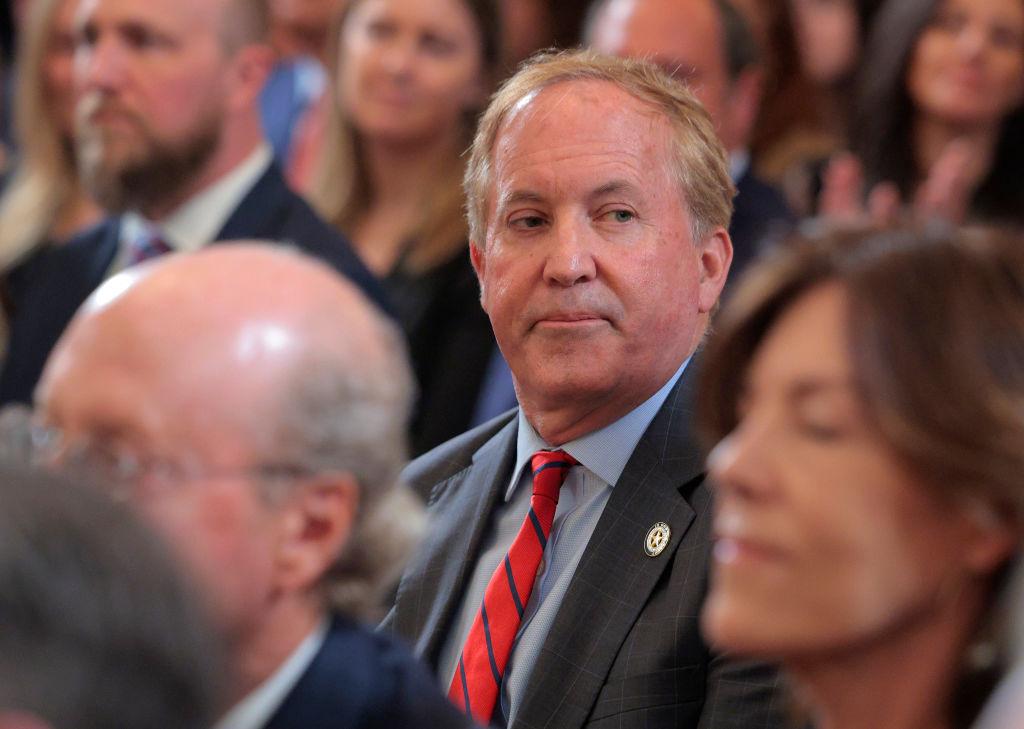
Paxton surviving cash dump in Texas Senate primary
Happy Wednesday morning.
News: House Minority Leader Hakeem Jeffries is expected to go to Annapolis, Md., today. Maryland Senate President Bill Ferguson has held out on redistricting even as the state House has passed the measure by overwhelming margins.
Paxton pushes through. TYLER, Texas — The GOP establishment spent more than $60 million to kneecap Texas Attorney General Ken Paxton’s Senate campaign.
It didn’t work.
Over the last six months, D.C. Republicans unleashed a tidal wave of TV ads boosting Sen. John Cornyn (R-Texas). Those ads reminded Lone Star State voters about Paxton’s messy divorce, controversial impeachment proceedings and a slew of corruption scandals involving the longtime pol.
But Paxton is entering the final weeks ahead of the March 3 Senate GOP primary just as he began it — the front-runner. And Paxton is convinced that he’s going to end Cornyn’s Senate career soon.
“My numbers look as good as they ever have. This is going to be a good race for me,” Paxton told us this week after an early voting kickoff event. “Now, John Cornyn’s at risk of finishing third. He may finish third. That’s where he’s at. He is in serious trouble of not even making a runoff.”
Here’s the crazy part: Paxton didn’t air TV ads of his own until mid-February. He held just a few public campaign events and barely responded to the pro-Cornyn onslaught.
“I don’t want to give their attacks dignity,” Paxton said.
Cornyn’s fundraising dwarfs Paxton’s. Yet Paxton enters any runoff in the pole position because those faceoffs draw the kind of smaller, more conservative electorate in which he thrives.
Warning bell. Senate Republicans have been sounding the alarm for months that Paxton can’t win a general election. Senate GOP leaders say the reasons Paxton is so beloved by the far-right — his hardline conservatism — make him uniquely vulnerable against a Democratic opponent in the fall.
The opposite is true of Cornyn, whose bipartisan deals on issues like gun control, support for Ukraine and previous skepticism of President Donald Trump have left him struggling in a Republican primary but then much better positioned for a general.
Cornyn upped his attacks on Paxton as early voting began on Tuesday. During an event in Austin, Cornyn predicted that having Paxton as the GOP nominee would endanger federal and statewide offices across Texas.
“We will have an Election Day massacre,” Cornyn said. “Republicans up and down the ticket will pay the price of having an albatross like our corrupt attorney general hung around their neck.”
Yet for all the money already spent — and all the money yet to come — it’s not clear that Paxton can be stopped.
The base. Paxton told us he entered the race last spring because Cornyn’s poll numbers were so abysmal.
After a summer of ads, Cornyn’s polling started to tick up in some public and private surveys. Paxton’s dropped somewhat. But most Republicans involved in the race agree: Paxton has a high floor.
Paxton has achieved celebrity status among the right by using his perch as the top lawyer in the nation’s largest red state to wage unceasing culture wars. He sued to overturn the 2020 election, targeted Pfizer over the Covid-19 vaccine and pursued cases against doctors who provide gender transition services.
Paxton has also faced a laundry list of scandals, including a Texas Senate impeachment trial (he was acquitted) and more recently, his wife divorcing him on “biblical grounds,” including accusations of adultery.
But in some ways, Paxton has developed Trumpian-like political armor, where the attacks against him seem to further entrench his hardcore loyalists.
“Ken Paxton has his base and his base isn’t leaving him,” said Rep. Troy Nehls (R-Texas), a Paxton endorser. “If a nasty divorce would disqualify you from being a member of Congress, we could not establish a quorum in Washington, D.C.”
Two other big factors swung in Paxton’s favor: Trump ignored pressure to endorse against him and a third candidate entered the fray.
The Hunt factor. The race between Paxton and Cornyn had begun to tighten when Rep. Wesley Hunt (R-Texas) jumped into the primary in October.
Both Cornyn and Paxton dismiss Hunt as a nonentity. But the anti-Hunt TV ads suggest otherwise.
Paxton’s super PAC appeared to knock Hunt because they’d rather face Cornyn in a runoff. An attack from a pro-Cornyn group likely means they want to ensure Hunt doesn’t box out the incumbent senator.
“I guess I’m doing better in the polls than you’re letting on. Otherwise you wouldn’t be spending the money,” Hunt declared at a Monday event in Dallas.
However, Hunt’s entrance all but ensures the race will go to a runoff the Tuesday after Memorial Day.
Looking ahead, Cornyn acknowledged he would need to change the typical runoff electorate to win. His plan: leverage endorsements from groups like the U.S. Chamber of Commerce and the Texas Farm Bureau that have collective memberships “approaching 2.6 million.”
“I’m not under the illusion all of them will show up and vote in the primary,” Cornyn said. “But we’re doing things that have never been done before to try to encourage people to turn out.”
Making nice. Paxton appears to be looking beyond the runoff.
At a restaurant in East Texas, Paxton addressed a crowd of supporters and took a few jabs at Cornyn, saying that he had accomplished little in Congress.
But he didn’t overly slam moderates as RINOs or throw too much red-meat to the base.
Consider this: Paxton declined to attack Senate Majority Leader John Thune or the NRSC, which has mocked him publicly as it tries to boost Cornyn.
“I’m not here to criticize any particular person other than the guy that’s running: John Cornyn,” Paxton said. “They make their decisions in Washington differently than we make them here. That’s fine. But once I’ve won, then I intend and hope that they’ll be willing and able to work with me.”
In an interview, Paxton acknowledged he would need to appeal to Democrats and independents in a general election: “I’ve won three statewide races, all of a sudden now I can’t win one?”
But there’s one caveat — those victories were before Paxton’s public divorce.
– Ally Mutnick
TODAY: Join Punchbowl News today at 12 p.m. ET for a conversation with candidate for Georgia lieutenant governor and former state Sen. John F. Kennedy (R-Ga.) on lawsuit abuse and insurance affordability. Afterwards, we’ll sit down with Adam Blinick, head of public policy at Uber. RSVP here!


CAPITOL SAFETY
Capitol Police threats report only tip of the iceberg
An 18-year-old wearing a tactical vest and carrying a loaded shotgun charged toward the West Front of the Capitol on Tuesday and was quickly arrested, U.S. Capitol Police Chief Michael Sullivan said.
The suspect, who hasn’t yet been named, didn’t live in the D.C. area and wasn’t known to police, Sullivan added. The suspect immediately surrendered when confronted by Capitol Police officers.
A possible motive hasn’t been revealed yet. As our readers know, Congress isn’t in session this week. But the incident was a reminder of the increasingly dangerous threat landscape for lawmakers and public officials, both in Washington, back home and everywhere in between.
A troubling trend. Capitol Police data published last month showed a major spike in threats toward members of Congress in 2025. Last year, the agency’s Threat Assessment Section investigated 14,938 “concerning statements, behaviors, and communications directed against Members of Congress, their families, staff, and the Capitol Complex.”
That’s an increase of more than 5,000 from the previous year — a jarring statistic. Yet the longer-term trends paint an even more concerning picture, according to a research firm.
The Institute for Strategic Dialogue conducted a study recently that focused on violent and threatening rhetoric toward lawmakers and prominent public officials on social media sites, including Reddit and YouTube. ISD compared the periods October 2021-September 2022 to October 2024-September 2025.
Among other findings, ISD said there was a 241% increase in violent threats between the two time periods. That spike was 124% for Democratic lawmakers and 364% for Republicans, with threats toward President Donald Trump accounting for nearly half of all threats in ISD’s database.
What to do about it. ISD CEO Sasha Havlicek said the study was “complementary” to the recent Capitol Police report because it shows a direct correlation between a spike in online threats and an increase in real-world targeting of lawmakers and prominent officials.
For example, violent rhetoric toward former President Barack Obama spiked last year on social media after Director of National Intelligence Tulsi Gabbard accused him of trying to “subvert” Trump’s 2016 election victory.
What’s more, ISD found that the individuals making the threats were primarily “partisan individuals” rather than people associated with terrorist or extremist groups.
Hostile foreign influence operations are also at play and have a direct interest in amplifying these sentiments.
“It’s seemingly becoming more random,” ISD’s threat analysis chief Katherine Keneally told us. “Finding the needle in the haystack is becoming much more difficult because the haystack is getting bigger and bigger.”
It goes without saying that the very same political polarization that’s driving these types of threats against lawmakers is making it more difficult for Congress to address. Social media in particular has enabled “echo chambers that have emerged as a result of the algorithmic distortions,” Havlicek said.
ISD says it works to share its data with local and federal law enforcement in real-time, but congressional action is long overdue in the social media space, as well as boosting security funding and resources for lawmakers.
— Andrew Desiderio

INVESTIGATION NATION
Epstein investigation continues with Wexner deposition
Les Wexner, the billionaire business executive who hired Jeffrey Epstein to manage his finances in the 1980s, will sit for a deposition with the House Oversight Committee on Wednesday. Wexner is scheduled to be deposed at his residence in New Albany, Ohio.
Wexner, the former CEO of L Brands, first met Epstein in the 1980s and gave Epstein power of attorney over his finances. Wexner has said he cut business ties with Epstein in 2007, but emails show the two communicated in 2008.
Wexner has denied any knowledge of Epstein’s crimes and has never been charged with a crime. But Wexner’s relationship with Epstein has attracted new coverage after the release of a 2019 FBI document that listed Wexner as a co-conspirator in the Epstein investigation.
During last week’s House Judiciary Committee hearing, Attorney General Pam Bondi said that Wexner’s name appears more than 4,000 times in the Epstein files.
Rep. Thomas Massie (R-Ky.) also pressed Bondi to explain why Wexner’s name had originally been redacted in the 2019 document.
A group of Democrats on the House Oversight Committee will hold a news conference in New Albany following the Wexner deposition. Participants include Ranking Member Robert Garcia (Calif.) and Reps. Stephen Lynch (Mass.), Rashida Tlaib (Mich.), Jasmine Crockett (Texas), Yassamin Ansari (Ariz.) and Dave Min (Calif.).
The Wexner deposition comes as the fallout over the Epstein files continues to wreak havoc across the globe. On Monday, Thomas Pritzker stepped down as executive chair of the Hyatt Hotels Corporation because of his ties to Epstein and Ghislaine Maxwell.
Next week, former President Bill Clinton and former Secretary of State Hillary Clinton are scheduled to sit for depositions before the Oversight Committee about Epstein. The Clintons initially sought to fight the subpoenas and avoid testifying, but they caved after the House moved to hold both in criminal contempt of Congress.
— Max Cohen
PRESENTED BY PHRMA

Americans get medicines three years before other countries. That’s worth protecting.

Vault: The great CFTC reversal on prediction markets
Commodity Futures Trading Commission Chair Mike Selig all but declared war on state governments this week, announcing his federal agency would oppose efforts by state attorneys general to crack down on prediction markets.
Selig has embarked on a media blitz in the past week, appearing in longform podcasts and TV interviews, the Wall Street Journal’s opinion pages and in a video on X with the same message: the CFTC is responsible for regulating prediction markets, not the states.
“To those who seek to challenge our authority in this space, let me be clear: we will see you in court,” Selig said in a Tuesday video address.
These comments mark a sharp reversal from Selig’s testimony before the Senate Agriculture Committee late last year, where the former nominee said he’d defer to the wisdom of the courts about the legal status of events contracts.
A light-touch CFTC will be a powerful ally for upstart prediction market companies like Polymarket and Kalshi. It will fall to the courts to decide whether Selig’s interpretation of the law is right.
Throwback. Democrats on the Senate Agriculture Committee pressed Selig for his views on prediction markets back in November. Several, including Sens. Tina Smith (Minn.), and Cory Booker (N.J.), expressed reservations about events contracts that resemble sports betting, which is otherwise not legalized on a national level.
Selig replied that he would “intend to always adhere to the law and follow what judicial decisions tell me to follow.”
This week brought a different tune. Prediction markets, Selig said on X, provide “useful functions for society by allowing everyday Americans to hedge commercial risks” by predicting the weather and energy prices.
Blowback. Senate Democrats were already skeptical heading into this week, writing in a letter to Selig on Feb. 13 that his recent remarks seemed “at odds with the intent of the Commodity Exchange Act.”
Tuesday marked an escalation from state-level Republicans. Utah Gov. Spencer Cox told Selig on X that “these prediction markets you are breathlessly defending are gambling—pure and simple.”
Sen. Catherine Cortez Masto (D-Nev.) said in a statement the CFTC is “willing to trample on Nevada and other states’ rights to regulate gaming. The vast majority of event contracts help facilitate sports wagering.”
Don’t expect much activity from Congress here in the near term. The Senate Agriculture and Banking Committees have had their hands full trying to implement the crypto sector’s legislative agenda via market structure legislation. There’s not much appetite to touch events contracts.
– Brendan Pedersen
AND THERE’S MORE
News: Versant has hired Jonathan Kott as its government affairs chief, the media company’s general counsel Jordan Fasbender announced.
Kott was a fixture on Capitol Hill, serving as Sen. Joe Manchin’s (I-W.Va.) longtime communications director. Kott also served in the same role for Sen. Chris Coons (D-Del.) in two separate stints. He was most recently a partner at Capitol Counsel, a federal lobbying shop.
Versant is the parent company of former NBCUniversal properties MS NOW (previously MSNBC) and CNBC, in addition to the Golf Channel and USA Network.
Ad Watch. Rep. Dan Crenshaw (R-Texas) is up with an ad slamming his primary rival, state Rep. Steve Toth, as a RINO. That’s not a sign of confidence ahead of his March 3 primary.
— Andrew Desiderio and Ally Mutnick


Presented by AstraZeneca

The 340B program is supposed to help vulnerable patients—but without strong safeguards, it’s siphoning away funds that could be used for free and charitable medicine. The 340B Rebate Model Pilot improves program integrity, preventing duplicate discounts and strengthening accountability. Urge HHS to implement the pilot today. Learn why it matters.

Crucial Capitol Hill news AM, Midday, and PM—5 times a week
Join a community of some of the most powerful people in Washington and beyond. Exclusive newsmaker events, parties, in-person and virtual briefings and more.
Subscribe to Premium
Special Projects
Explore our deep dives into the issues that matter the most today and will shape tomorrow's future, with expert reporting that goes beyond the headlines and into the heart of the Capitol.
Check it outEvery single issue of Punchbowl News published, all in one place
Visit the archive
Presented by AstraZeneca
The 340B program lacks transparency—making it hard to tell if it’s actually helping vulnerable patients. HHS can fix the problem by implementing the 340B Rebate Model Pilot, ensuring the program is transparent, compliant, and accountable. Learn more.