

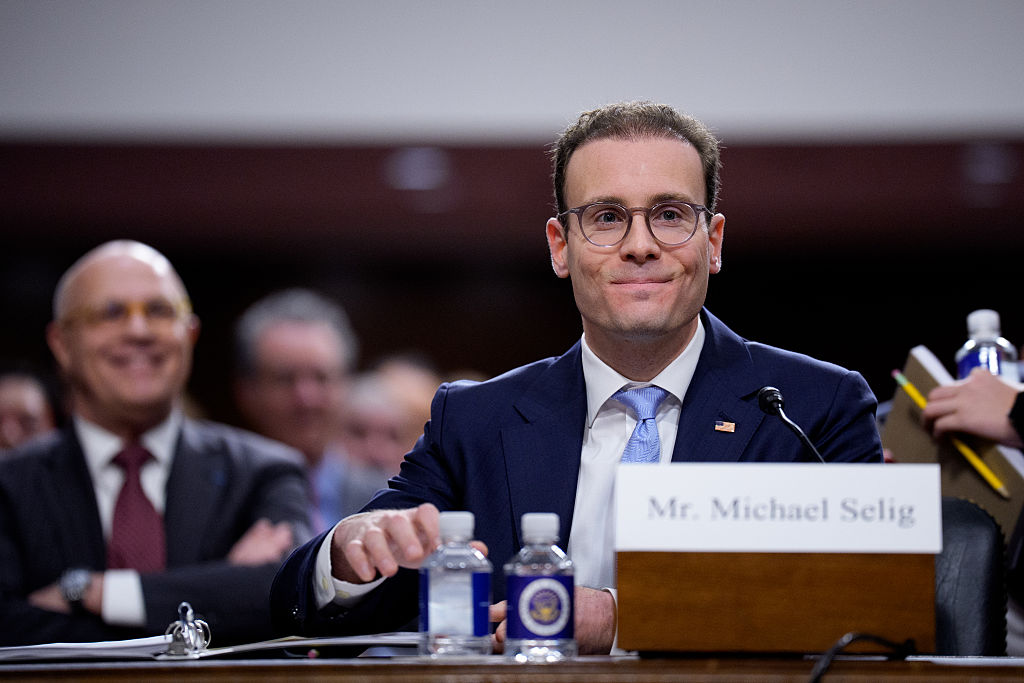
Commodity Futures Trading Commission Chair Mike Selig all but declared war on state governments this week, announcing his federal agency would oppose efforts by state attorneys general to crack down on prediction markets.
Selig has embarked on a media blitz in the past week, appearing in longform podcasts and TV interviews, the Wall Street Journal’s opinion pages and in a video on X with the same message: the CFTC is responsible for regulating prediction markets, not the states.
“To those who seek to challenge our authority in this space, let me be clear: we will see you in court,” Selig said in a Tuesday video address.
These comments mark a sharp reversal from Selig’s testimony before the Senate Agriculture Committee late last year, where the former nominee said he’d defer to the wisdom of the courts about the legal status of events contracts.
A light-touch CFTC will be a powerful ally for upstart prediction market companies like Polymarket and Kalshi. It will fall to the courts to decide whether Selig’s interpretation of the law is right.
Throwback. Democrats on the Senate Agriculture Committee pressed Selig for his views on prediction markets back in November. Several, including Sens. Tina Smith (Minn.), and Cory Booker (N.J.), expressed reservations about events contracts that resemble sports betting, which is otherwise not legalized on a national level.
Selig replied that he would “intend to always adhere to the law and follow what judicial decisions tell me to follow.”
This week brought a different tune. Prediction markets, Selig said on X, provide “useful functions for society by allowing everyday Americans to hedge commercial risks” by predicting the weather and energy prices.
Blowback. Senate Democrats were already skeptical heading into this week, writing in a letter to Selig on Feb. 13 that his recent remarks seemed “at odds with the intent of the Commodity Exchange Act.”
Tuesday marked an escalation from state-level Republicans. Utah Gov. Spencer Cox told Selig on X that “these prediction markets you are breathlessly defending are gambling—pure and simple.”
Sen. Catherine Cortez Masto (D-Nev.) said in a statement the CFTC is “willing to trample on Nevada and other states’ rights to regulate gaming. The vast majority of event contracts help facilitate sports wagering.”
Don’t expect much activity from Congress here in the near term. The Senate Agriculture and Banking Committees have had their hands full trying to implement the crypto sector’s legislative agenda via market structure legislation. There’s not much appetite to touch events contracts.