


January 2, 2026



PRESENTED BY

THE TOP
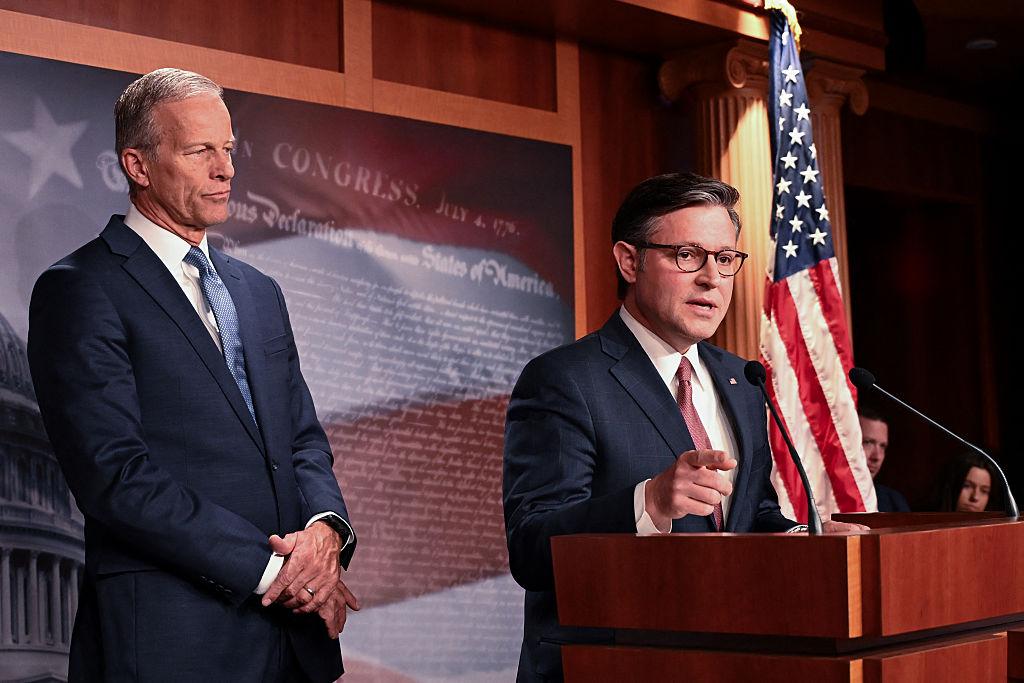
The 6 things Thune and Johnson have to watch out for
Happy Friday morning.
Today is the last day of Congress’ winter break. So please enjoy it while you still can.
It’s been more than two weeks since the House and Senate have been in session. Your holiday fog has probably — hopefully — lifted by now, so we want to refocus your attention on Speaker Mike Johnson and Senate Majority Leader John Thune, the two key GOP figures heading into the midterms. With 43 weeks until Election Day, Johnson and Thune are facing a daunting legislative and political climate.
Government funding. A partial government shutdown is just 28 days away if Congress can’t come together on an FY2026 funding deal.
Thune is struggling mightily to pass a five-bill minibus through the Senate, made more complicated by President Donald Trump’s apparent war on Colorado.
Meanwhile, Johnson needs to contend with conservatives who will inevitably be unhappy with the emerging topline funding levels from House and Senate appropriators. These will be closer to the Senate’s numbers than the House GOP’s party-line bills.
In our conversations over the past week or so, much of the intense internal GOP anger with Johnson seems to have subsided — for now. Members really needed a break at the end of December. But Johnson — a “Louisianan of the Year” finalist — needs to tread carefully. Yes, his job is hard. We’ll also note that House Republicans are rarely rational political actors.
House Republican leaders seem to think that they’ll be able to put some FY2026 spending bills on the floor next week. We remain skeptical on this. But if GOP leaders are able to get that done, it would show forward progress — something that rank-and-file members have demanded.
Retirements, primaries and more. When the House returns next week, the GOP’s already razor-thin majority will immediately shrink. Rep. Marjorie Taylor Greene (R-Ga.) is leaving Congress Jan. 5. Johnson’s majority will then be 219-213, a two-vote cushion (Remember that tie House votes fail.)
The House GOP leadership is watching carefully to see if Reps. Elise Stefanik (R-N.Y.), Cory Mills (R-Fla.) or Don Bacon (R-Neb.) leave before their terms are up. Stefanik and Bacon are retiring, while Mills has had a lengthy list of ethics and legal issues.
Retirements are less of an issue in the Senate, though Sen. Cynthia Lummis’ (R-Wyo.) announcement was a surprise.
The more acute concern for Thune — and Senate Minority Leader Chuck Schumer, for that matter — are the divisive primaries brewing in various states.
In Texas, GOP Sen. John Cornyn is locked in a three-way March primary that’s likely headed to a runoff. A Thune-aligned super PAC has spent tens of millions of dollars to prop up Cornyn.
Republicans also have no idea who will emerge from the crowded Georgia primary to take on Democratic Sen. Jon Ossoff. The Atlanta Journal-Constitution says this year could “again reshape Georgia’s political identity.”
The Trump campaign machine is humming. MAGA Inc., a Trump super PAC, raised more than $102 million in the last five months.
Trump management. One of the most challenging aspects of Johnson and Thune’s job is managing up — meaning making sure Trump is acting within some bounds of normalcy. They don’t have much control over this, of course.
But a looming Supreme Court decision on Trump’s authority to impose tariffs could give the leaders a bit more control than they’d like. A ruling against Trump would force the GOP-run Congress to take a series of uncomfortable votes on what has been a key tenet of Trump’s economic policies.
Democrats have been using Trump’s tariff regime to hammer their message on affordability and the rising cost of living.
Thune and Johnson are also facing calls from some Republicans to more aggressively tackle the affordability issue with actual legislation this year, rather than just messaging around the One Big Beautiful Bill Act.
Obamacare. Before the recess, House Republican leaders were befuddled about the media coverage of the expiring enhanced Obamacare premium subsidies. Republicans repeatedly claimed that, despite controlling all of the government, this was Democrats’ problem.
This will come to a head in the coming weeks now that Congress has gone over the Jan. 1 Obamacare cliff. There will be tremendous pressure on every side, as we laid out in Thursday’s AM edition.
Trump is, again, calling on Congress to set up a program that would send money directly to consumers instead of “fat cat insurance companies.” This would be a massive undertaking for Congress. But Trump has been consistent here, even if his focus is a bit fleeting.
FISA. Lawmakers need to start thinking about the April 20 expiration of FISA’s Section 702. Section 702 allows the government agencies to conduct warrantless surveillance of non-Americans overseas.
Congress has struggled with renewing this provision over the years. The last time this provision came up for a vote was April 2024, with 88 House Republicans voting no. This will be incredibly tricky with Johnson’s tight margins and House Democrats not in a terribly cooperative mood.
Venezuela: Tensions continue to ratchet up between the United States and Venezuelan President Nicolás Maduro’s regime.
Venezuelan officials have recently detained several Americans, while U.S. forces persist with deadly attacks against alleged “narco terrorists.” There was also a CIA drone strike on a Venezuelan port facility.
As the buildup of U.S. forces in the region grows, Congress may be forced to weigh in on this issue.
— Jake Sherman, Andrew Desiderio and John Bresnahan


DEFENSE
Crow leans into national limelight amid Trump ire
President Donald Trump called for Rep. Jason Crow’s (D-Colo.) execution over a video imploring service members to refuse illegal orders. Crow says he’d do it again in a heartbeat.
No stranger to the spotlight — he was a manager for Trump’s first impeachment — Crow said he’s received “hundreds” of death threats in response to the president’s remarks, while his district office in Aurora, Colo. got a bomb threat. But Crow says he’d “absolutely make the same decision” to do the video alongside five other Democratic lawmakers again.
“I don’t back away from the fight. I go to where the fight is,” Crow told us. “[This administration is] violating the law, they’re ignoring the law, they’re ignoring Congress, and I simply will not put up with it.”
A disproportionate amount of attention in the aftermath of the video has gone to the two Democratic senators involved — Mark Kelly (Ariz.) and Elissa Slotkin (Mich.). The Pentagon has formally launched a “command investigation” into the Arizona Democrat, a retired Navy captain and former astronaut.
But the episode has also raised the national visibility of the four House Democrats featured: Reps. Chrissy Houlahan (Pa.), Chris Deluzio (Pa.), Maggie Goodlander (N.H.) and Crow.
It’s unclear where the Trump administration’s vow for FBI interviews of the lawmakers stands. None of the offices told us they’d been interviewed since the mid-November pledge sparked a political furor.
Attorneys for Kelly on Dec. 18 demanded details from Defense Secretary Pete Hegseth after the DOD “escalated” its investigation, an intensification that prompted bipartisan unease in Congress.
Crow, who first came to Congress in the 2018 blue wave after dispatching a Republican incumbent, acknowledged concern that government intimidation and threats might scare off some interested in public service.
“That’s certainly what Donald Trump intends,” Crow said, adding that fact “makes it so much more important” that those, like him, “stand firm.”
“Fear is contagious, but so is courage, and we have to show our willingness to do our duty,” Crow said. “And that example, we hope, will inspire others to step up and do the same.”
Crow is trying to turn those words into action, recruiting national security veterans to run for Congress. Crow is the candidate recruitment co-chair for the DCCC.
Crow said he’s been proud to help Houlahan “mentor and support” the Hellcats, a group of female, first-time candidates with national security cred — and recently made trips to New Hampshire in support of Maura Sullivan and Arizona to campaign with JoAnna Mendoza.
The broader national visibility that comes from Trump’s focus is “just something that happens — that’s not the intent, that’s not the purpose,” Crow said, but he won’t change his approach.
Asked if he’d want to be tapped for the Senate if Sen. Michael Bennet (D-Colo.) wins the gubernatorial election, Crow didn’t say no: “I’m going to serve in the best way that I can — whatever that looks like.”
“Right now it is a no-fail mission for us to retake the House in the midterms,” Crow said. “I’m going to run around the country to find those folks, to support them, to mentor them, and to win. And we’ll see where that leads after that.”
— Anthony Adragna


Tech: What’s next for kids and privacy
The House Energy and Commerce Committee has a busy winter ahead when it comes to consumer protection online.
First, there are the bills designed to protect young people online, which are heading for a full committee markup even as the proposals continue to evolve. But privacy policies that would also address adults’ data are coming into focus too.
Here’s what’s next — and what the panel still has to sort out.
{if (profile.vars.Memberful_punchbowlnews_Premium_Policy_Tech_I_122089 == true || profile.vars.Memberful_punchbowlnews_Plan_Premium_Policy_Tech_I_122089 == true || profile.vars.Memberful_punchbowlnews_Premium_Policy_Tech_I_122100 == true || profile.vars.Memberful_punchbowlnews_Plan_Premium_Policy_Tech_I_122100 == true || profile.vars.Memberful_punchbowlnews_Premium_Policy_Tech_II_122090 == true || profile.vars.Memberful_punchbowlnews_Plan_Premium_Policy_Tech_II_122090 == true || profile.vars.Memberful_punchbowlnews_Premium_Policy_Tech_II_122101 == true || profile.vars.Memberful_punchbowlnews_Plan_Premium_Policy_Tech_II_122101 == true || profile.vars.Memberful_punchbowlnews_Premium_Policy_Tech_III_122091 == true || profile.vars.Memberful_punchbowlnews_Plan_Premium_Policy_Tech_III_122091 == true || profile.vars.Memberful_punchbowlnews_Premium_Policy_Tech_III_122102 == true || profile.vars.Memberful_punchbowlnews_Plan_Premium_Policy_Tech_III_122102 == true || profile.vars.Memberful_punchbowlnews_Premium_Portal_Tech_124422 == true || profile.vars.Memberful_punchbowlnews_Plan_Premium_Portal_Tech_124422 == true || profile.vars.Memberful_punchbowlnews_Plan_Punchbowl_News_Premium_Portal_The_Vault_Tech_121727 == true || profile.vars.Memberful_punchbowlnews_Plan_Punchbowl_News_Premium_Portal_Tech_124422 == true || profile.vars.Memberful_punchbowlnews_Premium_Policy_Tech_14_Day_Trial_122099 == true || profile.vars.Memberful_punchbowlnews_Plan_Premium_Policy_Tech_14_Day_Trial_122099 == true || profile.vars.Memberful_punchbowlnews_Premium_Policy_Tech_14_Day_Trial_122088 == true || profile.vars.Memberful_punchbowlnews_Plan_Premium_Policy_Tech_14_Day_Trial_122088 == true || profile.vars.Memberful_punchbowlnews_Plan_Punchbowl_News_Vault_Tech_126214 == true || profile.vars.Memberful_punchbowlnews_Plan_Punchbowl_News_Vault_Tech_126263 == true || profile.vars.Memberful_punchbowlnews_Plan_Punchbowl_News_Premium_Portal_The_Vault_Tech_Defense_138992 == true || profile.vars.Memberful_punchbowlnews_Plan_Punchbowl_News_Vault_Tech_Defense_136971 == true || profile.vars.Memberful_punchbowlnews_Plan_Punchbowl_News_Vault_Tech_Defense_138990 == true || profile.vars.Memberful_punchbowlnews_Plan_Punchbowl_News_Defense_Tech_136972 == true || profile.vars.Memberful_punchbowlnews_Plan_Punchbowl_News_Defense_Tech_138988 == true || profile.vars.Memberful_punchbowlnews_All_Access_Pass == true || profile.vars.Memberful_punchbowlnews_Plan_All_Access_Pass == true || profile.vars.Memberful_punchbowlnews_Plan_AllAccess_Plan_69511 == true)}
Kids and teens. The package of nearly 20 bills received a hearing and a subcommittee markup, both in December. The full panel now gets to put its mark on the legislation.
Rep. Gus Bilirakis (R-Fla.), who’s been shepherding the package as chair of the Commerce subcommittee, said the full panel markup will come later this month.
There’s still work to do before that, however. Bilirakis and Rep. Kathy Castor (D-Fla.) have pledged to return to a version of the Kids Online Safety Act that Democrats can support.
Democrats oppose the latest version of the high-profile bill, which would regulate social media design, because they say it imposes too little responsibility on platforms. The problem is that Democrats’ asks are mostly red lines for House Republican leadership.
House Energy and Commerce Committee Chair Brett Guthrie (R-Ky.) also wants to reconcile two different bills attempting to keep kids away from mature content on smartphones. One would verify users’ ages; the other relies more on parents giving their permission to kids’ app usage.
“I’m optimistic we can get there,” said Rep. Jay Obernolte (R-Calif.), a panel member and former app developer who’s been working with both sets of sponsors.
Obernolte said the bills have enough overlap that panel members are just sorting through “things on the periphery” that are different.
Right before Christmas, a federal court in Texas paused the state’s ID verification law as unconstitutional.
Privacy for the rest. Members of the Republican working group on privacy for users of all ages also told us they’ll finish an initial framework in the next month or so.
A note about timing, though: The kids and teens privacy issues in the package we mentioned above are teed up to go before comprehensive data protection, according to a source familiar with the process.
One more item on the docket: Rep. Bob Latta (R-Ohio), a longtime advocate of a federal framework for autonomous vehicles, said the committee wants “to get this thing moving in January.”
— Ben Brody and Diego Areas Munhoz
{else}

{/if}
PRESENTED BY UNITEDHEALTH GROUP

“We need to meet patients where they are.” – Dr. Rohan Wagle, Cardiology
APPROPS UPDATE
How 2026 is shuffling the appropriations panels
Appropriators have a lot to prove over the next month — not only that their committees are still relevant, but also that new lawmakers should join after 2026.
Between competitive races, redistricting and retirements, this year will shake up the makeup of the spending panels. House Appropriations Chair Tom Cole (R-Okla.) is acutely aware of that, saying Congress needs to pass appropriations bills by the end of January to show lawmakers that the committee is still a plum appointment.
“It’s a very important cycle for the Appropriations Committee, as a committee, on both sides of the aisle to remain relevant,” Cole said. “If we end up with a bunch of CRs, then why have an Appropriations Committee?”
The retirements. Senate appropriators Mitch McConnell (R-Ky.), Dick Durbin (D-Ill.), Jeanne Shaheen (D-N.H.) and Gary Peters (D-Mich.) have all already announced their retirements.
McConnell’s departure will open up the top job on the Defense subcommittee and Shaheen’s retirement will let a new Democrat takeover on the Agriculture funding panel.
Down the dais in the House, Reps. Dan Newhouse (R-Wash.), Ashley Hinson (R-Iowa) and Bonnie Watson Coleman (D-N.J.) have all announced that they won’t seek another term in the House. Hinson will instead run for Senate.
More appropriators may be out the door, too. Reps. Steny Hoyer (D-Md.) and Jim Clyburn (D-S.C.), 86 and 85 respectively, could retire. Hoyer is currently the top Democrat on the Financial-Services and General Government subcommittee, while Clyburn has the top Democratic spot on the Transportation-HUD panel.
Races to watch. The biggest 2026 race to watch in terms of the appropriations committees is Senate Appropriations Committee Chair Susan Collins’ (R-Maine) reelection bid. Democrats are hoping to flip the seat. If Democrats win, Sen. Lisa Murkowski (R-Alaska) is next-in-line to lead the committee in terms of seniority.
Sen. Jon Ossoff (D-Ga.) is also facing a competitive race to keep his Senate seat. Ossoff is currently the top Democrat on the Military-Construction-Veterans’ Affairs subcommittee.
Redistricting reverberations. In the House, Rep. Ken Calvert (R-Calif.), the Defense cardinal, has a tough primary against Rep. Young Kim (R-Calif.) after California’s redistricting drew them into the same district.
Rep. David Valadao (R-Calif.), the Legislative Branch cardinal, already had a tough race, but Democrats made his district slightly more blue in the state redraw.
Rep. Henry Cuellar’s (D-Texas) district became more red with Texas redistricting. Cuellar recently reclaimed his spot as the top Democrat on the Homeland Security subcommittee. President Donald Trump pardoned Cuellar, which allowed him to regain his appropriations post.
Rep. Marcy Kaptur (Ohio), the top Democrat on the Energy and Water subcommittee, is trying to pull off another win in a district dominated by Trump. Ohio’s new map made her seat even more red.
More appropriators may be on the chopping block, too, depending on how some states may draw their maps. It remains to be seen whether Florida Republicans will try to draw Democratic Reps. Lois Frankel and Debbie Wasserman Schultz out of their seats. Clyburn may also be a target if South Carolina ends up redrawing its map.
– Samantha Handler
THE MONEY GAME
Allred raised $3M in Q4
News: Former Rep. Colin Allred (D-Texas) raised more than $3 million in the fourth quarter of 2025. Allred ended the year with $1.7 million on hand.
Allred raised $550,000 in the 24 days since dropping his Senate bid and running for the House. Allred is running in Texas’ 33rd District and facing Rep. Julie Johnson (D-Texas) in the Democratic primary.
— Max Cohen


Presented by AstraZeneca

The 340B program is supposed to help vulnerable patients—but without strong safeguards, it’s siphoning away funds that could be used for free and charitable medicine. The 340B Rebate Model Pilot improves program integrity, preventing duplicate discounts and strengthening accountability. Urge HHS to implement the pilot today. Learn why it matters.

Crucial Capitol Hill news AM, Midday, and PM—5 times a week
Join a community of some of the most powerful people in Washington and beyond. Exclusive newsmaker events, parties, in-person and virtual briefings and more.
Subscribe to Premium
Special Projects
Explore our deep dives into the issues that matter the most today and will shape tomorrow's future, with expert reporting that goes beyond the headlines and into the heart of the Capitol.
Check it outEvery single issue of Punchbowl News published, all in one place
Visit the archive
Presented by AstraZeneca
The 340B program lacks transparency—making it hard to tell if it’s actually helping vulnerable patients. HHS can fix the problem by implementing the 340B Rebate Model Pilot, ensuring the program is transparent, compliant, and accountable. Learn more.