

December 8, 2025



PRESENTED BY

THE TOP
Two weeks left: NDAA and health care dominate the Hill
Happy Monday morning.
This is the second-to-last week in session this year for your United States Congress. The Senate returns this afternoon and the House comes back Tuesday evening. House Republican staff directors are in Boston for a retreat.
Both chambers will be focused on health care and defense policy.
With little time left in 2025, the political and policy stakes are high. The NDAA, the annual Pentagon policy bill, has passed every year for the last 64 years, so there’s a ton of urgency on that front.
However, there’s little urgency among Republican leaders in either chamber to address the expiring Obamacare subsidies, although we’re seeing signs of life from rank-and-file GOP lawmakers. Let’s start there.
News: GOP senators who represent dueling ideological factions in the Republican Conference are teaming up on a plan to extend the Obamacare subsidies for two years with income caps and other reforms.
The new proposal from Republican Sens. Bernie Moreno (Ohio) and Susan Collins (Maine), outlined in this one-pager, would cap income eligibility and eliminate zero-premium plans by requiring a $25 minimum monthly payment.
Under the Moreno-led plan, the full tax credit would be available for households with income of up to 400% of the poverty level, and then gradually phase out so that households making over $200,000 would no longer benefit.
It comes as the Senate is set to vote this week — likely Thursday — on Democratic legislation that extends the tax credits for three years, a promise Senate Majority Leader John Thune made to end the recent government shutdown. This won’t get anywhere close to 60 votes.
But Senate Republicans aren’t expected to hold a separate vote on a unified proposal of their own, a dynamic that’s fueling some GOP frustration with Thune, as we reported Friday.
Strange pair. Moreno has been in office for less than a year and represents the newer generation of GOP senators who are more aligned with the MAGA movement. Collins — who’s up for reelection next year — is a moderate dealmaker who didn’t vote for President Donald Trump and frequently breaks with him.
Moreno and Collins joining forces here reflects the broader concern among Republicans about the political impact of the year-end ACA subsidy cliff.
Yet the reality is that there still isn’t an alternative to Democrats’ legislation that unites Republicans. And Senate GOP leaders don’t want to counter Democratic unity on a messaging bill with a vote that splinters the GOP, as this one likely would.
But many Republicans, especially those up in 2026, want to be able to vote for something that’s not the three-year clean extension Democrats are pushing.
Other possible GOP alternatives include Senate HELP Committee Chair Bill Cassidy’s (R-La.) bid to expand HSA options. There’s also Sen. Rick Scott’s (R-Fla.) legislation, which mirrors what Trump has pitched. Scott’s bill has some momentum in the House, where Republican Study Committee Chair Rep. August Pfluger (R-Texas) is backing it.
Thune and other top Senate Republicans maintain that they don’t view this week as the deadline to offer a proposal that could get 60 votes — leaving open the possibility, however slim, of averting the cliff.
Speaker Mike Johnson told us Thursday that he plans to settle on a health care bill this week, with the key days being today and tomorrow. It’s safe to say that whatever Johnson puts on the floor won’t become law. But the big question for Johnson is whether his bill will include some sort of extension of the Obamacare subsidies.
Even if it does, that may not be enough to stop House GOP moderates from trying to force a compromise through the chamber with a discharge petition. The House Republicans seeking an ACA patch want it pretty badly. They’re pursuing a bunch of options in the desperate hope that something gets traction. A discharge petition would be a time-consuming long shot.
Now onto the NDAA. Leading lawmakers unveiled the compromise version of the annual defense policy bill that would authorize more than $900 billion in national security spending, repeal two decades-old war powers laws and give servicemembers a 3.8% pay bump.
The spending topline, which became a late-in-the-game issue for defense authorizers as they worked with appropriators to find consensus, represents an $8 billion increase over what the White House requested.
The release of the NDAA came after days of last-minute negotiations as lawmakers scrambled to reach an agreement on the fate of a massive housing supply bill that senators added to their version of the measure. The ROAD to Housing Act was ultimately left out of the final text amid pushback from House Financial Services Committee Chair French Hill (R-Ark.).
Other areas of disagreement centered on a proposed expansion of in vitro fertilization coverage for servicemembers and their families. Though the provision was included in both the House and Senate versions of the NDAA, it ran into resistance from Johnson and was left out of the final legislation.
Beyond that, the bill notably included a bicameral push to repeal the 2002 Iraq War and 1991 Gulf War AUMFs. Both the House and Senate versions of the NDAA contained repeal language.
But the final bill left out military base renaming provisions that also saw bipartisan support. The language aimed to thwart the administration’s attempts to rename certain installations after Confederate leaders. Trump vetoed the FY2021 NDAA due in part to its base-naming measures, though Congress overrode the veto.
The House needs to take the NDAA up this week for the Senate to act the week of Dec. 15. The House Rules Committee will meet on the bill Tuesday afternoon.
— Andrew Desiderio, Jake Sherman, Briana Reilly, Anthony Adragna and Laura Weiss


DEFENSE
Trump’s NatSec strategy splits defense hawks
SIMI VALLEY, Calif. — President Donald Trump’s newly unveiled national security plan divided leading defense lawmakers and sparked questions about how the United States will project power abroad.
The National Security Strategy seeks to refocus American foreign policy on the Western Hemisphere while downplaying the value of traditional alliances and offering muted criticism of Russia.
Here’s what Defense Secretary Pete Hegseth said during a speech in California Saturday at the Reagan National Defense Forum:
Congressional react. But it remains to be seen how the strategy will translate into a potential redistribution of U.S. resources, personnel and firepower throughout the world – especially to support a buildup of military assets in the Western Hemisphere.
“We need to see more information,” Sen. Deb Fischer (R-Neb.) told us at the forum. “But I think it shows a realization, as the president talked about the Trump corollary to the Monroe Doctrine, that this is our neighborhood.”
While Rep. Don Bacon (R-Neb.) applauded the emphasis on the Western Hemisphere, he said the strategy amounts to a 1930s-era document and “an isolationist type of foreign policy.”
“They’re more interested in criticizing Europe than Russia,” he said.
Rep. Adam Smith (Wash.), top Democrat on the House Armed Services Committee, said the strategy portends a return to dividing the world into “spheres of influence.” He said it wasn’t clear what “values” underpin the document.
Reconciliation redux. Top Trump administration officials at the forum also pledged defense spending will rise in the coming years, but they hinted those increases could come in the form of another reconciliation package.
Office of Management and Budget Director Russ Vought lauded the $150 billion DOD spending package included in the One Big Beautiful Bill Act as a “paradigm shift” for military funding. The GOP-only approach bypassed the 60-vote threshold in the Senate and avoided the “ratcheting up of nondefense spending” that usually comes with proposed military budget increases during the appropriations process, Vought said.
The OMB chief was responding to a Wall Street Journal editorial from Sen. Mitch McConnell (Ky.), the top Republican on the Senate defense funding panel. McConnell made the case for bolstering base DOD spending and argued relying on OBBB to increase investments in shipbuilding and other multiyear efforts “left critical programs on the cutting-room floor.”
But Vought promised defense dollars will “continue to grow.” Hegseth, after his keynote address, said he anticipates military spending as a percentage of GDP “is going up.”
“There will not be a hole there,” Vought said, adding officials “have not” made a decision about a second reconciliation bill.
House Defense Appropriations Subcommittee Chair Ken Calvert (R-Calif.) acknowledged in a Saturday interview that another reconciliation bill would be a heavy lift.
“I can count. It was hard last time. It’ll be harder next time,” he told us. “And they don’t have all the little sugar that goes on the side.”
— Briana Reilly
Be the first to get important scoops and policy developments when we launch our Defense vertical on Jan. 4. Join our email list today.


Hill staffers, including Dems, see Thune as most effective leader
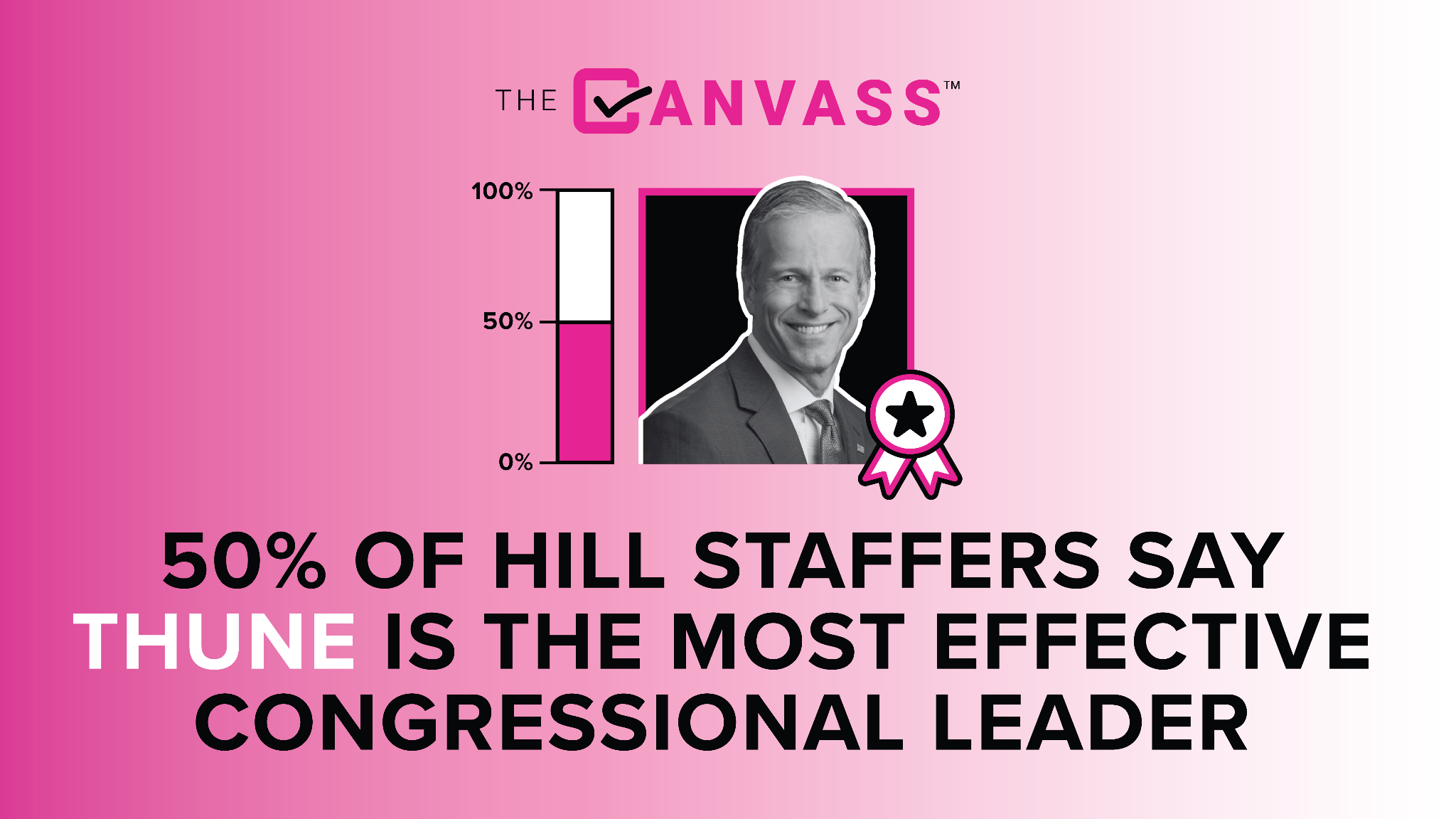
A majority of senior Democratic staffers on Capitol Hill said Senate Majority Leader John Thune is the most effective congressional leader, according to our latest Canvass survey.
When asked which of the “Big Four” is the most effective, 54% of senior Democratic aides chose Thune. Around a quarter — 27% — said House Minority Leader Hakeem Jeffries, while 13% said Speaker Mike Johnson.
Just 6% of senior Democratic staffers chose Senate Minority Leader Chuck Schumer.
Among all senior aides surveyed, 50% said Thune is the most effective, followed by 33% for Johnson, 14% for Jeffries and 3% for Schumer.
These results are a reflection of multiple different dynamics on the Hill, including many Democrats’ belief that Schumer hasn’t been an effective opposition leader in the Trump era.
It also shouldn’t be terribly shocking that Thune came out on top, especially when you consider how successful he’s been supporting President Donald Trump and his agenda.
Thune has been able to keep his conference together on the big-ticket items, from reconciliation to Cabinet nominees, while resisting the president’s nagging over the filibuster and blue slips. Thune also led a rules-change effort that steamrolled Democrats’ slow-walking of Trump’s other nominees.
While Thune is going through a rough patch right now on appropriations and health care, that pales in comparison to the near-constant chaos of Johnson’s speakership. And unlike Johnson, the South Dakota Republican isn’t nearly as dependent on Trump for his own success.
On Schumer. The New York Democrat’s popularity has plummeted this year, particularly among progressives, after he helped provide the votes for a GOP-authored stopgap funding bill in March.
That sentiment was accelerated last month when eight Democratic senators backed a bipartisan deal to end the government shutdown even though Schumer voted against it.
Schumer has become something of a lightning-rod figure in Democratic primaries, with several top candidates saying they won’t support him for Democratic leader if they’re elected to the Senate.
Despite the anger on the left, Schumer’s job isn’t in any real danger, as we’ve reported. It’s also worth noting that Schumer helped engineer the passage of landmark bipartisan legislation when he served as majority leader during the Biden administration — something Schumer’s allies say proves his effectiveness.
Want to take part in The Canvass? Our survey provides anonymous monthly insights from top Capitol Hill staffers and K Street leaders on key issues Washington is dealing with. Sign up here if you work on K Street. Click here to sign up if you’re a senior congressional staffer.
— Andrew Desiderio
PRESENTED BY WELLS FARGO

Wells Fargo has donated over $2 billion to strengthen local communities over the last 5 years. See how.
THE MIDTERMS
What we’re watching
Today marks the start of a massively important week for the midterms.
Texas. Texas’ candidate filing period closes Monday at 6 p.m. CT. There is still a ton of uncertainty, mostly around Democratic fields, so let’s start there.
Rep. Jasmine Crockett (D-Texas) has said she’ll announce today whether she is running for House or Senate. Many Democrats expect her to run for Senate, a move that almost guarantees the primary will extend to a May runoff. Former Democratic Rep. Colin Allred (Texas) and state Rep. James Talarico are already running.
But if Crockett doesn’t blow up the Senate race, she will upend the Dallas-area congressional primaries. If Crockett runs statewide, Rep. Marc Veasey (D-Texas) plans to file for the new version of Crockett’s district. And Rep. Julie Johnson (D-Texas) is set to file for the new version of Veasey’s seat. Johnson was drawn out of her seat in the recent redistricting.
If Crockett files for reelection to the House, expect a high-stakes game of musical chairs among Democrats.
Meanwhile, Republicans are no closer to solving a primary fiasco of their own. GOP leaders and their allies spent months trying first to boost incumbent Sen. John Cornyn over Texas Attorney General Ken Paxton, and then to avoid a three-way primary with Rep. Wesley Hunt (R-Texas).
Nothing is final until this evening but it seems likely that Republicans failed to convince Hunt not to run for the Senate.
Indiana. State Senate Republicans will convene Monday to consider the state House’s redistricting proposal. Indiana State Senate President Pro Tempore Rod Bray will have to decide whether to put it on the floor for a vote, which would likely come later in the week.
This is a rapidly changing situation, but there is a sense of optimism among some GOP operatives that the state Senate could fold and accept the map.
SCOTUS. The Supreme Court will hear oral arguments Tuesday on NRSC v. FEC, a campaign-finance case that could weaken coordination limits between party committees and campaigns.
This case is extremely wonky but a big deal. It could save both parties millions of dollars in TV advertising costs and basically let groups – like the NRSC and DCCC – coordinate freely with their candidates’ campaigns.
Missouri. The liberal group gathering signatures to freeze Missouri’s new congressional map must submit its petitions by Thursday. They need to present more than 100,000 signatures from registered voters among six of the eight congressional districts.
The campaign plans to submit far more, knowing many will be deemed invalid. If successful, the group could save Rep. Emanuel Cleaver (D-Mo.) in 2026.
– Ally Mutnick
THE CAMPAIGN
News: The New Democrat Coalition Action Fund is weighing in on four House primaries in top flip opportunities. The group is backing Jonathan Nez in Arizona’s 2nd District, Jasmeet Bains in California’s 22nd District, Sarah Trone Garriott in Iowa’s 3rd District and former Rep. Ben McAdams (D-Utah) in Utah’s 1st District.
More endorsement news: VoteVets is backing Democrat Ammar Campa-Najjar’s bid in California’s 48th District. Campa-Najjar, a Navy Reserve officer, has run for Congress multiple times in the past.
— Max Cohen



Enter a new era of Punchbowl News with exclusive merch from our swag store. From t-shirts and quarter-zips to mugs, hats and even pickleball paddles, we’ve got you covered.

Crucial Capitol Hill news AM, Midday, and PM—5 times a week
Join a community of some of the most powerful people in Washington and beyond. Exclusive newsmaker events, parties, in-person and virtual briefings and more.
Subscribe to Premium
Special Projects
Explore our deep dives into the issues that matter the most today and will shape tomorrow's future, with expert reporting that goes beyond the headlines and into the heart of the Capitol.
Check it outEvery single issue of Punchbowl News published, all in one place
Visit the archive
Go deeper with a Premium+ membership to Defense, Tech, Vault OR all three. Access monthly briefings with reporters, paywalled content, breaking news texts in your coverage area and more, bringing you closer to the action.