


February 5, 2026


PRESENTED BY

THE TOP
Republicans’ political crunch over affordability
Happy Thursday morning.
Vulnerable Republicans have a big political problem on their hands.
The bipartisan Senate negotiations to revive enhanced Obamacare subsidies are all but dead, leaving health care costs skyrocketing for millions of Americans. At-risk GOP lawmakers must now wage a new fight, figuring out if — and how — they can force their party to take up legislation to help Americans dealing with rising costs before the midterm elections.
“It’s necessary to do everything on affordability across the board,” Rep. Brian Fitzpatrick (R-Pa.) told us. “Health care is the most significant piece of it. There’s also housing, there’s food, there’s fuel, there’s childcare, there’s elder care, there’s transportation. It’s all unaffordable right now.”
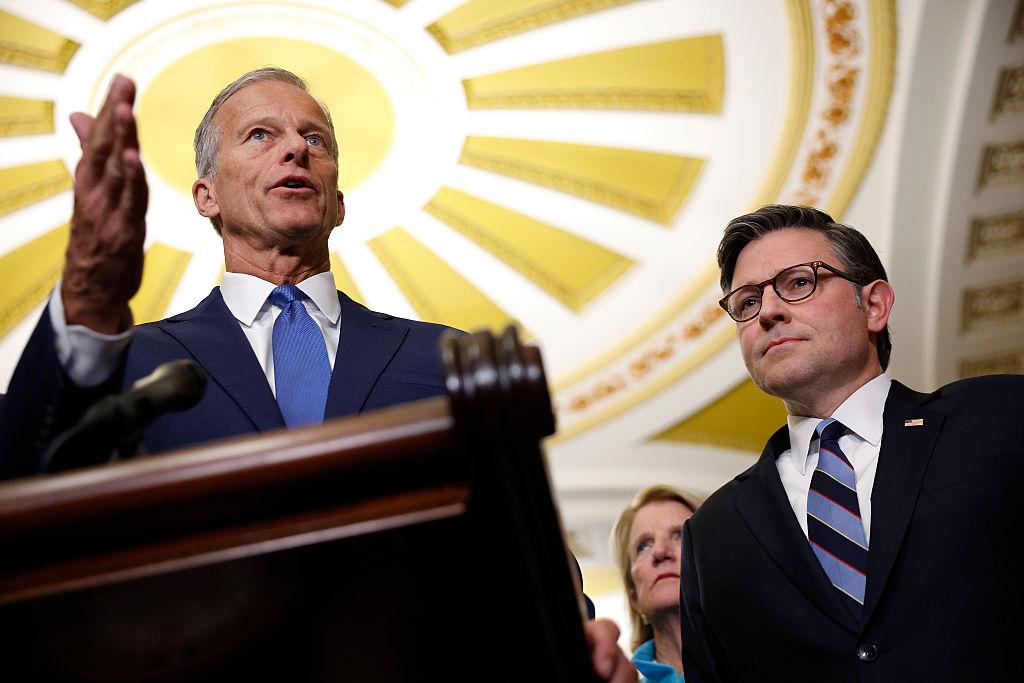
Yet Republicans face numerous hurdles in doing this. Speaker Mike Johnson has a razor-thin margin and faces near-constant revolts from his right flank. The speaker wanted to spend the early part of 2026 on health care, but intervening events have diverted his focus.
The Senate is now consumed with a funding standoff over ICE, and there are a host of other issues that Senate Majority Leader John Thune wants to take up — housing, a farm bill, a highway bill, crypto and more.
There’s deep skepticism among Republicans about getting another reconciliation bill done this year, which makes it much harder to see any health care bills passing. Bipartisan efforts on housing and permitting bills — both top priorities for vulnerable House Republicans — are facing problems.
The appetite for bipartisan dealmaking will shrink even more as the midterms grow closer. Yet as President Donald Trump’s poll numbers tank and the economy wobbles, at-risk Republicans have no choice but to try whatever they can to push legislative fixes.
“The centrists — we’re fighters,” Fitzpatrick said. “We don’t back down. We’re not afraid to go against the grain, go against leadership. So that’s what we’re going to do this year.”
Democrats think these GOP members and senators had their chance and missed it.
“[Republican leaders] have left their members out to dry,” House Minority Whip Katherine Clark said. “The Republicans have shown they simply don’t care.”
Obamacare fallout. Republicans are clear-eyed that the fallout from the Obamacare cliff, which saw boosted credits expire on Jan. 1, will be a key midterm issue, maybe even the most important one.
“If it doesn’t come together, then both sides will probably decide how they’re going to use it politically,” Thune said of Obamacare talks. “But I’ve always felt like, at least at the leadership level, that’s the Democrats’ ultimate objective.”
In another sign of how potent the issue is, some vulnerable Republicans are vowing to keep up their efforts despite the slim chances of success.
“It’s unfortunate that it was set up to expire in 2025, but this is an issue that I’ll keep fighting for and working on because it’s important,” said Ohio Republican Sen. Jon Husted, who’s up for reelection in November.
Democrats believe they have the upper hand politically. The Senate’s most vulnerable incumbent Democrat, Sen. Jon Ossoff (Ga.), is making the Obamacare fight a centerpiece of his campaign.
Ossoff told us the expiration is “a disaster for my constituents” and that he’s hearing a lot on the topic from Georgians across the state.
The message back home. Republicans in some of the country’s tightest reelection races told us that when they speak to constituents about health care, they make the point that Obamacare is a broken system that led to higher costs for them.
Yet this is a complicated message for Republicans when voters face huge premium price hikes or lose coverage.
“My well-informed constituents understand there are tremendous flaws in the [Obamacare] program,” Rep. Nick LaLota (R-N.Y.) said. “Even those who rely on it and celebrate it know that insurance companies have made record profits, denied a lot of their claims during this time. They want solutions from Washington. They know I’m fighting for solutions.”
Another New York Republican, Rep. Mike Lawler, said he talks through ways to improve the system and touts wins at the Trump administration level and in Congress, such as the House-passed GOP health care package. However, that bill has no path in the Senate.
“I tell them the truth,” Lawler said of conversations back home. “But part of this also is a recognition that Obamacare itself has not actually reduced health care costs in America, so it’s not just a function of extending the enhanced premium tax credits. It’s a function of actually fixing the system.”
Problems on top of problems. The gravity of this moment isn’t lost on endangered GOP incumbents, especially in the House. The Republicans’ biggest legislative achievement this Congress — the OBBB — remains unpopular. The job market is the worst in years, inflation is stubbornly high, Trump’s foreign policy moves have confused even GOP lawmakers at times, and the public’s support for the president’s hardline immigration policies — a huge GOP plus in 2024 — is cratering.
There’s lots of warning signs for Republicans: the Democratic wins in last November’s elections, the growing number of House GOP retirements, and last week’s Texas Senate stunner. They have boatloads of cash, and the redistricting battles are still playing out, so this isn’t a rerun of 2018 yet. But Democrats — and a number of Republicans — believe they’re going to win the House in nine months.
— Laura Weiss, John Bresnahan, Andrew Desiderio and Samantha Handler
ICYMI: We hosted Reps. Tony Gonzales (R-Texas) and Andrea Salinas (D-Ore.) at our Summit on Youth Mental Health Tuesday. Read all about it here. You can also watch the full video here.


FUNDING FIGHT
Democrats lay out DHS demands as both sides dig in
Senate Minority Leader Chuck Schumer and House Minority Leader Hakeem Jeffries have released their 10 demands for reforms to federal immigration enforcement — and Republicans are already pushing back. All of which doesn’t bode well for a deal on Department of Homeland Security funding.
Here’s the list. Democrats want to mandate judicial warrants for entering private property; a ban on masks; a requirement that agents identify themselves; no enforcement at medical facilities, schools, churches, courts and polling places; no racial profiling; new use-of-force standards; allowing local law enforcement to investigate “excessive force” complaints; mandatory use of body cameras; and regulation of the types of “uniforms and equipment” that the DHS uses.
“These reforms should apply to federal activity, whether funded by FY26 appropriations bills, the [One Big Beautiful Bill Act] or any other act,” Schumer and Jeffries said in their letter to Speaker Mike Johnson and Senate Majority Leader John Thune.
Schumer and Jeffries also called for the removal of Homeland Security Secretary Kristi Noem from her post, and a drawdown of federal agents in Minnesota, which has emerged as the key flashpoint in the immigration fight.
Many of these Democratic demands are non-starters for Hill Republicans, including requiring judicial warrants.
“This is not a time for political posturing,” said Sen. Katie Britt (Ala.), who’s been tapped as the lead Senate GOP negotiator. After the list was released publicly on Wednesday night, Britt slammed it as “a ridiculous Christmas list of demands for the press.”
But what Democrats are hoping for is that this list prompts negotiations with President Donald Trump. The White House anticipates having staff-level conversations with Democrats to explore whether a deal is actually possible. Although initial reactions from Republicans Wednesday night were not positive.
Chances of a deal receding. Congress’ track record on immigration policy — whether it’s border security, legalization or enforcement — is abysmal. The past few days have shown once again why.
There were signs last week of a potential opening for a bipartisan deal to rein in ICE.
After Senate Democrats threatened to block a massive FY2026 spending package, the White House agreed to split off DHS funding and pass a short-term funding patch to buy time for a renegotiation.
Trump adopted a more conciliatory posture after federal agents fatally shot Alex Pretti in Minneapolis. Republicans largely acknowledged Democrats’ concerns about ICE, saying they would discuss ways to tamp down Trump’s harsh immigration crackdown.
But just days later, lawmakers’ hopes for striking a deal have all but vanished. There’s real doubt about whether Congress can even agree to a short-term funding patch for DHS, leaving unrelated agencies in limbo.
Stalemate. House Democrats refused to provide the votes for the funding deal that Schumer negotiated with the White House. That came even as the Trump administration agreed to create a legislative path to address Democrats’ ICE demands on their two-week timeline.
Meanwhile, Trump’s MAGA allies on the Hill have urged fellow Republicans to hold firm against Democrats’ proposals and push for partisan initiatives of their own. Recent Senate GOP Conference meetings have turned more adversarial toward Democrats’ ICE push.
On Wednesday, Jeffries and Thune accused each other of not being serious about getting a deal.
Next steps. Thune told us he plans to decide today on how to address the Feb. 13 funding cliff for DHS. The majority leader needs to tee up a legislative vehicle before the Senate adjourns for the weekend in order to guarantee enough time to process a funding patch before next Thursday, when several senators are leaving town for the Munich Security Conference and other CODELs.
Senators from both parties believe a short-term stopgap for DHS can get the requisite votes, but only if enough progress has been made on bipartisan negotiations.
— Andrew Desiderio


Defense: Hawks to Pentagon — show us your list
Congressional defense hawks are clamoring to see Defense Secretary Pete Hegseth’s final list of “underperforming” military contractors. It’s a designation that will mark the Pentagon’s latest salvo in its crusade to get better results from the companies it pays to build weapons and other military tools.
“Yes, it’ll be a long list,” Rep. Ken Calvert (R-Calif.), the House’s top defense appropriator, predicted this week. “The days of underperforming and overpaying are over.”
Frustration toward the Pentagon’s major weapons makers has reached a boiling point under the Trump administration, culminating in an executive order cracking down on the defense industry. The directive, which has roiled the supplier base, gives Hegseth a Friday deadline to identify the companies that aren’t performing to his liking.
The Pentagon hasn’t said whether it will share the list publicly. There’s no requirement under the order for it to be given to Congress. Companies hit with a demerit on Friday can submit a “remediation plan,” which may mean the Hill will have to wait for that process to play out before getting a copy of the offenders list.
In interviews this week with half a dozen defense hawks, all expressed a strong desire to see the results of the Pentagon review soon. They hinted the list could inform the FY2027 budget process as Hegseth doubles down on his plans to overhaul the way the Defense Department buys military equipment.
“They’re going to have to” let Congress see the list, said Rep. Rob Wittman (R-Va.), a senior member of the House Armed Services Committee. “We need everybody to perform. So I have no problem with elevating expectations on performance, expectations on efficiency.”
There’s a bipartisan desire to extract better outcomes from the Pentagon’s suppliers.
“Defense contractors have been ripping off American taxpayers for decades,” Sen. Elizabeth Warren (D-Mass.) said. “Let’s see what happens at the end of the week and whether or not Hegseth really delivers.”
From list to legislation. Hegseth’s final product could serve as a guidepost for the next defense policy bill, some lawmakers suggested.
Sen. Deb Fischer (R-Neb.) said knowing why companies made the list could dictate congressional action in the NDAA.
“The rationale, I think, is the most important part,” Fischer said. “Why are these individual companies, these contractors, being singled out?”
Sen. Jack Reed (R.I.), the top Democrat on the Armed Services Committee, said the administration should be working with lawmakers to take “practical action to correct” production delays and cost overruns.
— Briana Reilly and Anthony Adragna

WPCF DINNER
Highlights from the 80th WPCF dinner

Lawmakers and journalists alike dressed up and celebrated on Wednesday evening during the 80th Washington Press Club Foundation dinner, honoring pioneering female reporters, the Capitol Hill press corps and the lawmakers they cover.
Highlights:
— Raising a glass with Punchbowl News during the VIP reception: Sens. Mike Rounds (R-S.D.), Ruben Gallego (D-Ariz.), Tim Sheehy (R-Mont.), Tina Smith (D-Minn.), plus dinner headliners Reps. Kat Cammack (R-Fla.) and Madeleine Dean (D-Pa.).
Also: Reps. Jake Auchincloss (D-Mass.), Nathaniel Moran (R-Texas), Mike Lawler (R-N.Y.), Derek Tran (D-Calif.), Anna Paulina Luna (R-Fla.), Dave Min (D-Calif.), John McGuire (R-Va.), Hillary Scholten (D-Mich.), Brendan Boyle (D-Pa.), Michael Baumgartner (R-Wash.), Josh Gottheimer (D-N.J.), Mike Flood (R-Neb.), Pat Ryan (D-N.Y.), Blake Moore (R-Utah), Kelly Morrison (D-Minn.), Scott Peters (D-Calif.), Ryan Mackenzie (R-Pa.), Johnny Olszewski (D-Md.) and Sarah McBride (D-Del.).
— Former Speaker Nancy Pelosi gave an address stressing the importance of the free press.
— Cammack delivered a spicy roast taking aim at Pelosi’s age and stock portfolio, and Rep. Jerry Nadler’s (D-N.Y.) wardrobe, among many other barbs. Cammack’s repeated ribbing of Rep. Nancy Mace (R-S.C.) also drew laughs. Dean’s speech was a far more mundane affair with jokes sprinkled in and a focus on the importance of the Fourth Estate.
— USA TODAY Washington Bureau Chief Susan Page received the lifetime achievement award. Melissa Nann Burke of the Detroit News won the regional reporting award.
– Max Cohen
AND THERE’S MORE
Scoop: Senate Majority PAC is filing two lawsuits Thursday in federal court against the Federal Election Commission.
The first suit argues that NRSC is improperly using “legal and building funds” to run TV ads for candidates through a joint fundraising committee.
The second suit argues that those JFCs should not get the lower ad rate offered to candidates because they are not the candidate’s campaign.
These suits could take on increasing importance as the Supreme Court weighs whether to unravel the coordination limits between campaigns and party committees. The courts are asked to decide whether party committees are eligible for the lower ad rate.
Something Special. The special primary to fill now-Gov. Mikie Sherrill’s North Jersey seat is today. The winner of the primary in this deep-blue district will almost certainly become a new member of Congress.
The top contenders: former Rep. Tom Malinowski (D-N.J.), Essex County Commissioner Brendan Gill, former Lt. Gov. Tahesha Way and Analilia Mejia, a former campaign aide to Sen. Bernie Sanders (I-Vt.).
Missouri. The Congressional Black Caucus PAC is endorsing Rep. Wesley Bell’s (D-Mo.) reelection campaign. Bell, who knocked off former Rep. Cori Bush (D-Mo.) last cycle, is facing a rematch with her this year.
Trade news. Sens. Catherine Cortez Masto (D-Nev.) and Jerry Moran (R-Kan.) will introduce a bill this morning that would require the U.S. Trade Representative to push for a working group on travel and tourism as part of the joint review of the United States–Mexico–Canada Agreement. Cortez Masto will pitch it to Treasury Secretary Scott Bessent during a Senate Banking Committee hearing this morning.
Illinois. Rep. Robin Kelly (D-Ill.) is out with a new spot in the Illinois Senate race that features footage and photos of her with former President Barack Obama.
— Max Cohen, Brendan Pedersen and Ally Mutnick


Presented by AstraZeneca

The 340B program is supposed to help vulnerable patients—but without strong safeguards, it’s siphoning away funds that could be used for free and charitable medicine. The 340B Rebate Model Pilot improves program integrity, preventing duplicate discounts and strengthening accountability. Urge HHS to implement the pilot today. Learn why it matters.

Crucial Capitol Hill news AM, Midday, and PM—5 times a week
Join a community of some of the most powerful people in Washington and beyond. Exclusive newsmaker events, parties, in-person and virtual briefings and more.
Subscribe to Premium
Special Projects
Explore our deep dives into the issues that matter the most today and will shape tomorrow's future, with expert reporting that goes beyond the headlines and into the heart of the Capitol.
Check it outEvery single issue of Punchbowl News published, all in one place
Visit the archive
Presented by AstraZeneca
The 340B program lacks transparency—making it hard to tell if it’s actually helping vulnerable patients. HHS can fix the problem by implementing the 340B Rebate Model Pilot, ensuring the program is transparent, compliant, and accountable. Learn more.