


March 19, 2026



PRESENTED BY

THE TOP
Congress won’t be able to avoid the Iran war much longer
Happy Thursday morning.
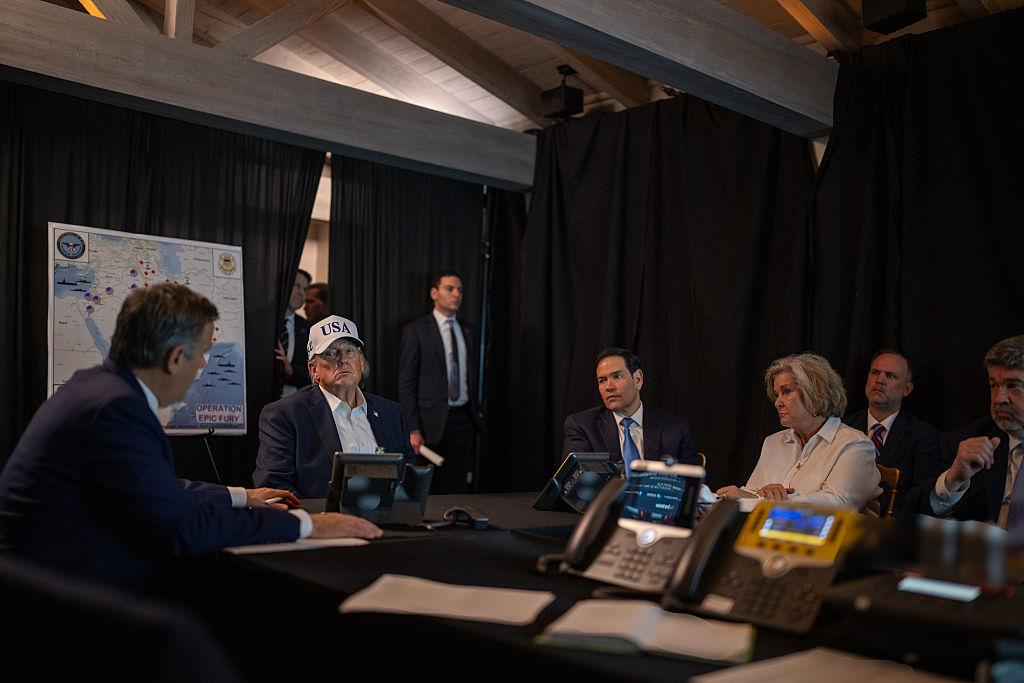
Congress has sat firmly on the sidelines as President Donald Trump wages an increasingly deadly war on Iran. GOP leaders and rank-and-file lawmakers have repeatedly voted against efforts to rein in Trump’s war powers, insisting that this would be a quick and victorious campaign.
But all that may be about to change.
With NATO and other U.S. allies refusing to supply warships to guard the vital Strait of Hormuz, Reuters reported Wednesday night that the White House is considering deploying thousands of U.S. troops to the Middle East region. This could include the use of U.S. ground troops on the Iranian shoreline or Kharg Island, a key Iranian oil transfer facility, in order to reopen the waterway.
Such a move would be a dramatic escalation of the American military campaign against Iran, risking more U.S. casualties while adding greatly to the price tag for the operation. It would also be a huge political challenge for Trump and Hill Republicans, who have let the president have a free hand during the widening war. So far, at least 13 service members have died with another 200 wounded, although many of them have returned to duty.
Trump administration officials downplayed the Reuters report, noting that senior Trump administration officials — including Secretary of State Marco Rubio — have repeatedly said they aren’t ruling out the use of ground forces against Iran. The Pentagon has already sent the 31st Marine Expeditionary Unit, a force of around 2,200 Marines, to the region. The unit is expected to arrive by next week.
Iran’s ability to block the Strait of Hormuz — roughly 20% of the world’s oil supply moves through the passage daily — has triggered a global energy crisis and caused oil prices to soar to $114 per barrel.
Iranian missiles caused “significant damage” at a huge Qatari liquified natural gas facility on Wednesday. That Iranian barrage was in response to an earlier Israeli attack on an Iranian gas site. There were further Iranian attacks on Qatar and Saudi Arabia on Thursday, including a Red Sea facility. Natural gas prices have spiked, especially in Europe.
Trump — aware of the rising panic in global energy markets and what it means for the war — lashed out at the Israelis on Truth Social for the attack on the South Pars gas field:
Trump added that the U.S. “will massively blow up the entirety of the South Pars Gas Field at an amount of strength and power that Iran has never seen or witnessed before” if Iranian forces attack Qatar again. That would be a devastating blow to Iran, yet it would also trigger an economic earthquake far beyond the Middle East.
NATO No. Trump has been publicly furious over the refusal of Britain and other allies to send warships to join in the Iran conflict, even suggesting he may pull the United States out of NATO in response.
But the problem remains for Trump and Pentagon leaders — Iran is still able to fire missiles and drones at Israel and the Gulf States as part of an economic warfare campaign, despite the overwhelming assault from U.S. and Israeli air forces.
However, the use of ground combat forces inside Iran in order to reopen the Strait of Hormuz would be a red line for many lawmakers in both parties. Trump may be forced by necessity to come to Congress to authorize such an expedition. GOP lawmakers privately tell us this would be an “uphill fight,” although they want to see if Trump actually makes the request first.
“Secretary Rubio said ‘No, we’re not planning on boots on the ground,’” Sen. Lisa Murkowski (R-Alaska.) said. “If that has changed, if that has shifted … whether it’s the Marine Expeditionary Unit or these others that may be coming their way, if they know it, we got a pretty decent sized SCIF. They need to be talking to us about it.”
The internal debate over ground troops comes as the Washington Post reported that the Pentagon has asked the White House to request $200 billion-plus from Congress for the Iran conflict, a figure that would stun everyone on Capitol Hill and may not be politically feasible.
We reported Monday that the White House could ask for $100 billion or more for an Iran funding bill. The Pentagon may be overshooting what it actually needs. But it’s fair to say that the price tag is rising rapidly for what was once expected to be a limited operation.
As we’ve pointed out, there’s virtually no chance Democrats would back any Iran funding request at this time. Republican leaders have considered using a party-line reconciliation package as a vehicle to pass this funding. That would be a very difficult vote for vulnerable Republicans.
Also, DHS vote incoming. On the heels of a shocking Senate confirmation hearing that got tense and personal before ending in a trip to the SCIF, Sen. Markwayne Mullin’s (R-Okla.) nomination to lead the Department of Homeland Security will get a committee vote this morning.
Sen. Rand Paul (R-Ky.), who chairs the Homeland Security and Governmental Affairs Committee, will vote against Mullin. That means Mullin will need one Democrat to break ranks and back the nomination. Sen. John Fetterman (D-Pa.) said earlier this month that he’d support Mullin, though the Pennsylvania Democrat would only say Wednesday that he’s keeping an open mind and “we’ll see.”
If Mullin’s nomination advances as expected, Senate GOP leaders are eyeing floor action early next week.
DHS has been shut down for 33 days now, and there’s no resolution in sight to the standoff over ICE and Trump’s immigration crackdown.
— John Bresnahan, Briana Reilly, Laura Weiss and Jake Sherman
Next week: Join us on Wednesday, March 25, at 8:30 a.m. ET for a conversation with Rep. Brett Guthrie (R-Ky.) on the news of the day and electric grid reliability. Afterward, we’ll sit down with Jim Matheson, CEO of the National Rural Electric Cooperative Association, for a fireside chat. RSVP here!



Tech: Nvidia’s Huang says H200s will be in China in ‘weeks’
SAN JOSE, Calif. — Nvidia is back in business in China. Congress will be watching closely.
In an interview Wednesday, Nvidia CEO Jensen Huang told us the AI giant’s H200 chips will make their way into the Chinese market as early as a few “weeks.” It could take a little longer as the company has to restart its whole supply chain after both Washington and Beijing created roadblocks to selling the chips to China.
While Nvidia hasn’t heard directly from the Chinese government, businesses in China have been making purchase orders, signaling they’re authorized to receive the chips, Huang said. The U.S. government has also issued export licenses authorizing the sales, he added.
“There’s no other process that’s necessary,” Huang said.
The chips are manufactured in Taiwan. They’ll then be shipped to the United States to be checked before being sent to customers in China. Nvidia will provide the U.S. government the 25% “cut” Huang negotiated with President Donald Trump.
Blackwells. China hawks in Congress sounded the alarm earlier about the Trump administration allowing Nvidia to sell H200s to China, and they’d hoped the licensing process would slow down the sales. These hawks likely won’t be pleased about the H200 orders soon heading to China, and they’ll be even more upset about what Huang wants to do next.
Huang said that “early next year,” he’ll make the push for the U.S. government to allow Nvidia to sell its Blackwell chips to China. The Blackwell chip architecture is more advanced than the H200. Trump so far hasn’t allowed Nvidia to send those chips to China.
Huang said he’ll ask for the green light to remain competitive in China as Huawei ramps up development of its own AI chips. Huang noted that he’d make the request after Nvidia’s most advanced chips — Vera Rubin — are rolled out in the United States in the second half of the year.
“When all of the American companies have ramped up in Vera Rubin, we should start to think about making sure that Blackwell is able to go compete in the market,” Haung said.
Huang argued it’s critical that the United States remains competitive in China, the second largest AI market in the world, in order to solidify its global dominance of the AI stack. Commerce Secretary Howard Lutnick shared the view that U.S. tech should be diffused around the world during a closed-door appearance in San Jose this week, Huang said.
No Groqs in China. Huang also said that Nvidia isn’t planning on sending a version of its Groq chips to China.
Nvidia announced at its GTC conference this week that it’d incorporate chips from the Groq startup — not to be confused with xAI’s Grok model — with Nvidia’s Rubin platform to accelerate performance.
But those chips aren’t going to China, Huang said, contradicting reporting from Reuters.
The report is “totally false,” Huang said.
– Diego Areas Munhoz

THE CAMPAIGN
GOP frets SAVE Act push undermining midterm messaging
President Donald Trump believes Republicans will lose the midterm elections if the Senate doesn’t pass the SAVE America Act.
Many Senate Republicans will tell you the opposite: That Trump’s relentless focus on the long-shot legislation is sparking internecine procedural bickering that’s pushing the GOP way off-message in an election year defined by cost-of-living concerns.
“The reason people want to vote for Republicans in the midterms is obviously going to be about the economy and making sure that we are taking the steps to make life more affordable,” Senate Majority Leader John Thune told us when asked if he agrees with Trump’s assessment.
Still, Republican leaders see the core of the SAVE America Act — voter ID and proof of citizenship for federal elections — as a popular issue to highlight, and they want to use it as a cudgel against Democrats. But GOP infighting, egged on by Trump, is preventing them from capitalizing.
“We’re spending so much time talking about the procedure and the ‘how.’ And I keep wanting to bring it back to the actual policy,” a frustrated Sen. John Hoeven (R-N.D.) told us. “We win this issue ultimately because the people want it. We need to keep that in mind — however this works out.”
To that end, most Republicans believe putting Democrats on-record against the bill is a win on its own, and that they then need to turn their attention back to issues that will actually move voters. That includes resolving differences with the House over a landmark housing bill and hammering Democrats over the ongoing DHS shutdown, now in its second month.
Yet Thune took a big risk by allowing a multi-day debate over the SAVE America Act on the Senate floor, knowing that a failed vote wasn’t likely to satisfy Trump — or that an influential group of conservatives in his conference wouldn’t easily back down.
Presidential priorities. Trump and his allies aren’t interested in a messaging effort. They’re framing the SAVE America Act’s passage as an existential fight, insisting they can pick off enough Democrats to clear the 60-vote threshold if they just hold the Senate floor long enough. Meanwhile, Trump is making it harder by demanding additional provisions restricting mail-in ballots, an issue that divides Republicans.
“At some point, obviously we’ll have to draw it to a conclusion,” Thune told us. “We’ll just play it by ear in terms of when we wind it [down]. But if it looks like there’s any headway being made with Democrats, then we’ll continue to pursue that.”
Sen. Mike Lee (R-Utah) said it would be a “mistake” and politically “suicidal” for Thune to set up a doomed-to-fail procedural vote.
“We need to debate this as long as it takes to get it done,” Lee said.
— Andrew Desiderio
PRESENTED BY WALMART

Walmart is investing $1 billion in career-driven training and development programs. Learn how the retailer is supporting associates – with or without a degree.
THE AI INNOVATORS
How AI is changing education and workforce training

The latest installment in our series, The AI Innovators, launched today. In this edition, we explored how artificial intelligence is reshaping academic instruction and the workforce through innovative educational tools.
In classrooms, instructors are using AI to personalize lesson plans and handle administrative tasks. Educational institutions are also incorporating the technology into skills they teach students. And older or displaced workers are using it to gain new competitive abilities.
With these advancements in AI, policymakers are thinking of ways educators and trainers can use AI while also balancing ethical concerns associated with the technology.
The four-part series, in partnership with Google, is exploring the way AI is transforming society across different sectors, with a particular focus on health care, the economy, cybersecurity and education.
Read the full feature, and check back on The Daily Punch feed later this morning to listen to the accompanying podcast.
– Shania Shelton
AND THERE’S MORE
House Oversight Democrats on Wednesday evening walked out of a briefing from Attorney General Pam Bondi and her deputy, Todd Blanche, about the Jeffrey Epstein investigation. Democrats said Bondi wouldn’t commit to following the subpoena that Oversight Chair James Comer (R-Ky.) issued on Tuesday. The Democrats accused Bondi of holding the private briefing in an attempt to get out of testifying under oath.
Republicans accused Democrats of playing politics and said Bondi was responsive to their questions.
DHS news. Reps. Brian Fitzpatrick (R-Pa.) and Tom Suozzi (D-N.Y.) are planning to introduce a bipartisan proposal to end the Department of Homeland Security shutdown. Fitzpatrick and Suozzi’s bill would fund DHS agencies at previously agreed upon levels while setting new mandates for how ICE operates, including on body cameras, training, entering sensitive locations, on-officer identification and independent investigations.
It aims to strike a compromise on key hang-ups in the DHS standoff. The bill would prevent ICE agents from wearing masks but also crack down on doxxing. It would require judicial warrants for criminal arrests. Fitzpatrick and Suozzi will say on their new podcast, The Pod Couple, that they’re backing reforms for ICE to meet typical law enforcement standards.
Endorsement watch. The Working Families Party and Justice Democrats are endorsing state Rep. Chris Rabb in Pennsylvania’s 3rd District. Two WFP members of the Philadelphia City Council — Kendra Brooks and Nicolas O’Rourke — are also backing Rabb.
Minnesota news: Rep. Angie Craig’s (D-Minn.) Senate campaign is being backed by Democratic Reps. Rosa DeLauro (Conn.), Janelle Bynum (Ore.), Susie Lee (Nev.) and Lucy McBath (Ga.).
New coalition. Former Rep. Brad Wenstrup (R-Ohio) is heading up a new health care policy coalition called Americans for Health Excellence.
– Max Cohen, Laura Weiss and Jake Sherman


Presented by AstraZeneca

The 340B program is supposed to help vulnerable patients—but without strong safeguards, it’s siphoning away funds that could be used for free and charitable medicine. The 340B Rebate Model Pilot improves program integrity, preventing duplicate discounts and strengthening accountability. Urge HHS to implement the pilot today. Learn why it matters.

Crucial Capitol Hill news AM, Midday, and PM—5 times a week
Join a community of some of the most powerful people in Washington and beyond. Exclusive newsmaker events, parties, in-person and virtual briefings and more.
Subscribe to Premium
Special Projects
Explore our deep dives into the issues that matter the most today and will shape tomorrow's future, with expert reporting that goes beyond the headlines and into the heart of the Capitol.
Check it outEvery single issue of Punchbowl News published, all in one place
Visit the archive
Presented by AstraZeneca
The 340B program lacks transparency—making it hard to tell if it’s actually helping vulnerable patients. HHS can fix the problem by implementing the 340B Rebate Model Pilot, ensuring the program is transparent, compliant, and accountable. Learn more.