


April 30, 2026



PRESENTED BY

THE TOP
SCOTUS sets off redistricting frenzy
Happy Thursday morning.
We have the latest on FISA, funding for the Department of Homeland Security and what happened on the House floor late Wednesday night down below..
But first, let’s talk about the battle for the House majority.
Republicans and Democrats have waged an all-out redistricting war this cycle, an unprecedented and bitterly partisan fight that’s extended from coast to coast. But this is nothing compared to what’s coming in 2028.
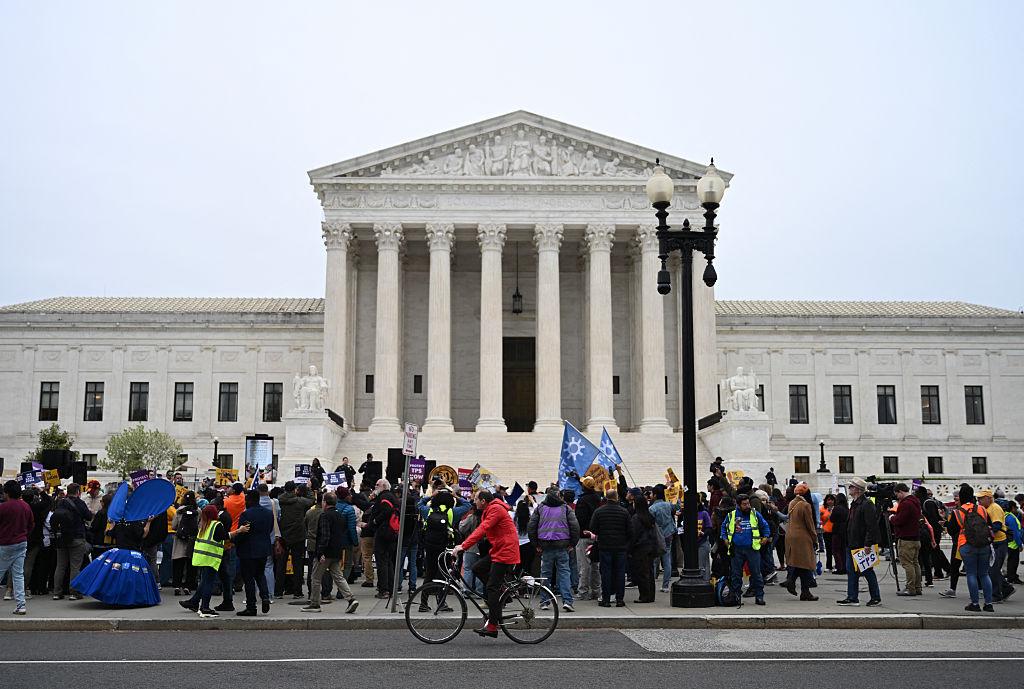
The Supreme Court’s decision on Wednesday to defang Section 2 of the Voting Rights Act will have a limited impact on this election cycle. Yet the high court has set off a maelstrom of congressional redraws for 2028.
Some states that took a pass on redistricting in 2026 — Indiana, Illinois, Maryland and Kansas — may now face increased pressure to jump in. States that have already redrawn their House maps could try again next year in a bid for even more partisan gains.
Most importantly, the SCOTUS ruling gives red states in the South a clear path to erasing minority districts, likely slashing the number of Black lawmakers representing Louisiana, Alabama, Georgia, Texas, South Carolina and Mississippi.
But here’s something else to consider — the SCOTUS bombshell may also allow blue states to spread voters currently in a single majority-minority seat across multiple districts, creating more Democratic-leaning seats overall.
Democrats were already working furiously to undo the redistricting commissions and state laws that hamstrung them this cycle. Now that task — ongoing in states like New York and Colorado — has greater urgency. And Democrats have more tools to deploy to do that.
“I don’t see what stops this downward spiral,” said Rep. Glenn Ivey (D-Md.). “This opinion feeds into it even more.”
Democrats’ game plan. Democrats were laying the groundwork to redistrict in 2028 well before Wednesday’s ruling in order to counter anticipated GOP maneuvers.
Lawmakers in New York are advancing legislation to sidestep the state’s redistricting commission that would allow the Democratic-dominated legislature to gerrymander its 26 districts. A similar effort is going on in Colorado, where the eight-member congressional delegation is evenly split. Democrats have also indicated they may try to do away with New Jersey’s commission.
Democrats can attempt to redistrict more seats next year if they flip statehouses this fall and gain full control in states like Pennsylvania and Minnesota.
As devastating as the SCOTUS ruling is for Democrats in the South — it may mean a handful of seats for Republicans this cycle and many more in 2028 — there are other opportunities elsewhere.
In big blue states like New York and New Jersey, mapmakers have honored the VRA by packing Black and Hispanic voters into a handful of districts. But if the VRA is neutered, those voters could be dispersed for partisan gain.
“There’s not just southern states, there’s northern states. We can do it too. We haven’t done it. We don’t want to do it,” Rep. Gregory Meeks (D-N.Y.) said. “But if they want to do it, OK, we’re going to do it, too.”
Several states, including New York and California, have state-level voting rights acts that protect majority-minority districts. This SCOTUS ruling could mean that state-level VRAs no longer apply because they conflict with a new federal precedent.
The Congressional Black Caucus discussed the implications of the Louisiana decision and how to fight back during its weekly lunch Wednesday, shortly after the ruling came down.
“I’d take 52 seats from California. I sure would. And 17 seats from Illinois,” Rep. Terri Sewell (D-Ala.) said. That would mean no Republican representation in either state.
This CBC posture is a big deal. There’s often tension between state and federal lawmakers who want to preserve Black-majority districts and others who want to maximize the total number of Democratic districts. This SCOTUS ruling may have changed that calculus some.
A new GOP South. The Louisiana decision didn’t strike down Section 2 entirely, although the ruling made it very difficult for anyone to use the VRA to challenge seats as illegal racial gerrymanders.
“Race-based redistricting is an odious practice prohibited by our colorblind Constitution and now the Supreme Court has restored the Voting Rights Act to its proper context,” said Adam Kincaid, the president of the GOP’s redistricting trust.
Most immediately, this ruling puts the two Democratic members in Louisiana at risk: Reps. Cleo Fields and Troy Carter. Louisiana’s primary is May 16, so Bayou State lawmakers will have to move quickly in the coming days if they want to reopen filings and pass a new map. There’s already an indication they will.
Fields is the most in danger because the use of race to draw his Black-majority seat was specifically deemed unconstitutional.
“If you tell me I have to be white to serve in Congress from Louisiana, I can’t do nothing about that,” Fields said Wednesday, reacting to the ruling.
There’s some chance Reps. Jim Clyburn (D-S.C.) and Steve Cohen (D-Tenn.) could see their districts change before the midterms. And the ruling could weaken some legal challenges against Florida Gov. Ron DeSantis’ new congressional map, which passed the state legislature on Wednesday. This is a big boost for House Republicans.
Beyond that, other GOP-controlled states may have to wait for 2028.
Mississippi, North Carolina and Texas have already held 2026 primaries. Alabama and Georgia, which have May 19 primaries, will struggle to attempt any last-minute redistricting. Alabama GOP Gov. Kay Ivey said she won’t call a special session.
One other important note: Republicans can redraw maps far more easily than Democrats. Democrats still have to amend state constitutions, go through referendums and win control of swing-seat state houses.
“There are going to be a whole host of states that I do think need to be prepared to take action in order to combat what is being threatened in the South,” John Bisognano, the president of the National Democratic Redistricting Committee, told us.
– Ally Mutnick, Max Cohen and John Bresnahan
NEW: Join us on Wednesday, May 20, at 9 a.m. ET for a conversation with Reps. Vern Buchanan (R-Fla.) and Paul Tonko (D-N.Y.). Punchbowl News’ Andrew Desiderio will sit down with Buchanan and Tonko to talk news of the day, the importance of early and accurate dementia diagnosis and their work on the Alzheimer’s Screening and Prevention (ASAP) Act. Afterward, Joanne Pike, president and CEO of the Alzheimer’s Association, will join Punchbowl News’ Dave Clarke for a fireside chat. RSVP now!


DEADLINE DAY
Thune rejects Johnson’s FISA deal, House in chaos
Senate Majority Leader John Thune’s exasperation with House Republicans has culminated in a flat-out rejection of Speaker Mike Johnson’s hard-fought deal to extend a key foreign surveillance authority.
Instead, the Senate is planning to jam the House with a 45-day extension of FISA Section 702 before leaving town Thursday for a weeklong recess.
FISA is one of multiple high-profile issues that have put Johnson and Thune at odds — and in Johnson’s case, crosswise with the White House.
Privacy hawks like Sen. Ron Wyden (D-Ore.) are grumbling at the short-term FISA patch. But Senate leaders are confident they’ll secure an agreement to send the measure to the House before leaving town — and just hours before the Section 702 authority is set to expire.
The House GOP leadership is considering moving the short-term FISA bill under suspension of the rules — needing a two-thirds majority — if the measure passes the Senate. Section 702 authority expires today.
Johnson fought to muscle through a FISA extension in the House on Wednesday. But the addition of a central bank digital currency ban to please conservative hardliners made it “dead on arrival,” in the Senate, Thune said.
DHS drama. Just before 11 p.m. on Wednesday, House Republicans adopted the Senate-passed budget resolution for the reconciliation bill funding ICE and Border Patrol. The 215-211 vote came after five hours of haggling between GOP leaders and Republican rank-and-file members over unrelated issues like E15 ethanol sales.
House Republicans then spent the rest of Wednesday night debating the farm bill and related amendments. They expect to vote on the legislation today. But GOP leaders have punted consideration of a bill mandating year-round sale of E15 until after recess.
“With a narrow majority, this is how every close vote is,” House Majority Leader Steve Scalise told us.
The House and Senate are only scheduled to be in session for two weeks in May, which means Republicans will need to move quickly on the final reconciliation bill to meet President Donald Trump’s June 1 deadline.
Yet even more urgently for Johnson is the long-stalled Senate bill to fund the rest of DHS.
The White House has called on Johnson to pass it. But Johnson is still trying to placate rank-and-file Republicans, including House Appropriations Committee Chair Tom Cole (R-Okla.), who dislike language that “zeroes-out” ICE and Border Patrol funding.
Following the budget resolution vote, Scalise said GOP leaders still haven’t decided whether to try to tweak the Senate-passed DHS bill.
“We’re gonna work on that now,” Scalise said late Wednesday. “We had to get through this budget, so we’ll resolve to make that decision tomorrow morning.”
The White House has said it’ll run out of money to pay DHS employees starting Friday.
— Laura Weiss, Max Cohen, Samantha Handler, Ally Mutnick, Andrew Desiderio and Rachel Umansky-Castro
PRESENTED BY AMAZON

Amazon invests billions of dollars in people, resources, and services that support businesses at every stage of their journey. See the impact.
FRIENDS ACROSS THE AISLE
Democrat-founded firm banks several GOP campaigns
A small Maryland bank launched and led by a former House Democrat has become home to a striking number of Republican campaigns, according to a review of federal election records.
Forbright Bank was founded by former Rep. John Delaney (D-Md.), husband to current Rep. April McClain Delaney (D-Md.). In recent years — and particularly since 2024 — Forbright has banked a growing amount of high-profile GOP campaigns.
The effort to block Virginia Democrats from adopting their redistricting referendum banked with Forbright. The Club for Growth has several campaign arms banked with the Maryland lender, including Club for Growth Action and Win It Back PAC.
McClain Delaney, currently locked in a competitive June primary against former Rep. David Trone (D-Md.), jointly owns between $25 million and $50 million in Forbright Bank stock per a 2025 financial disclosure.
There’s no evidence that the $7.9 billion-asset Forbright actively sought Republican clients. And it’s rare for banks to turn down customers for political reasons, especially since 2025.
Pivot. Forbright’s business ties to Republican campaigns grew after a 2022 rebrand, according to a review of deposit interest income reported to the FEC. The firm changed its name in 2022 from Congressional Bank to Forbright, which pitches itself as a firm “committed to decarbonization.”
In the last four years, Forbright Bank has paid a total of just under $400,000 in interest income to GOP campaigns. In 2025 alone, the amount was more than $350,000. That’s far larger than the sum paid to campaign interest in the two decades prior to 2022: just over $90,000. This helps illustrate the uptick in deposits.
That includes campaigns supporting Rep. Brian Fitzpatrick (R-Pa.), Sen. Kevin Cramer (R-N.D.), House Ways and Means Committee Chair Jason Smith (R-Mo.), Rep. Greg Murphy (R-N.C.), acting Secretary of the Navy Hung Cao, Reps. Jake Ellzey (R-Texas), Rudy Yakym (R-Ind.) and Rob Wittman (R-Va.).
In a statement, Forbright Bank spokesperson Ben Wakana said the firm “does not discriminate based on political affiliation as required by federal regulations.” Wakana said any suggestion that the bank had a political agenda would be “wrong, intentionally misleading and defamatory.”
Many federal campaigns are banked by a combination of local institutions and one of two specialized firms. Nationwide, the $1.7 billion-asset Chain Bridge Bank is the predominant campaign bank for Republicans, while the $8.9 billion-asset Amalgamated Bank has a huge number of Democratic organizations as clients.
In the family. Forbright has few banking ties with Democrats. We identified just one Democratic congressional campaign to bank at Forbright: Rep. Brad Schneider (D-Ill.). Congressional Hispanic Caucus Bold PAC reported mortgage payments to Congressional Bank between 2018 and 2023 for a total of about $325,000.
Counterpunch. Trone, co-owner of the liquor chain Total Wine & More, has his own ties to Republicans. McClain Delaney Campaign Manager Nick London pointed us to Trone’s previous support for Republican campaigns.
Total Wine has received $366,000 in disbursements from GOP campaigns, according to an analysis of FEC records. That figure is almost exactly 50% of the $729,000 spent by all federal campaigns at Total Wine since 2003, per the FEC, making the partisan split even.
Trone is self-funding his comeback bid and attempting to run to Delaney’s left. Trone gave up his House seat for an unsuccessful Senate bid in 2024.
– Brendan Pedersen and Ally Mutnick

📆
What we’re watching
Senate. The Senate is planning to take a procedural vote on a nominations package at 11:30 a.m.
Sen. Adam Schiff (D-Calif.) and Minority Leader Chuck Schumer will hold a news conference at 10 a.m. ahead of another Iran war powers vote. That’s expected at 1:45 p.m.
Off the floor, Veterans Affairs Secretary Doug Collins will have a Senate Appropriations budget hearing at 10 a.m. Defense Secretary Pete Hegseth and Joint Chiefs of Staff Chair Gen. Dan Caine will testify before the Senate Armed Services Committee at 11 a.m. after a contentious House session Wednesday that focused on the Iran war’s cost and funding for Ukraine.
House. The House will be in session before leaving later today for the May recess. The floor schedule is in flux, but GOP leaders are aiming to vote on the farm bill and related amendments. Republicans leaders may try to vote on a short-term FISA extension on suspension depending on what the Senate does.
Washington. President Donald Trump and First Lady Melania Trump will participate in a 10:50 a.m. farewell with King Charles III and Queen Camilla at the White House.
— Anthony Adragna and Laura Weiss
PUNCHBOWL NEWS EVENTS
Tech and Human Connection

On Tuesday evening, we hosted “Cocktails and Conversation: Tech and Human Connection,” an event that featured networking and a fireside chat about the growing crisis of loneliness and the role technology can play in strengthening real-world human connections. Punchbowl News Founder and CEO Anna Palmer sat down for a conversation with Spencer Rascoff, CEO of Match Group. Thank you to Match Group for partnering with us on this event.
Raising a glass: Derrell Taylor of Rep. Laura Underwood’s (D-Ill.) office; Nikhil Srinivasan and Diana Solares of Rep. Rosa DeLauro’s (D-Conn.) office; Margaret Mulkerrin of Rep. Steny Hoyer’s (D-Md.) office; Russell Warren of Sen. Lindsey Graham’s (R-S.C.) office; Audrey Cook and Ian Pigg of Sen. Marsha Blackburn’s (R-Tenn.) office; and Lauren Philips of Sen. Lisa Murkowski’s (R-Alaska) office. Also there: Riya Vashi, Anna Elsasser and Viet Shelton of the DCCC; Lauren French of the Senate Majority PAC; Sophie Gormley of the Committee for a Responsible Federal Budget; and Ismael Muradi and Emil Lauszus of the Embassy of Denmark.
AND THERE’S MORE
Endorsement news. The Congressional Hispanic Caucus BOLD PAC is endorsing Dublin, Calif., Mayor Melissa Hernandez in the race to fill former Rep. Eric Swalwell’s (D-Calif.) seat. The Blue Dog PAC is endorsing Sacramento County District Attorney Thien Ho in California’s 6th District. This is an open seat that has shifted to the left under redistricting.
Job moves. Sarah Dolan Schneider is heading to Anthropic, where she’ll be a leader on the federal policy communications team. Schneider was a senior vice president at S-3 Group and previously served as executive director of America Rising.
Anthropic is in the midst of litigation against the Trump administration over a contracting dispute with the Pentagon. President Donald Trump recently praised the company after meeting with CEO Dario Amodei, however.
— Max Cohen and Ben Brody

Presented by AstraZeneca

The 340B program is supposed to help vulnerable patients—but without strong safeguards, it’s siphoning away funds that could be used for free and charitable medicine. The 340B Rebate Model Pilot improves program integrity, preventing duplicate discounts and strengthening accountability. Urge HHS to implement the pilot today. Learn why it matters.

Crucial Capitol Hill news AM, Midday, and PM—5 times a week
Join a community of some of the most powerful people in Washington and beyond. Exclusive newsmaker events, parties, in-person and virtual briefings and more.
Subscribe to Premium
Special Projects
Explore our deep dives into the issues that matter the most today and will shape tomorrow's future, with expert reporting that goes beyond the headlines and into the heart of the Capitol.
Check it outEvery single issue of Punchbowl News published, all in one place
Visit the archive
Presented by AstraZeneca
The 340B program lacks transparency—making it hard to tell if it’s actually helping vulnerable patients. HHS can fix the problem by implementing the 340B Rebate Model Pilot, ensuring the program is transparent, compliant, and accountable. Learn more.