


April 3, 2026



PRESENTED BY

THE TOP
House GOP tumult while the Senate frays but holds

Happy Friday morning.
House Republicans are in open revolt. GOP lawmakers held a nearly three-hour call Thursday, during which Speaker Mike Johnson pitched them on passing the Senate’s Department of Homeland Security minus ICE and CBP funding bill. That’s the same bill that Johnson called a “joke” a week ago.
Johnson is now telling House Republicans they must accept this bill because the Senate doesn’t have the votes for anything else. That’s proven to be a tough sell. Another problem for House Republicans — the SAVE America Act, which they’ve passed multiple times, is going to end up in reconciliation, leaving it at the mercy of Senate parliamentary rules.
House Republicans now may hold off voting on the DHS funding until the reconciliation process begins. We’ll see what the White House thinks about that. This DHS bill doesn’t have the votes right now — or anywhere close.
Trump vs. the Senate. The Senate is holding — for now.
President Donald Trump’s nonstop lobbying of Senate Republicans to weaken the Senate’s institutional powers is running into a brick wall. There are signs that this reality — even Trump has limits in dealing with the “World’s Greatest Deliberative Body” — may finally be settling in at 1600 Pennsylvania Ave.
Thanks to GOP senators’ refusal to blow up the filibuster for the SAVE America Act, Trump tried to impose voting restrictions via executive order this week. Democrats immediately sued to stop him. Plus, as Senate Republicans stood by the Judiciary Committee’s “blue slip” policy, Trump bypassed the Senate by installing some U.S. attorneys, only to later lose in court.
Now, rather than go nuclear on the filibuster in the face of Democratic opposition, Hill Republicans will use reconciliation to fund ICE and CBP for three years. Trump finally embraced the Senate’s DHS funding deal after being forced to go around Congress twice to pay DHS employees amid the never-ending shutdown.
“My job, obviously, is to define reality. And the reality is that it’s not even a close call,” Senate Majority Leader John Thune told us when asked about the chances of a successful vote to nuke the filibuster.
Dueling assessments. That doesn’t mean Trump is giving up or will stop nagging Thune over the filibuster or the blue slip. Trump and Thune have diverged, both publicly and privately, on the whip count for triggering the nuclear option, which would require support from at least 50 of the 53 GOP senators.
Trump has said as recently as Sunday that Thune would only be “a couple of votes short” if he wanted to scrap the filibuster. “That’s what being a leader is. You have to get the votes,” Trump added.
There are two problems with this assessment. First, Thune personally doesn’t want to do it. Secondly, Thune believes Trump’s whip count is way off.
“It’s not a handful of three or four Republicans in the Senate,” Thune told us, appearing to reference Trump’s comments. “It is a large number of Senate Republicans who feel very strongly about the filibuster, its role in our democracy, and the role it plays in giving a voice to the minority.”
Thune acknowledged that Democrats’ “obstructionist” tactics on government funding have “intensified the interest in doing something on the filibuster.” Yes, more GOP senators now support getting rid of it than at the start of Trump’s term. But that number is still only around 12 to 15, GOP leadership sources estimate.
This is news. Two top White House officials — legislative affairs chief James Braid and political director James Blair — have been meeting privately with GOP senators in recent months to develop their own whip list, according to multiple sources familiar with the matter.
The implication here is that Trump should know full well just how deep Senate Republicans’ opposition is to going nuclear, even as he claims they’re just a few votes shy.
The imperial presidency. Trump dramatically pushes the bounds of executive power daily, using his overwhelming control over Republicans to extend the reach of the presidency. In recent months, this has run from the Iran war to the Presidential Records Act to “pocket rescissions” to remodeling the White House.
As for the Senate, the fact that Republicans are funding ICE and CBP through reconciliation — prompted by Democrats blocking that funding without reforms — is “just not good” for the future of the appropriations process, Thune said.
But Thune panned Trump’s threats to pull the United States out of NATO, declaring that Senate Republicans would, for the most part, oppose such a move.
Trump FY2027 budget: Congress and the White House are still fighting over FY2026 funding — a massive failure by all involved — although Trump is ready to pivot to FY2027 spending. The White House will introduce its new budget proposal today. This will set up a huge political battle with Democrats over guns vs. butter. Trump will want far higher defense spending even as he pushed cuts to Medicaid and other entitlement programs to pay for the One Big Beautiful Bill. Democrats will fight hard on this.
Trump will call for a $1.5 trillion defense budget next year, with hundreds of billions of dollars in Pentagon funding set to be jammed through Congress by Republicans on a party-line reconciliation vote, according to Inside Defense. This would be the biggest year-to-year increase in defense spending since World War II.
Presidential budgets are just goals; they’re not binding. Democrats will overwhelmingly reject this proposal, even though many on their side of the aisle want to boost defense spending too.
House Republicans are planning on moving quickly on marking up FY2027 spending bills, although there’s no spending deal with Democrats or the Senate. Yet the only funding bill that must pass this year is a CR from the end of the fiscal year — Sept. 30 — to some point beyond Election Day.
— Andrew Desiderio, Jake Sherman and John Bresnahan


THE CAMPAIGN
Primary bonanza kicks off in May
After the primary excitement in Texas and Illinois in March, things are momentarily quiet in the campaign world this month. But get ready for a jam-packed May. Here’s what to expect.
May 5: Indiana and Ohio
In Ohio’s 9th District, Republicans hope to finally get a candidate who can knock off the longest-serving woman in Congress, Rep. Marcy Kaptur (D-Ohio). The top contenders include former ICE official Madison Sheahan, state Rep. Josh Williams and 2024’s unsuccessful nominee Derek Merrin.
In Indiana, President Donald Trump has backed primary challengers to the state legislators who defied his command to redistrict the congressional map.
May 12: Nebraska and West Virginia
In Nebraska’s toss-up and newly open 2nd District, both parties will choose their candidates to succeed retiring Rep. Don Bacon (R-Neb.). The top Democrats: state Sen. John Cavanaugh, nonprofit executive Denise Powell and veteran Kishla Askins. The presumptive GOP nominee is Omaha City Councilmember Brinker Harding.
American Action Network, a nonprofit tied to House GOP leaders, is meddling in the Democratic primary in an attempt to tank Cavanaugh. The group is running digital ads thanking him for “supporting Trump’s MAGA agenda.” That signals they believe Cavanaugh is the most formidable in a general election.
May 16: Louisiana
Sen. Bill Cassidy (R-La.) faces a challenge from Trump-backed Rep. Julia Letlow (R-La.). Will Cassidy’s vote to convict Trump following the Jan. 6 Capitol riot come back to bite him five years later?
Cassidy is in real trouble here. Louisiana closed its primaries so affiliated Democrats cannot vote in the GOP contest. Cassidy and Letlow could advance to a June runoff if no one clears at least 50%.
May 19: Alabama, Georgia, Idaho, Kentucky, Oregon and Pennsylvania
Georgia Republicans will decide their nominee to run against Sen. Jon Ossoff (D-Ga.). Right now, Rep. Mike Collins (R-Ga.) is the favorite over Rep. Buddy Carter (R-Ga.) and former football coach Derek Dooley, whom Gov. Brian Kemp is backing.
In Kentucky, Trump is supporting Ed Gallrein, a primary challenger to Trump antagonist Rep. Thomas Massie (R-Ky.). There’s also the Senate primary to replace retiring Sen. Mitch McConnell (R-Ky.), where Rep. Andy Barr (R-Ky.), former Kentucky Attorney General Daniel Cameron and businessman Nate Morris are competing. All are trying to dodge any ties to McConnell, who has become politically toxic in the state.
In Alabama, Rep. Barry Moore (R-Ala.) is the favorite to win the GOP primary to replace Sen. Tommy Tuberville, who is running for governor. Moore is endorsed by Trump and the NRSC.
There’s also a competitive Democratic primary in Pennsylvania’s 7th District, one of the party’s top flip opportunities. The main contenders are firefighter Bob Brooks and veteran Ryan Crosswell. The GOP incumbent is freshman Rep. Ryan Mackenzie.
This is going to be a brutal primary because both Brooks and Crosswell have robust redboxes, signaling that super PACs plan to be involved. Brooks’ campaign hopes outside groups will tout his dual endorsements from Pennsylvania Gov. Josh Shapiro and Sen. Bernie Sanders (I-Vt.). Crosswell’s campaign wants groups to highlight his decision to quit the Justice Department after “Trump tried to force” him “to drop a corruption case against one of his cronies.”
May 26: Texas runoffs
The month will end with a huge showdown: the Senate primary runoff between Sen. John Cornyn (R-Texas) and Texas Attorney General Ken Paxton. Senate GOP leaders appeared on the cusp of finally landing a Trump endorsement for Cornyn. But Paxton stalled this by leveraging strong support from his base and some savvy political maneuvering.
Other runoff battles to watch: Rep. Julie Johnson (D-Texas) and former Rep. Colin Allred (D-Texas) in Dallas, plus Democratic Reps. Al Green and Christian Menefee in Houston.
We’ll note there are two special elections in safe House seats coming up in April — Georgia’s heavily red 14th District on April 7 and New Jersey’s solidly blue 11th District on April 16.
— Ally Mutnick and Max Cohen

PRESENTED BY META


K Street: Democrats likely to win the House
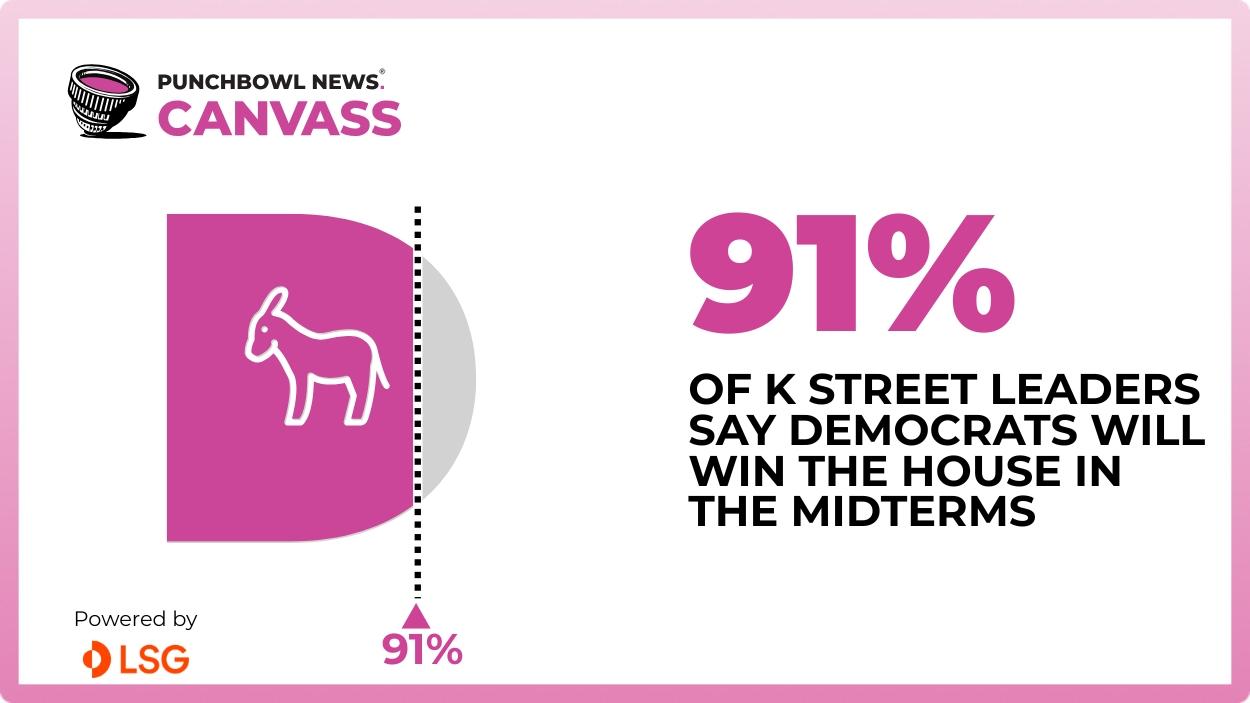
Nearly all K Street leaders believe Democrats are on track to take back the House in the 2026 midterms, according to our latest Canvass survey.
The broad agreement is already influencing how Congress approaches spending, policy and relationships ahead of a potential shift in power.
Most respondents (91%) said Democrats will win control of the House in November, compared to just 9% who believe the GOP will hold onto its razor-thin majority.
There’s also skepticism about whether Republicans can even maintain their grip on the House before this session ends. Just over half of K Street leaders said it’s likely Republicans will lose their majority before the new Congress is sworn in.
Beyond the House, K Street is already mapping out key Senate primaries.
Maine. Respondents narrowly favored Graham Platner to win the Maine Senate Democratic primary, with 53% backing him compared to 45% for Gov. Janet Mills. A recent Emerson poll in the Pine Tree State shows Platner ahead of Mills by 27 points.
Texas. GOP Sen. John Cornyn is seen on K Street as the frontrunner in the Texas Senate Republican primary, with 52% predicting he’ll win compared to Texas Attorney General Ken Paxton’s 46%. President Donald Trump said he would make an endorsement in the runoff between the two, but there’s been no announcement yet. Texas GOP Rep. Brandon Gill, a Trump ally, endorsed Paxton on Thursday.
Cornyn got 42% of the vote in March, edging out Paxton. But the race goes to a runoff in May, without Rep. Wesley Hunt (R-Texas) on the ballot.
The Canvass K Street was conducted March 2-20 in partnership with independent public affairs firm, LSG.
Plus. Here’s the one-pager summing up the results of this month’s Canvass survey. Also check out the full poll and the slide deck.
Want to take part in The Canvass? Our survey provides anonymous monthly insights from top Capitol Hill staffers and K Street leaders on key issues facing Washington.
Don’t miss out on your chance to be heard! Sign up here if you work on K Street. Click here to sign up if you’re a senior congressional staffer.
— Rachel Umansky-Castro
THE MONEY GAME
Iowa news. Democrat Sarah Trone Garriott raised $1.67 million in the first quarter of 2026, significantly outraising vulnerable GOP Rep. Zach Nunn (Iowa). That’s a huge sum for a challenger. Nunn raised $835,000 into his principal campaign committee. Adding up all of Nunn’s campaign accounts, his team says his Q1 tally rises to $1.2 million.
Iowa’s 3rd District will be one of the nation’s top battlegrounds. And this cash disparity will give Democrats confidence they can flip Nunn’s seat. Trone Garriott has consolidated Democratic support ahead of the primary and is operating in general election mode.
The competitive chair. House Administration Committee Chair Bryan Steil (R-Wis.) raised more than $1.3 million in the first quarter and has more than $5.5 million on hand. The DCCC is targeting Steil, who represents a district anchored in the southeastern part of the state. Democrats have a competitive, multi-candidate primary.
Virginia news. Shannon Taylor, the Henrico County commonwealth’s attorney who is running for the House, raised more than $525,000 in Q1. Taylor has over $800,000 in cash on hand.
— Max Cohen, Ally Mutnick and Jake Sherman
PRESENTED BY META


Presented by AstraZeneca

The 340B program is supposed to help vulnerable patients—but without strong safeguards, it’s siphoning away funds that could be used for free and charitable medicine. The 340B Rebate Model Pilot improves program integrity, preventing duplicate discounts and strengthening accountability. Urge HHS to implement the pilot today. Learn why it matters.

Crucial Capitol Hill news AM, Midday, and PM—5 times a week
Join a community of some of the most powerful people in Washington and beyond. Exclusive newsmaker events, parties, in-person and virtual briefings and more.
Subscribe to Premium
Special Projects
Explore our deep dives into the issues that matter the most today and will shape tomorrow's future, with expert reporting that goes beyond the headlines and into the heart of the Capitol.
Check it outEvery single issue of Punchbowl News published, all in one place
Visit the archive
Presented by AstraZeneca
The 340B program lacks transparency—making it hard to tell if it’s actually helping vulnerable patients. HHS can fix the problem by implementing the 340B Rebate Model Pilot, ensuring the program is transparent, compliant, and accountable. Learn more.