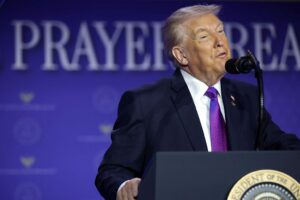


DORAL, Fla. — House Republicans are defending a razor-thin majority amid a balky economy, ominous historical trends, a growing retirement list and a burgeoning oil crisis sparked by the chaotic U.S. war against Iran.
Among President Donald Trump’s pieces of advice to Republicans gathered here at the House GOP’s legislative retreat? Pass the SAVE America Act. That’s the legislation requiring photo ID and proof of citizenship to vote in federal elections that Senate Majority Leader John Thune insists has no path forward in the Senate.
Trump also talked about drug prices, health care and housing during his speech to rank-and-file GOP lawmakers. All of these policies face dim prospects in Congress this year.
For a restless House Republican Conference eager for a vision on how to win in 2026, Trump didn’t offer much that was terribly substantive, highlighting one of the central challenges for the party with just 238 days until Election Day. Trump isn’t terribly focused on issues that will help win hard-fought races.
For example, Trump said the SAVE America Act could “guarantee the midterms” for the GOP, while a failure to pass the bill would spell “big trouble.”
But Trump didn’t unveil any detailed plan to bring down the cost of living. That’s the issue that Democrats — and voters — insist will be the difference in November.
In fact, as Democrats continue to rail against the GOP for rising prices, Trump doubled down on his dismissal of “affordability” as a real problem for voters.
To make matters worse, Trump acknowledged that he knew attacking Iran would lead to a spike in oil prices. Expect Democrats to clip this quote in attack ads from now to Election Day. California Democratic Gov. Gavin Newsom is already seizing on the comment.
As the Iran war continues, Trump seems cognizant of how rising oil prices could lead to more pain at the pump for average Americans. Oil prices dropped on Monday from their earlier highs, although gas prices are still spiking nationwide. Saudi Aramco, the world’s largest exporter of oil, said there will be “catastrophic consequences” if the Strait of Hormuz remains shut.
Trump, however, seems all over the map on the duration and scale of the war.
Trump said he’d direct the Navy to protect tankers operating in the Strait of Hormuz. In a Truth Social post later Monday night, Trump warned that “Death, Fire, and Fury will reign [sic] upon them” if the Iranians continue to block the vital passageway. “Additionally, we will take out easily destroyable targets that will make it virtually impossible for Iran to ever be built back, as a Nation, again…,” Trump declared.
But Trump can’t settle on an overarching message for the war on Iran, especially the biggest question: when will it end?
Trump on Monday repeatedly referred to the U.S.-Israeli bombing campaign as a “short-term excursion” that is “very complete.”
Trump also said, “We’ll not relent until the enemy is totally and decisively defeated.” And, here at the retreat, Trump said, “We’ve already won in many ways, but we haven’t won enough.”
All of which left GOP lawmakers and official Washington — as well as Tehran and Tel Aviv — wondering which one is the right answer.
Headwinds watch. During the opening day of the House GOP retreat, hosted for the second year running at Trump’s Doral resort, Republican leaders acknowledged that holding the House in November would be an uphill climb.
“History will tell us that the party in the majority is supposed to lose seats,” Rep. Lisa McClain, the House Republican Conference chair, said on Monday. “But I don’t know about you, history has been wrong a lot this year.”
Trump put it this way: “We’re fighting a little tradition.”
2018 was the last election cycle that House Republicans were in a similar spot. Democrats ended up gaining 41 seats in that “Blue Wave” year. Facing political headwinds that year, 34 House Republicans passed on running for another term.
After Rep. Darrell Issa’s (R-Calif.) retirement announcement on Friday, the tally for the 2026 cycle has now hit 35. And it’s only March 10.
Democrats also note that a significant portion of these retirements are in battleground seats, including Michigan’s 10th District, Arizona’s 1st District, Nebraska’s 2nd District and Issa’s seat in California’s 48th District. There are outer reach opportunities for Democrats in open seats in South Carolina’s 1st District, Kentucky’s 6th District, Montana’s 1st District and Iowa’s 2nd District.
Sticking by Trump. Trump’s approval rating is 19 points underwater, per a polling average. A January New York Times poll found 49% of Americans say they are worse off now than a year ago.
Republican leaders are, unsurprisingly, sticking by Trump, given his stranglehold on the GOP electorate. Speaker Mike Johnson said the United States was in “a new golden age.” McClain hailed Trump as a “history-defying president.”
It’s not all doom and gloom for the GOP, we’ll note. Last month, we broke down the GOP money advantage; how a potential Supreme Court decision overturning Section Two of the Voting Rights Act would boost Republicans; and how messy Democratic primaries stand in the way of a Democratic majority.
Back on the farm. Senate Republicans are preparing to move quickly on Sen. Markwayne Mullin’s (R-Okla.) nomination to lead the Department of Homeland Security.
Sen. Rand Paul (R-Ky.), who chairs the Homeland Security and Governmental Affairs Committee, told reporters the panel will hold Mullin’s confirmation hearing March 18 as long as his paperwork is completed in time.
Mullin should have an easy time getting confirmed given wide GOP support for his nomination. But Paul wouldn’t tip his hand on how he’ll handle the pick after Mullin reportedly called him a “freaking snake.” Paul told us he’s “going to reserve judgment now” but that HSGAC’s hearing will be “interesting.”