

We have the latest on FISA, funding for the Department of Homeland Security and what happened on the House floor late Wednesday night down below..
But first, let’s talk about the battle for the House majority.
Republicans and Democrats have waged an all-out redistricting war this cycle, an unprecedented and bitterly partisan fight that’s extended from coast to coast. But this is nothing compared to what’s coming in 2028.
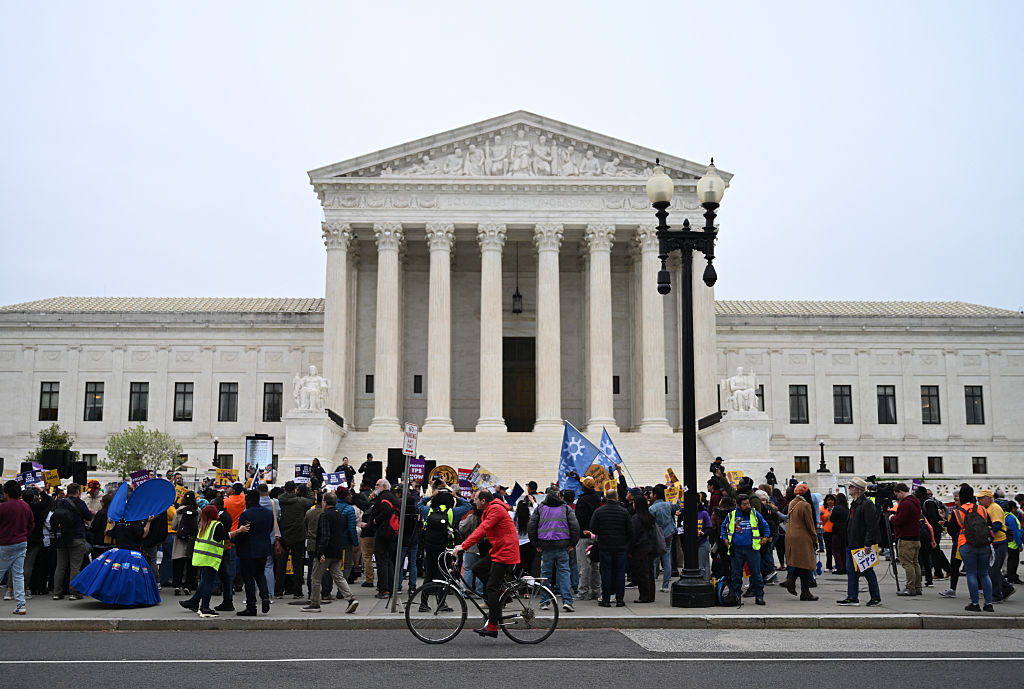
The Supreme Court’s decision on Wednesday to defang Section 2 of the Voting Rights Act will have a limited impact on this election cycle. Yet the high court has set off a maelstrom of congressional redraws for 2028.
Some states that took a pass on redistricting in 2026 — Indiana, Illinois, Maryland and Kansas — may now face increased pressure to jump in. States that have already redrawn their House maps could try again next year in a bid for even more partisan gains.
Most importantly, the SCOTUS ruling gives red states in the South a clear path to erasing minority districts, likely slashing the number of Black lawmakers representing Louisiana, Alabama, Georgia, Texas, South Carolina and Mississippi.
But here’s something else to consider — the SCOTUS bombshell may also allow blue states to spread voters currently in a single majority-minority seat across multiple districts, creating more Democratic-leaning seats overall.
Democrats were already working furiously to undo the redistricting commissions and state laws that hamstrung them this cycle. Now that task — ongoing in states like New York and Colorado — has greater urgency. And Democrats have more tools to deploy to do that.
“I don’t see what stops this downward spiral,” said Rep. Glenn Ivey (D-Md.). “This opinion feeds into it even more.”
Democrats’ game plan. Democrats were laying the groundwork to redistrict in 2028 well before Wednesday’s ruling in order to counter anticipated GOP maneuvers.
Lawmakers in New York are advancing legislation to sidestep the state’s redistricting commission that would allow the Democratic-dominated legislature to gerrymander its 26 districts. A similar effort is going on in Colorado, where the eight-member congressional delegation is evenly split. Democrats have also indicated they may try to do away with New Jersey’s commission.
Democrats can attempt to redistrict more seats next year if they flip statehouses this fall and gain full control in states like Pennsylvania and Minnesota.
As devastating as the SCOTUS ruling is for Democrats in the South — it may mean a handful of seats for Republicans this cycle and many more in 2028 — there are other opportunities elsewhere.
In big blue states like New York and New Jersey, mapmakers have honored the VRA by packing Black and Hispanic voters into a handful of districts. But if the VRA is neutered, those voters could be dispersed for partisan gain.
“There’s not just southern states, there’s northern states. We can do it too. We haven’t done it. We don’t want to do it,” Rep. Gregory Meeks (D-N.Y.) said. “But if they want to do it, OK, we’re going to do it, too.”
Several states, including New York and California, have state-level voting rights acts that protect majority-minority districts. This SCOTUS ruling could mean that state-level VRAs no longer apply because they conflict with a new federal precedent.
The Congressional Black Caucus discussed the implications of the Louisiana decision and how to fight back during its weekly lunch Wednesday, shortly after the ruling came down.
“I’d take 52 seats from California. I sure would. And 17 seats from Illinois,” Rep. Terri Sewell (D-Ala.) said. That would mean no Republican representation in either state.
This CBC posture is a big deal. There’s often tension between state and federal lawmakers who want to preserve Black-majority districts and others who want to maximize the total number of Democratic districts. This SCOTUS ruling may have changed that calculus some.
A new GOP South. The Louisiana decision didn’t strike down Section 2 entirely, although the ruling made it very difficult for anyone to use the VRA to challenge seats as illegal racial gerrymanders.
“Race-based redistricting is an odious practice prohibited by our colorblind Constitution and now the Supreme Court has restored the Voting Rights Act to its proper context,” said Adam Kincaid, the president of the GOP’s redistricting trust.
Most immediately, this ruling puts the two Democratic members in Louisiana at risk: Reps. Cleo Fields and Troy Carter. Louisiana’s primary is May 16, so Bayou State lawmakers will have to move quickly in the coming days if they want to reopen filings and pass a new map. There’s already an indication they will.
Fields is the most in danger because the use of race to draw his Black-majority seat was specifically deemed unconstitutional.
“If you tell me I have to be white to serve in Congress from Louisiana, I can’t do nothing about that,” Fields said Wednesday, reacting to the ruling.
There’s some chance Reps. Jim Clyburn (D-S.C.) and Steve Cohen (D-Tenn.) could see their districts change before the midterms. And the ruling could weaken some legal challenges against Florida Gov. Ron DeSantis’ new congressional map, which passed the state legislature on Wednesday. This is a big boost for House Republicans.
Beyond that, other GOP-controlled states may have to wait for 2028.
Mississippi, North Carolina and Texas have already held 2026 primaries. Alabama and Georgia, which have May 19 primaries, will struggle to attempt any last-minute redistricting. Alabama GOP Gov. Kay Ivey said she won’t call a special session.
One other important note: Republicans can redraw maps far more easily than Democrats. Democrats still have to amend state constitutions, go through referendums and win control of swing-seat state houses.
“There are going to be a whole host of states that I do think need to be prepared to take action in order to combat what is being threatened in the South,” John Bisognano, the president of the National Democratic Redistricting Committee, told us.