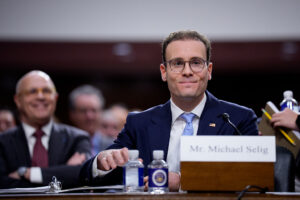


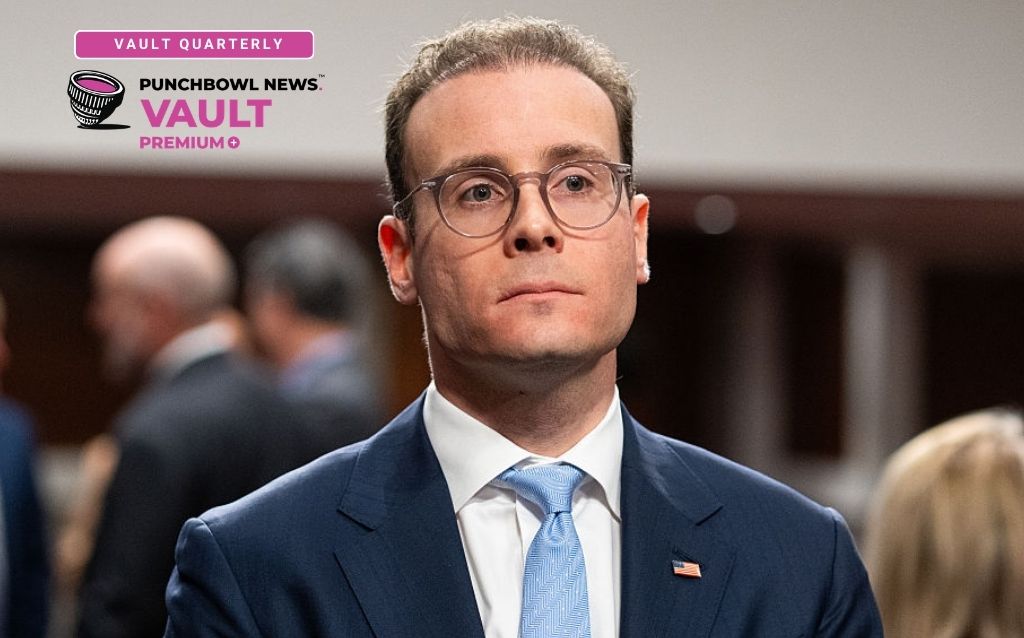
Prediction markets have taken the United States by storm. Commodity Futures Trading Commission Chair Mike Selig wants to do something about that — not a crackdown, to be clear, but a fulsome regulatory hug.
“We need to embrace and actually do our jobs as regulators to regulate these things,” Selig said in an interview inside the CFTC’s downtown office. “I’m taking that job on. I’m moving very quickly.”
If your advertisements are anything like ours, you have been seeing a lot of marketing for prediction markets over the past year. Leading firms like Kalshi and Polymarket rely on a CFTC-regulated financial product — event contracts — to allow customers to place bets on everything from the outcome of college sports to who will win the 50th season of Survivor.
Selig believes event contracts represent a new frontier in how everyday consumers can manage their everyday financial risks. And his top priority is defending the CFTC’s sole authority over these markets.
“I think we should get past this silly debate as to what the authority of the agency is. It’s very clear in the statute,” Selig said. “Then, we can move on to this really, more interesting question of, what should policy look like for event contracts?”
The CFTC’s role in this market is simple common sense to Selig, a former SEC and CFTC staffer.
“Congress has had this appetite for the CFTC to be the pretty-much-everything regulator, to the extent you’re treating it in the future, creating a future market,” Selig said. “Why not predictions on politics?”
Here’s some related news. We obtained the CFTC’s first Trump-era release of guidance for prediction market firms.
A six-page document, set to be published later today, summarizes the CFTC’s “current views on the listing and trading of event contracts.” That includes the need for prediction market companies to “comply with the 23 statutory core principles” set for in the Commodity Exchange Act, such as “trading only derivative contracts that are not readily susceptible to manipulation.”
And the CFTC document reminds readers that the commission “retains authority” to stay any event contract that fails to prove its “not readily susceptible to manipulation.”
Selig told us that monitoring for — and catching — market manipulation is just part of the process.
“It’s not always the case that every certification is bulletproof. There’s risk that things can be manipulated. That happens in our markets for every commodity,” Selig said. “We wouldn’t have exchanges if we’re throwing them all out of business because there happens to be manipulation.”
Gambling? Not in this commodity regulator, Selig says.
A lot of ink has been spilled on whether events contracts are simply gambling by another name. State and tribal governments certainly think so.
Selig disagrees, but it’s difficult to avoid the association entirely. The CFTC chair tried to distinguish between the rigor of the federal financial regulators and that of a casino.
“Our markets aren’t designed for gambling. They’re designed for risk management,” Selig said. “Hedgers, speculators, market makers, we’ve got all sorts of market participants. But these are financial markets, and we have really different standards than, of course, the casinos and all that.”
Use case. Back in February, Selig argued that prediction markets provide “useful functions for society by allowing everyday Americans to hedge commercial risks.”
We asked: Do everyday Americans need to hedge their commercial risks? Really? Selig’s “yes” was emphatic.
“This is a real opportunity for everyday Americans to be able to manage certain risk,” Selig said. “I do view this as something that democratizes access to our derivatives market.”
Here’s the example Selig posed to us:
Next up. Selig’s agency will play a key role in setting regulatory standards for crypto, whether or not Congress can muscle through a bill overhauling the sector’s legal framework.
Selig — whose office shelves feature a pair of black high top shoes with a bitcoin logo, resembling merchandise sold by President Donald Trump on the 2024 campaign trail — says he was an early believer in crypto after reading the original bitcoin white paper in 2011.
“We rely so much on intermediaries and gatekeepers in every aspect of our lives,” Selig said. “That really should not necessarily be the case in a free society where we’re trying to preserve privacy in many aspects of our lives. And the technology’s there to make that a reality.”