

The government-funding deadline is now one week away. We’re going to delve into three key dynamics to watch during the coming days – and possibly weeks – as this crisis unfolds.
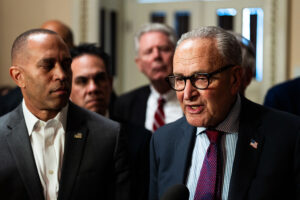
Trump vs. Democrats: We scooped that President Donald Trump would meet with Senate Minority Leader Chuck Schumer and House Minority Leader Hakeem Jeffries on Thursday. It’s not clear yet if Speaker Mike Johnson and Senate Majority Leader John Thune will attend. Because why would the speaker and Senate majority leader attend a meeting on FY2026 spending just days before the shutdown deadline?
Schumer and Jeffries have been demanding this meeting with Trump, and now they’ve got it. Will it be a repeat of Trump’s disastrous December 2018 sitdown with Schumer and then Speaker Nancy Pelosi? Or will 2025 Trump be different? Will the president invite in cameras like the last time? How will Jeffries respond in his first-ever sitdown with Trump? There’s lots to ponder.
Johnson and Thune should want to be in this meeting to make sure that their negotiating position is represented. Trump likes nothing more than chasing a deal. Of course, the two sides are far apart. But with Trump in a room with two Democrats, you can’t be too sure of something unpredictable happening.
What’s at stake? It’s a high-pressure situation, to say the least. Federal agencies shut down on Oct. 1 if the two sides don’t reach a deal. Republicans are offering a “clean” continuing resolution to Nov. 21, a proposal that allows GOP and Democratic appropriators to continue negotiating on a broad FY2026 spending accord.
Schumer and Jeffries have countered with a dramatically different offer of their own: an Oct. 31 CR that includes a permanent extension of Obamacare premium tax credits; reversal of the GOP’s One Big Beautiful Bill’s massive Medicaid cuts; an end to billions of dollars in unilateral spending rescissions by the White House, and restoration of public-broadcasting funds that Republicans have eliminated. The cost of this Democratic package is $1 trillion-plus.
There’s no way that Trump or GOP congressional leaders will accept the Democrats’ offer, although a number of moderate House and Senate Republicans would go along with an Obamacare subsidies extension.
The House has already passed the Republicans’ Nov. 21 CR. Senate Democrats blocked it, only to have Senate Republicans in turn block the Democrats’ plan.
Thune can force another vote on the GOP proposal before a shutdown starts, and we expect him to do that. Schumer will have to keep rallying Democrats to vote it down. The pressure will thus build on Schumer as the crisis plays out.
Democrats believe an unprecedented shutdown under full Republican control of Washington will backfire on Trump and GOP leaders. Republicans are convinced they have a far stronger hand than in any previous shutdown showdown. Most Republicans don’t even think Schumer and Jeffries deserve a meeting and should simply accept the House GOP’s CR.
Trump and OMB Director Russ Vought have wide discretion over how painful a shutdown will be. Trump can keep hundreds of thousands of federal workers on the job even if they’re not getting paid. Or he can close down huge swathes of the government in order to maximize the pain on the American public — and by extension, Democrats. He can mix and match at will.
The politics of the House coming back. We scooped on Monday that Jeffries has told his members to be prepared to come back to D.C. on Sept. 29, even though the House is out of session.
Why would this be the case? Because Johnson and House GOP leaders have announced they won’t bring the House back until at least Oct. 1. In other words, after a shutdown has started.
We expressed our skepticism of this strategy in Monday’s AM edition, only to hear complaints from Republicans. Yet as we noted, Jeffries and dozens of House Democrats will be in town starting Wednesday for the Congressional Black Caucus Foundation’s annual legislative meeting. Now Jeffries is upping the stakes by potentially having all his members in town on Sept 29, too. The Senate will be here, as will Trump. But House Republicans say they’re all set and don’t need to come back as the government closes. Got it.
One quick note: We looked back at the 2013 shutdown, the last full government shutdown. The GOP-run House was in session and voting 15 of the 16 days the shutdown covered, including the day it began. It was different during the 2018-19 partial shutdown, but that was post-election. Democrats had already won a big House margin and a huge chunk of the shutdown took place during the Christmas holiday season. We’ll see how Johnson plays this.
Potential offramps. We noted that there’s no way that Trump or Hill Republicans accept the Democratic CR proposal. But is there any chance for Republicans to do a deal, especially on Obamacare subsidies?
We’ve told you before that some vulnerable House GOP moderates want a one-year extension. Some Senate Republicans are pushing this too. Neither effort is Republican-leadership sanctioned.
So can a deal happen? Not on a seven-week CR, according to Hill Republicans. But Trump could push GOP leaders to accept a two-year extension as part of an FY2026 funding deal. And as we’ve seen time and time again, Republicans will do whatever Trump says.
For now, Republicans remain convinced that Democrats – especially Schumer – will fold, if not before a shutdown starts, then shortly afterward.