

In less than 19 hours — at 12:01 a.m. Wednesday — the federal government will shut down for the first time since 2018.
This shutdown is the most predictable development of the year. We’ve been saying it was likely since March 31.
It’ll be a late night in the Senate. GOP leaders will bring up both the House-passed Nov. 21 CR and the Democratic counter-proposal for votes again. When these fail, the Senate could hold a bunch of procedural and “show” votes through the midnight deadline. The House isn’t in session.
Let’s review what we’ve learned over the last day and what we’re watching going forward.
1. Schumer and Jeffries. Monday was a bit of a mess for the two top Democratic congressional leaders.
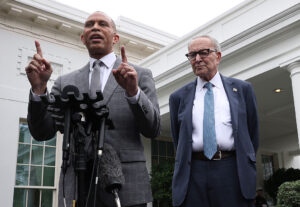
Senate Minority Leader Chuck Schumer floated a week-long stopgap funding bill, among other options, to his rank-and-file early on Monday. Unfortunately for Schumer, this became public before he, House Minority Leader Hakeem Jeffries, Speaker Mike Johnson and Senate Majority Leader John Thune went to the White House for their meeting with President Donald Trump.
Some progressives said this showed Schumer was trying to wriggle out of a shutdown even before it began. It also drew the ire of House Democrats, who privately fretted that their Senate counterpart was laying the groundwork to abandon them again. Schumer’s allies say he was just trying to plan for different contingencies.
During the White House meeting, which one participant described as “spirited,” Schumer and Jeffries peppered Trump with their list of demands to keep the government open. This included everything from extending the enhanced Obamacare tax credits to nixing Trump’s ability to unilaterally cut funding.
Schumer and Jeffries didn’t float a short-term funding bill during the closed-door session. And when Schumer returned to the Capitol, he walked away from the idea.
Republicans say it’s unclear precisely what Democrats’ bottom line is to keep the government open — or reopen it. As we’ve said repeatedly over the last few months, Schumer has the most to lose here. And he has moderate Democrats who may get a bit restless if a shutdown drags on. More on that below.
2. Republicans still have an advantage — for now. In 2013, Republicans shut down the government to repeal Obamacare. In 2018, Republicans shut down the government to try to get money for Trump’s border wall, even though Trump was president.
Both efforts failed. Shutdowns rarely work as a negotiating ploy.
Republicans have the luxury of a simple message this time: We’re willing to negotiate, but not with the threat of a government shutdown hanging over us. It’s the same message Democrats have employed successfully in past showdowns.
By contrast, Democrats have a lot of demands.
Even though the House Republican leadership is making what we think is a bone-headed move by keeping the chamber out of session while federal agencies run out of money, the straightforwardness of the GOP’s message is useful.
But watch out. Democrats are already scheduling Capitol news conferences and other events. Democrats could even try to go to the floor today when the House gavels in for its pro-forma session.
3. Dems trying to drive a wedge between Trump and the Hill GOP. Every Democrat we spoke to after Monday’s Oval Office meeting had the same analysis: Trump would cut a deal, but the president is being held back by Johnson and Thune.
Thune dismissed Schumer’s rhetoric as a desperation move: “I don’t know what they’re talking about. We’re unified. We’re all on the same page.”
Democrats are smart to try to stoke division between the Hill and White House.
There was one moment in the meeting when Trump asked the congressional leaders to keep talking to try to hash out an agreement. Schumer and Jeffries said that they need Trump to get a deal because he will be the ultimate decider. Trump agreed with that.
4. An ACA deal is very hard. One important dynamic that’s getting overlooked in this debate is just how hard it would be for Congress to pass an extension of the Obamacare enhanced premium tax credits.
Senior House Republican sources say that roughly 10% of the conference wants to extend the pricey Covid-era policy. It would take a herculean effort for Trump to get the rank-and-file Republicans to agree to extend the credits.
Even the most ardent GOP supporters of extending the Obamacare subsidies believe they need to be curtailed and eventually phased out for good. There are several different ideas out there for how to achieve this, including means-testing the credits or requiring minimum payments from enrollees.
Others want a clean short-term extension — say, one year — to give Congress more time to iron out a longer-term plan. For conservatives, the policy is a double-whammy: an Obamacare item and a Covid benefit. It’s quite easy for them to say “hell no.”
All of that would need to be ironed out through a very complicated negotiation that would likely require several weeks. That’s not to mention the pressure it would put on Thune and Johnson inside their respective conferences.
Yet Trump and administration officials acknowledge they’re eager to have discussions on this. Plenty of Hill Republicans, especially in the Senate, want to extend the subsidies. Maybe this is the only way out. But that doesn’t mean it’s easy.
5. How long can a shutdown last? The last full government shutdown was 2013. The entire government was shut for 16 days. The 2018 shutdown was far longer, but the Pentagon and other agencies were funded.
Shutdowns end when one side blinks. Schumer can’t blink because of internal party pressure. And do you think Trump wants to fold to Schumer? Based on this unhinged, offensive Trump tweet from Monday night, we’re in for a long shutdown.