


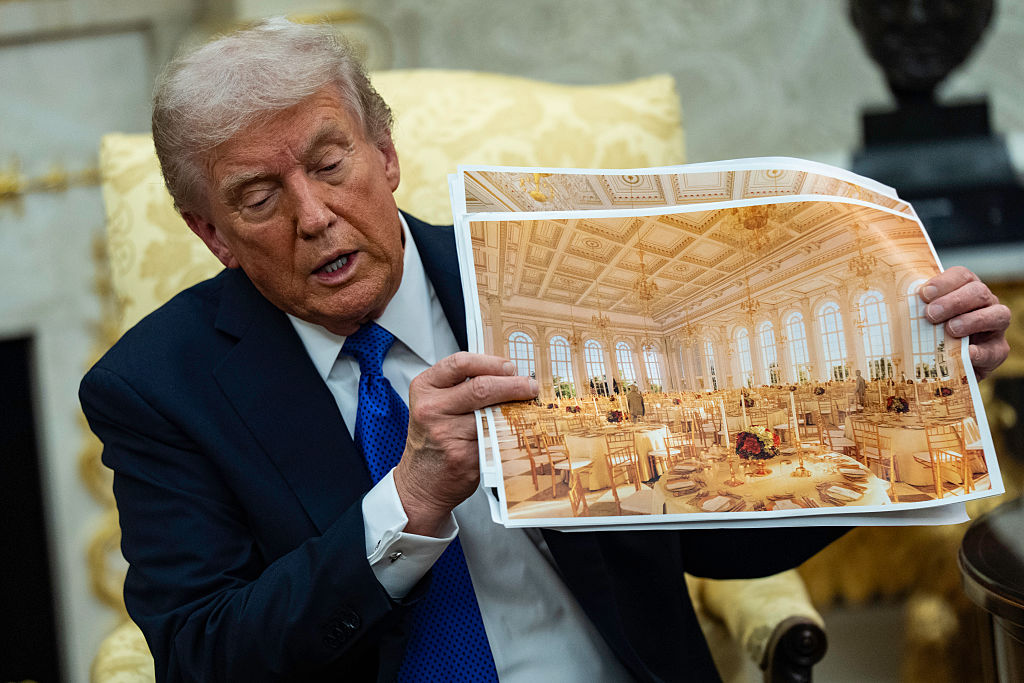
The White House’s $1 billion request to secure President Donald Trump’s new ballroom is getting a very frosty reception on Capitol Hill, casting doubt on whether GOP leaders can keep it in the upcoming immigration reconciliation package.
Several House and Senate Republicans are privately raising alarms about the money and the political pitfalls of funding anything related to Trump’s controversial ballroom, even as the White House, administration officials and GOP leaders insist the $1 billion is only for security.
Some of these skeptical Republicans feel the ballroom project is just too politically toxic right now, especially when Trump said for so long that it would be paid for by private funds. Trump’s approval ratings are in the 30s. Gas is $4.55 per gallon. Trump can’t yet find a path to victory against Iran, while he and other administration officials are threatening another war in Cuba.
“A first-year poli sci major would know not to ask members to take this vote and we hope the speaker does too,” one House Republican told us.
Another House Republican put it this way: “There is no way in hell that this will get 218 votes on the floor.”
The House GOP moderates to keep an eye on include: Reps. Brian Fitzpatrick (Pa.), Nick LaLota (N.Y.), Don Bacon (Neb.), Jen Kiggans (Va.) and Rob Bresnahan (Pa.).
Trump’s ballroom project isn’t new, but the president and his congressional allies have made a fresh push for the facility since the White House Correspondents’ Dinner shooting. Trump has repeatedly said that construction would be fully funded by private donors and cost around $400 million.
Now the administration wants Republicans in Congress to approve $1 billion for security. The White House says this pot of money would also fund other Secret Service upgrades.
More gripes. It’s not only the politics of the ballroom security funding that has some moderate Republicans fed up. These Republicans feel there’s not nearly enough clarity on exactly where the funding would go, details the White House will need to address next week.
There’s concern as well about trying to expand the reconciliation bill beyond immigration enforcement funds. This isn’t what Republican leaders promised.
California Rep. Kevin Kiley, who left the GOP to become an Independent, said he’d vote against the reconciliation package unless Republicans pass ICE reforms, which is unlikely. Kiley also is queasy about the ballroom money:
“The idea of just having this funded all at once with very little process, very little scrutiny, very little explanation as to what the funds are going to be going toward, how this benefits our country or national security or taxpayers — I think that’s problematic.”
Speaker Mike Johnson can only lose two votes on any given bill. Johnson needs near unanimity here — and he doesn’t have that yet.
Senate problems. Yet GOP leaders may ultimately be spared from the ballroom battle.
Some Senate sources believe the language won’t survive a “Byrd Bath,” the process by which the parliamentarian decides whether each provision complies with strict reconciliation rules.
It could also fall out during a markup or vote-a-rama if enough rank-and-file Republicans speak out. Democrats can force an amendment vote on the ballroom language and would only need support from a handful of GOP senators.
Senate Appropriations Committee Chair Susan Collins (R-Maine) is one to watch. Collins is also the most vulnerable Senate Republican on the ballot this November.
“As the process moves forward, Congress will need to hear the case for why the proposed funding is necessary and how it would be used to upgrade White House security,” Collins said in a statement to the Portland Press Herald this week.
One Senate Republican noted the disparity between the $400 million estimate for the ballroom’s construction and the $1 billion request for security. The GOP senator added that Congress has received no information from the administration about the ballroom itself, other than the intention to fund it via private donors.
The administration’s case. The White House and Department of Homeland Security point to the need to bolster security in the wake of the WHCD attack.
The argument from Trump administration officials and the Senate GOP leadership is that the reconciliation bill text explicitly states ballroom funding can’t go toward “non-security elements” of the project.
They’re also pointing to this letter from DHS Secretary Markwayne Mullin and Secret Service Director Sean Curran declaring the $1 billion isn’t just for security. The letter says some of the requested funds will be used on increased protection for government officials and high-profile events, and improvements to training facilities.
The messaging war. Senate Democrats plan to center their vote-a-rama message against the Republican immigration package on what’s not in the bill: measures to address affordability. Democrats will argue the GOP is spending tens of billions of dollars on ICE and Trump’s ballroom while neglecting the rising cost of living.
When we asked Senate Minority Leader Chuck Schumer about his message in the upcoming vote-a-rama, he said it’ll be all about rising costs.
“We’re just not going to stop talking about the cost of living,” Sen. Brian Schatz (D-Hawaii) added. “We’re not going to change from day to day or week to week. Everybody understands our strategy. Everything is too costly and it’s Donald Trump’s fault.”
Note: Trump will deliver remarks in the Rose Garden at noon today.