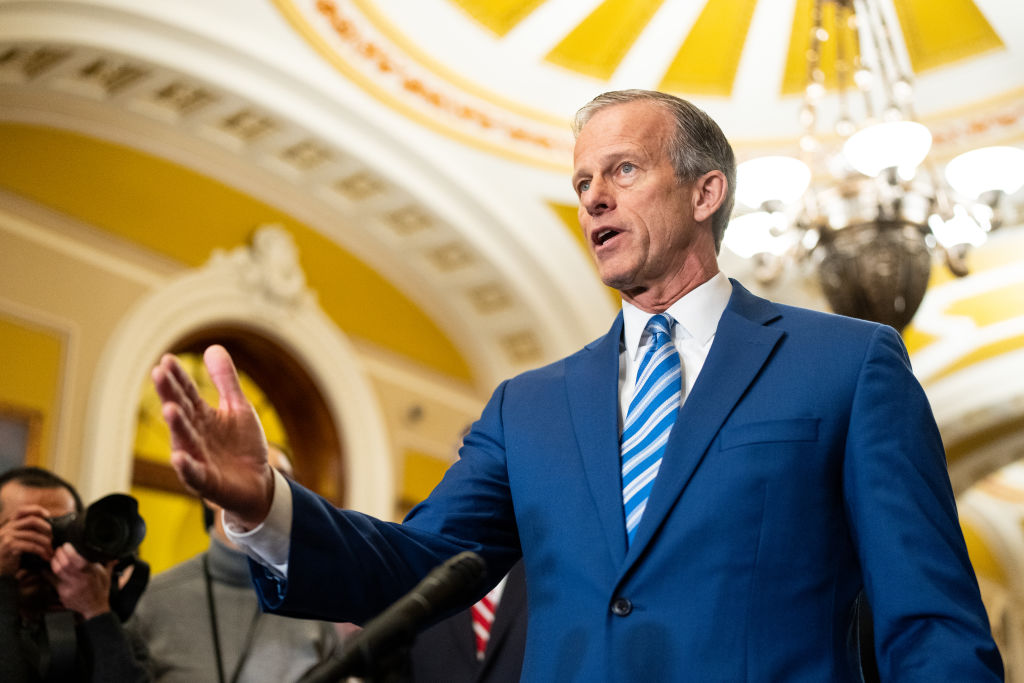
The Senate is slated to take a key vote next week that could tell us a lot about the likelihood of a government shutdown.
Senate Minority Leader Chuck Schumer and top Democrats have warned that Republicans’ approval of a $9 billion rescissions package, paired with the White House’s ongoing hostility toward Congress’ power of the purse, could doom chances of a bipartisan government funding deal this fall.
By teeing up a vote on a funding bill that cleared the Appropriations Committee by a big bipartisan margin — the FY2026 MilCon-VA bill — Senate Majority Leader John Thune is forcing an early test of Democrats’ willingness to have that fight.
“We’ll see if the Democrats want to play ball. I hope they do,” Thune told us. “All of these threats to the contrary — at the end of the day, I think it’s in everybody’s interest to figure out how to keep the government funded.”
The Senate Appropriations Committee has cleared four funding bills to date, three of them unanimously or nearly so. The Senate will hold a procedural vote next on the MilCon-VA bill, which the panel adopted on a 26-3 vote — meaning it should, in theory, pass overwhelmingly on the floor. Of course, that’s far from likely. Funding the government past Sept. 30 will require at least seven Democratic votes.
All eyes on Dems. For now, Schumer is staying mum about Senate Democrats’ strategy. He deflected multiple times Thursday when asked how Democrats would handle upcoming funding votes. Yet Democrats sure seem like they’re gearing up for a shutdown fight, especially after the debacle in March.
Schumer was more focused Thursday on criticizing OMB Director Russell Vought, who caused a stir on the Hill after saying the appropriations process should be “less bipartisan” and that he expects additional rescissions requests.
Vought’s comments certainly didn’t help Thune’s case. The South Dakota Republican distanced himself from Vought’s remarks by noting that funding the government must, by definition, be bipartisan because of the Senate’s 60-vote threshold.
Many Senate Democrats are insisting that they should use that leverage absent commitments from Republicans to reject future rescissions requests. And even that might not be enough.
Here’s Sen. Chris Murphy (D-Conn.), a senior Appropriations Committee member:
“They’re putting bills on the floor with the promise that, if we vote for them, they will then put a rescissions bill on the floor to strip out all of our stuff? Why on earth would we agree to that? It’s insane… We’re not patsies. And we shouldn’t act like it.”
Murphy also warned that if Republicans make this “the new normal,” Democrats will do “the exact same thing” if they win back power.
Sen. Chris Van Hollen (D-Md.), another top appropriator, said Democrats will need to have internal discussions to hash out a strategy.
“As of now, it’s hard to see a path there,” Van Hollen told us. “We need to put in place some kind of assurances that the bills we just voted on… will not be undone with a rescissions process.”
Some Republicans are lending credence to Democrats’ concerns about a lack of trust between the two parties wrecking the Senate’s appropriations process, like Sen. Thom Tillis (R-N.C.).
“If someone in the administration goes and cuts something that was clearly a part of a deal that got funding done in the past, then they’re destroying our chances of getting trust for the next appropriations bill,” Tillis said.