THE TOP
The good, the bad and the ugly of 2025
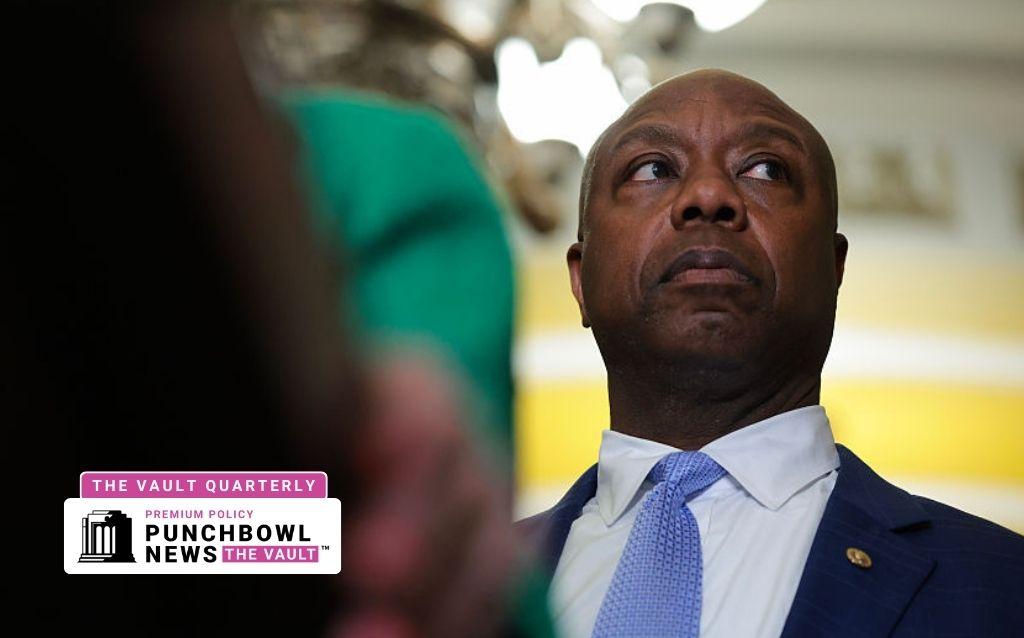
Welcome to our Punchbowl News The Vault Quarterly Edition!
What a century this year has been. Congress roared to life in 2025, and economic policy will feel the effects for a long, long time.
The Trump administration’s control of Washington cracked open a world of deregulatory possibilities for industry. Banks, crypto and corporate America all complained mightily about the Biden years, and this was a golden opportunity to “recalibrate” their regulators in the nation’s capital.
Now, with one year down and one more to go in the 119th Congress, it’s as good a time as any to take stock of the moment and what it portends for next year. 2025 had its fair share of the good, bad and ugly, and we’ll be wading through the ripples for the foreseeable future.
Let’s start with the lead: We sat down with Senate Banking Committee Chair Tim Scott (R-S.C.) to talk about all things crypto, housing and beyond. The South Carolina Republican was candid in discussing his efforts to woo Democrats and Republicans alike on year-end legislative efforts that have all but consumed the Capitol this week.
We also dive deep into the politics of trade in this quarterly edition. The Trump administration has been comfortable calling the shots here since January. But Congress’s day is coming, with major pressure issues coming up that lawmakers can’t ignore.
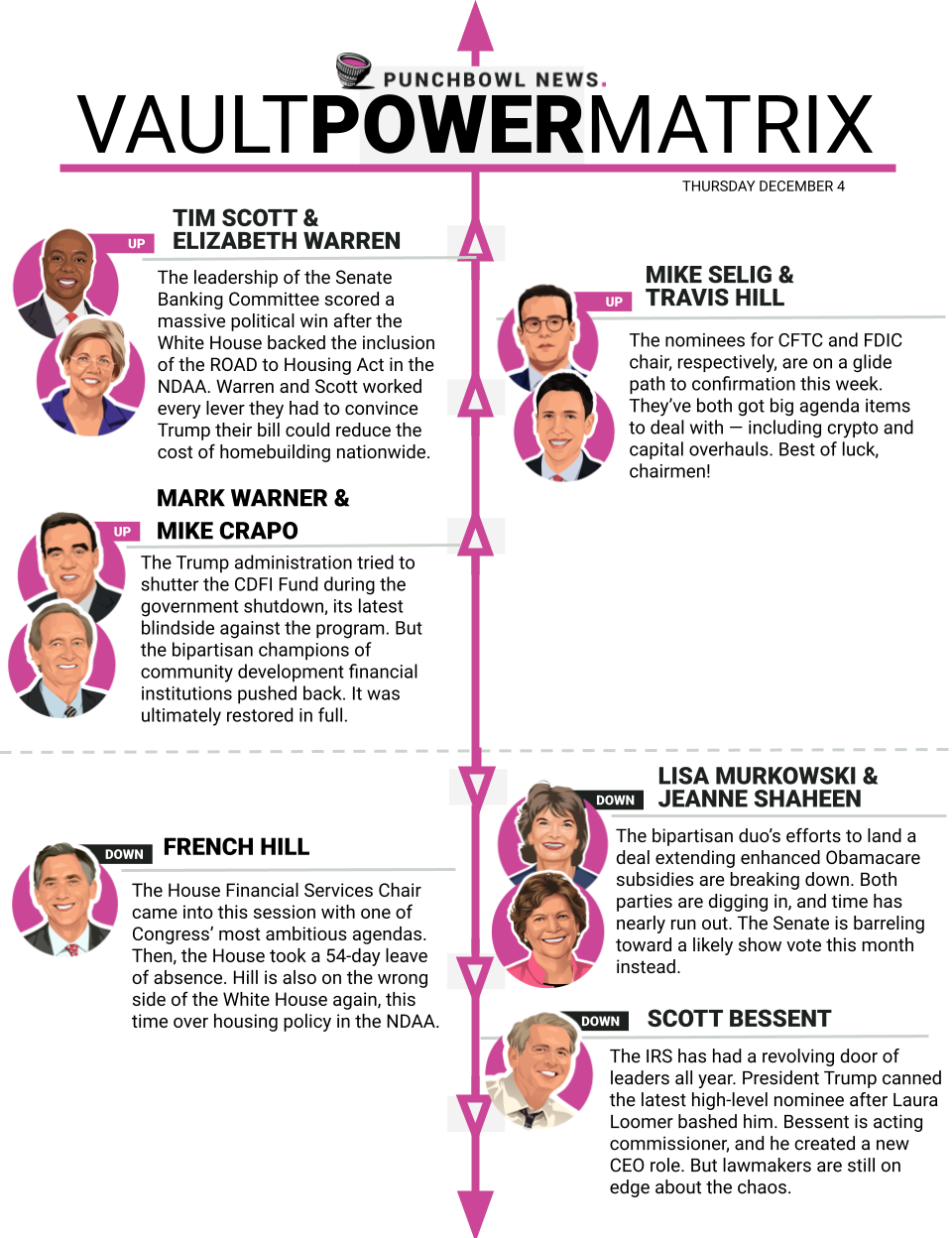
But we know why you’re really here. The Vault Power Matrix is back, it’s better than ever, and yeah, sure, we’ve had to shuffle some stuff around last minute with annual defense authorization politics breaking loose left and right. It happens.
Thank you, as always, for reading. We’ll see you in 2026.
– Brendan Pedersen and Laura Weiss
Love The Vault Quarterly? In addition to this newsletter, members of our Premium Policy: The Vault community get Washington x Wall Street and tax policy intel every day with deep analysis integrated into their Midday and PM newsletters, the Sunday Vault, exclusive interviews, breaking news alerts and monthly briefings with our Vault reporters. Schedule a demo and free trial of The Vault with our team.
THE INTERVIEW
Tim Scott smiles through the crucible
Sen. Tim Scott (R-S.C.) has led the Senate Banking Committee through its most active period in well over a decade. There have been ups, and there have been downs.
Now, with 2025 coming to a close, we wanted to sit down with Scott and talk about the year that’s been and the year that’s to come. That means crypto, housing and the 2026 election.
Market structure. Bipartisan talks around landmark legislation to overhaul financial markets and incorporate the crypto sector have been slow-going. Scott is annoyed and continues to blame Democrats for the pace.
“We’ve had drafts out since [July], and then we had another one come out a couple months ago in September. And yet we’re still waiting for them to finish figuring out where they want to go on the process,” Scott said. “Five months seems to be long enough for me to read a page a day and be OK with it.”
Democrats counter that the bill presents huge changes to the shape of the U.S. financial system, and they’re seeking a broad array of compromises to reach a bipartisan agreement.
Ultimately, Scott is chair of the committee with Washington under Republican control. That makes him responsible for the dealmaking.
Gripes aside, Scott acknowledged the tenor of the talks has improved in recent weeks. “I think they are getting to a place where they finally have gotten serious about getting something done,” the chair said, referring to Democratic negotiators.
Behind you! Scott also has one detractor on his side of the committee that has complicated the math around market structure talks.
Sen. John Kennedy (R-La.) doesn’t want a markup to move forward yet, pointing to process and policy concerns about the legislation. Kennedy told reporters Monday night his position hadn’t changed. “I’m right where I was. I’ve got a lot of questions. Ready for a hearing on the bill,” Kennedy said.
Scott said he’s been talking to the Louisiana Republican quite a bit.
“I’ve had as many conversations with Senator Kennedy as probably anybody on the topic of market structure, and he certainly is very keen to be fully informed,” Scott said. “Good news is, his staff and my staff have met days on end. So the information that he needs is now what’s in his office.”
Housing. The Senate’s bipartisan effort to enact the ROAD to Housing Act in the annual defense authorization package was tripped up last week in the face of opposition from House Financial Services Committee Chair French Hill (R-Ark.).
Scott said he’d been working on Hill through Thanksgiving. And while odds looked slim that ROAD would make the NDAA’s final cut, a last-minute push from the White House has made its passage a real possibility this year.
“I’ve talked to my good friend French. During the Thanksgiving weekend, we had a couple chats,” Scott said.
Scott conceded the bill is large, nodding to ROAD’s “40 component parts.” But ROAD was Scott’s marquee piece of legislation long before crypto took center stage. Scott invoked the White House more than once in pitching the bill to us, as the Trump administration grapples with the American affordability crisis in housing and beyond.
“President Trump is very serious, laser-focused on getting something done,” Scott said, pointing to the average age of first-time homebuyers being 40 years old. “And I don’t think either body, House or Senate, wants to stand in the way of meeting the needs of the average person.”
Hats, hats. We’ve written before about Scott’s two big jobs in the Senate — Banking chair, of course, and leading the Senate Republican campaign arm. The two jobs have sometimes been in conflict with each other. The Banking chair Scott needs Democratic support for crypto legislation, and the NRSC chair wants Democrats wiped off the map in 2026.
But this was the first time we’ve been able to ask Scott about the dynamics directly. Scott says wearing both hats is simple enough, pointing to strong personal ties with Democratic senators like Sen. Cory Booker (N.J.). “When Cory got engaged, he sent the engagement pictures to me,” Scott said.
Scott’s relationship with Sen. Kirsten Gillibrand (D-N.Y.) is also robust. Like Scott, Gillibrand is both playing a key role in crypto talks and leading the Senate Democrats’ campaign arm this cycle.
“She and I have been working together on market structure for months and months and months,” Scott said. “And yeah, when we put on the red jersey and the blue jersey, we’re going to do battle. That’s the way it’s supposed to be.”
“But when you’re off the football field, you shake hands and you go back to your Bible study. She and I are in Bible study together,” Scott added.
Sources tell us that’s the same Bible study group where Gillibrand got to know Sen. Bill Hagerty (R-Tenn.), which formed a crucial partnership that helped secure the final passage of the GENIUS Act last summer.
Fed watch. By most accounts, Kevin Hassett is the frontrunner to be Trump’s Federal Reserve chair nominee. Scott is a fan.
“I’ve known Kevin for about 10 years now. He’s certainly incredibly intelligent, very motivated,” Scott said. “He’s an optimist of all optimists, and I’m an optimistic person myself.”
— Brendan Pedersen
2026 AGENDA
Congress can’t keep ignoring trade
Congressional Republicans have been sitting back and letting President Donald Trump launch aggressive trade wars all over the world — even though the tariffs still make many in the GOP squirm.
But in 2026, Congress may finally have to face the trade agenda head-on. And regardless of whether tariff policy is thrown into lawmakers’ laps by the Supreme Court, trade will undoubtedly become an even bigger issue on Capitol Hill next year.
Here’s why.
1) From corporate America to Congress, everyone’s waiting on pins and needles for the Supreme Court’s ruling on Trump’s tariffs.
The court is expected to rule sometime in the coming months. The case is focused on whether Trump can use the International Emergency Economic Powers Act to levy tariffs worldwide.
If the tariffs go down, the Trump administration could draw on other authorities and investigations to fuel its trade wars, which may be enough to satisfy the president. But there are Hill Republicans convinced the president will want them to step in, which would be a brutal political exercise.
House Republican leaders put in place a policy this year that blocks measures overturning Trump’s tariffs from coming to the floor. But that prohibition expires at the end of January. The House GOP leadership faced a minor revolt over the last extension of the ban, so it’s not clear how a future effort would go.
2) There’s a massive trade deadline bearing down in 2026: the review date for USMCA, the landmark North American trade deal from Trump’s first term.
The Trump administration has already kicked off its formal review of the pact with Canada and Mexico. Key parties are weighing in on their priorities.
The Ways and Means Committee has started to ramp up its own review of the USMCA. The panel hosted Mexico’s top economic official for a meeting in September.
Senate Finance Committee Chair Mike Crapo (R-Idaho) named the USMCA review as a priority and told us he’s already hearing a lot of stakeholder feedback.
“It’s like almost every political issue we have today, there’s a lot of different positions,” Crapo said.
3) Republicans are antsy for some trade activity. GOP leaders of the trade committees are pushing to renew key trade extenders, including a program for exports from sub-Saharan African countries. The African Growth and Opportunity Act will likely be a candidate if there’s a legislative vehicle available for it to ride in this January.
GOP lawmakers would like some new trade deals to review — a common feeling on the Hill. And Republicans are continuing to focus on global tax talks, including opposition to foreign countries’ digital services taxes. That’s an issue that has previously been dealt with in trade negotiations.
— Laura Weiss
DON’T MISS THIS
ICYMI: The latest on crypto, Obamacare cliff and trade
It’s been a busy fall for The Vault.
We’ve brought you all the news on the biggest financial services, tax and trade storylines dominating Capitol Hill. Here’s the best of our recent reporting.
Crypto market structure. This effort to bring landmark changes to the financial system was the story that just kept giving this quarter. We were the first to report warning lights from Senate Democrats concerned that Republicans were moving too fast. We scooped the collapse of bipartisan talks in October. And as things slowly came back to life in November, we’ve been all over every twist and turn.
Trade. Congress is turning more and more to trade policy, as we wrote above. We covered the Supreme Court tariff case’s massive stakes for Capitol Hill. And we broke news on how key trade extenders could also be the House Ways and Means and Senate Finance panels’ best chance at dealmaking in the next couple of months.
Digital asset taxes. Republican tax writers’ next big project after passing the One Big Beautiful Bill is crypto. We scooped how the GOP is planning a major tax package that sets the rules for digital assets. We’ll be on top of all the twists and turns as the committees get in on the crypto policymaking boom.
Deposit insurance. The Senate’s bipartisan push to expand deposit insurance limits reached a peak during the shutdown, despite gripes from the nation’s largest banks. But when the House came back to town, skeptical members took a hatchet to that leading bill. We brought you the inside scoop on the bicameral drama that incensed the leadership of the House Financial Services Committee, too.
The Obamacare fight. The looming expiration of enhanced Obamacare subsidies has become a massive political fight on Capitol Hill. We’ve chronicled the policy and political stakes and brought you inside the room where this crucial debate is happening. Check out some of the latest news.
— Laura Weiss and Brendan Pedersen
The Vault Recap
Editorial photos provided by Getty Images. Political ads courtesy of AdImpact.
The 340B program is supposed to help vulnerable patients—but without strong safeguards, it’s siphoning away funds that could be used for free and charitable medicine. The 340B Rebate Model Pilot improves program integrity, preventing duplicate discounts and strengthening accountability. Urge HHS to implement the pilot today. Learn why it matters.
Crucial Capitol Hill news AM, Midday, and PM—5 times a week
Join a community of some of the most powerful people in Washington and beyond. Exclusive newsmaker events, parties, in-person and virtual briefings and more.
Subscribe to Premium
Special Projects
Explore our deep dives into the issues that matter the most today and will shape tomorrow's future, with expert reporting that goes beyond the headlines and into the heart of the Capitol.
Check it outEvery single issue of Punchbowl News published, all in one place
Visit the archiveThe 340B program lacks transparency—making it hard to tell if it’s actually helping vulnerable patients. HHS can fix the problem by implementing the 340B Rebate Model Pilot, ensuring the program is transparent, compliant, and accountable. Learn more.