


March 31, 2026



PRESENTED BY

THE TOP
John Thune’s jam
Happy Tuesday morning.
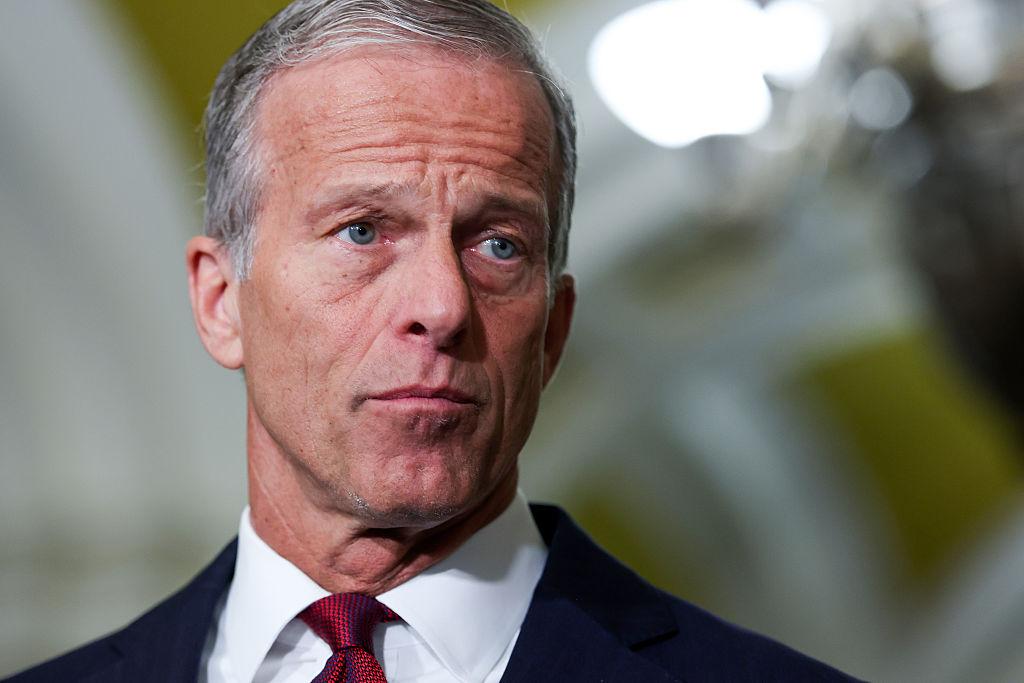
Senate Majority Leader John Thune’s back is up against a wall.
Thune’s tumultuous split with Speaker Mike Johnson over DHS funding has the South Dakota Republican under increasing pressure from all sides, including from President Donald Trump and some rank-and-file GOP senators.
The White House believes it’s unsustainable for the Senate to stay out of session for two weeks while DHS isn’t funded. House Republican leadership is privately sniping at Thune for what they consider a dumb political move. Hardline GOP senators are calling on him to bring the chamber back into session immediately.
This jam is one that Thune has sought to avoid since becoming Senate GOP leader 15 months ago, coordinating very carefully with Republican senators, Johnson and especially Trump. This clash is particularly tough for Thune: Johnson’s rejection of the unanimous Senate deal to end the DHS shutdown has re-ignited Trump’s push to get rid of the filibuster and jam GOP priorities through Congress while they still can.
Filibuster fight. Senate Republicans’ anger at Democrats for blocking DHS funding — even though House Republicans rejected the Senate bill — is leading more of them to embrace Trump’s calls to get rid of the filibuster.
Trump is taking full advantage. He’s using the GOP infighting to press his case once again, including directly to Thune during a Sunday phone call. The pair spoke again on Monday, we’re told.
Several GOP senators told us there’s a sense that Trump is using the DHS funding crisis as a pretext to get rid of the filibuster so that he can achieve his ultimate goal — passage of the SAVE America Act.
“John has done a good job at holding the line. But I am very troubled by what I see right now,” said a GOP senator who was granted anonymity to speak candidly. “It feels like that line is starting to evaporate a bit.”
Sen. John Hoeven (R-N.D.) was noncommittal on the filibuster when asked on Monday, but said Thune was “absolutely” handling the situation well.
“It does protect important conservative policies that we have to be very mindful of,” Hoeven said of the filibuster. “So you have to look at the immediate battle and the longer-term war.”
Trump praised Thune on Sunday but he also told reporters that being a leader means Thune has to work to “get the votes” to nuke the filibuster.
Thune has proven skilled as the firewall against Trump’s prodding over the filibuster and other institutional norms in the Senate. Thune has been able to avoid direct conflict with the president while consistently rejecting Trump’s missives.
But Thune now finds himself at an inflection point with Trump and many of his colleagues who want him to cut short the chamber’s two-week recess and go nuclear.
“What do DHS funding and the SAVE America Act have in common? A lot,” Sen. Mike Lee (R-Utah) said. “And they’re both casualties of the Senate being too eager to recess — even when pending, urgent business remains unresolved.”
Inside Thune’s thinking. To put it bluntly, Thune feels like he’s been thrown under the bus. His allies have taken issue not only with Johnson’s approach to the DHS funding fight but also with the insinuation that Thune somehow tried to pull a fast one on House Republicans by cutting a deal with Senate Minority Leader Chuck Schumer last week.
Some of Thune’s biggest critics right now — Lee and Sen. Rick Scott (R-Fla.) among them — could have objected to the Senate deal but chose not to, his allies note. Plus, not a single GOP senator showed up to try to pass the House’s 60-day DHS CR during the Senate’s pro forma session on Monday, despite them clamouring for a return to D.C.
Johnson’s move also sapped momentum from a second budget reconciliation effort, which Republicans intend to use to fund ICE and CBP, as well as other priorities. Thune had been skeptical of another reconciliation bill, but now he’s on board, something House Republicans should be happy about. Johnson’s rejection of the Senate bill only delays that process.
That doesn’t mean Thune is absolved of responsibility here to try to end the crisis. The House made its move, and now it’s up to the Senate to respond. And it’s a terrible look for Republicans to stay on recess for the full two-week break. TMZ is posting photos of lawmakers on vacation while DHS remains shuttered.
Yet as far as the Senate is concerned, cutting short the recess is looking unlikely.
Hoeven said Monday that GOP leaders were still exploring a path forward with Democrats that could get unanimous consent, potentially before the next pro forma session on Thursday. But that’s probably wishful thinking. Most Republican senators still believe the best path is for the House to take up the Senate bill.
“We sent the bill over there so that if some Republicans wanted to vote no, they could have voted no. Ultimately, we think it would have passed,” Hoeven said.
In the meantime, Thune opposes trying to reconvene for a normal session if there’s nothing to do other than hold “show votes,” as he told GOP senators on Sunday. Plus, it requires unanimous consent to break the pro forma schedule.
— Andrew Desiderio
Welcome! We’d like to welcome Rachel Witkowski to the Punchbowl News team. Rachel starts this week as our Congress editor. She has deep experience both as a reporter and editor in Washington and will be critical to helping shape our news coverage and manage our growing editorial team.


THE TWO SIDES OF PENNSYLVANIA
Can Trump force Congress to come back?
The White House has made it abundantly clear: Congress should be in session to work on fully reopening the Department of Homeland Security, which has been without funding since Feb. 14.
But here’s a question: Can President Donald Trump force Speaker Mike Johnson and Senate Majority Leader John Thune to bring lawmakers back?
This has already become an issue. Sen. Mike Lee (R-Utah) raised it over the weekend and pinned it to the top of his X page.
Of course, Trump has massive political leverage to force Congress to come back to town. Thune and Johnson tend to listen to the president. And we have to imagine that this will get resolved in a political realm before Trump uses some other power.
But the Constitution has a say here as well.
Article II, Section 3 of the Constitution says that the president “may, on extraordinary occasions, convene both Houses, or either of them.”
There has been a lot of debate about what this means and what, if any, limitations exist on a president’s ability to call Congress back into session.
In sum, the White House tends to view its power broadly, while Congress will see the executive branch’s authority as narrow as possible. Congressional prerogative matters here. The president shouldn’t be able to micromanage Congress’ schedule, institutionalists will say.
But there are several issues to consider.
In 1989, Bill Barr, then the assistant attorney general, penned the memo entitled “The President’s Authority to Convene the Senate.” The three-page Office of Legal Counsel memo argued that a president can convene Congress at any time for any reason regardless of the status of the adjournment, break or session.
The memo concludes by saying this bluntly: “The Constitution places no limitation on when the President may convene either or both Houses.”
OLC memos aren’t binding, but administrations typically use them as guidance.
In 1947, George T. Washington, then the assistant solicitor general, wrote that the “nature of the recess or adjournment” doesn’t matter. But if Congress “is not in session” and an “extraordinary occasion has arisen which requires that it be in session” is the operative test.
However, the Supreme Court has ruled that the Senate decides its own schedule. In a 2014 case dealing with former President Barack Obama’s appointments to the National Labor Relations Board, former Justice Stephen Breyer made clear that the Constitution has given the Senate “broad delegation of authority … to determine how and when to conduct its business.” Pro forma sessions count, he wrote.
Again, none of these situations is completely analogous. Both the House and Senate are still technically in session, holding pro forma sessions. Yet this is something you should keep an eye on over the coming days as this situation heats up.
– Jake Sherman

DISCHARGE WATCH
House set to rebuke Trump’s Haiti policy
The House will soon vote on a bill to stop the Trump administration from ending temporary deportation protections for Haitian migrants after Rep. Ayanna Pressley’s (D-Mass.) discharge petition hit 218 signatures.
Four Republicans — Reps. Mike Lawler (N.Y.), Maria Elvira Salazar (Fla.), Don Bacon (Neb.) and Brian Fitzpatrick (Pa.) — joined with Democrats on the discharge petition.
The petition forces a vote on Rep. Laura Gillen’s (D-N.Y.) and Lawler’s bill to direct DHS to designate Haiti for temporary protective status (TPS) until 2029.
“This is a life-saving measure,” Gillen told us. “To send these people back to Haiti right now would be tantamount almost to a death sentence.”
Behind the scenes. Pressley’s team began preparing for an effort to protect Haiti’s TPS designation after President Donald Trump’s election, given Trump’s political attacks on Haitians during the 2024 campaign. Pressley, the co-chair of the Congressional Haiti Caucus, met with Republicans to warn about the negative economic impacts of mass deportations of Haitians who work as home health care workers.
Pressley’s team chose the Gillen-Lawler bill as the vehicle because it resembled a bill sponsored by now-Secretary of State Marco Rubio when he was in the Senate.
“Extending TPS for Haiti is not just the right thing to do — it’s also good policy, ensuring that our TPS holders can continue their essential work and contributions across the country,” Pressley said in a statement.
Where things stand. Pressley’s discharge petition hit 218 signatures on March 27. There’s now a seven-legislative day waiting period until Pressley can give notice of intent to offer a motion to discharge.
Speaker Mike Johnson then has a two-legislative day window to schedule a vote on the discharge. If the House votes to discharge, the chamber will be able to vote on final passage of the Haiti TPS bill that same day.
The Trump administration has sought to remove Haiti’s TPS designation, arguing that conditions in Haiti no longer warrant deportation protections for migrants in the United States. After a federal judge paused the TPS cancellation in February, the Trump administration on March 11 asked the Supreme Court to intervene to end Haiti’s TPS.
Discharge central. This is the fifth time there’s been a successful discharge in the razor-thin GOP House majority this Congress. Democrats have forced votes on the ACA tax credits extension, the release of the Epstein files, federal workers’ union rights and proxy voting for expectant mothers and fathers.
We’ll note that House passage doesn’t guarantee Senate passage or even a vote. But it will allow senators who support the measure to push it in that chamber, and the political repercussions will be felt beyond Washington.
— Max Cohen
PRESENTED BY META


K Street: Unlikely Senate GOP guts filibuster
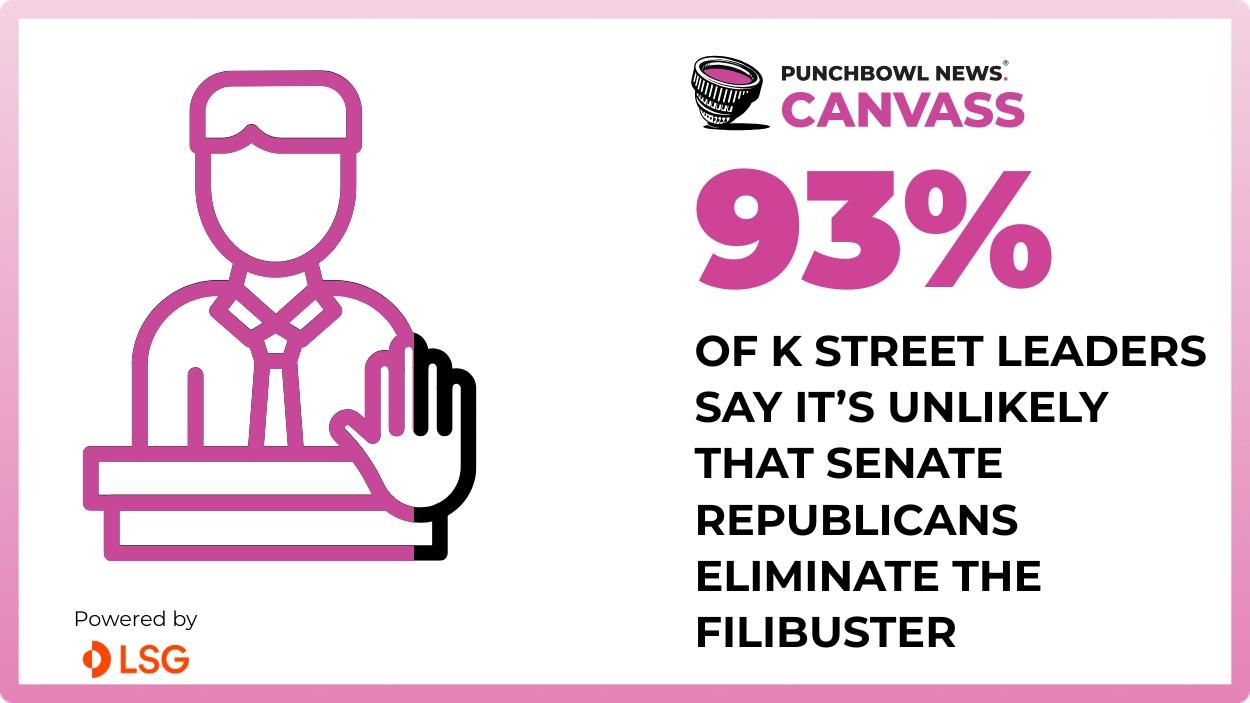
Nearly all K Street leaders say it’s unlikely that Senate Republicans will eliminate the filibuster in 2026, according to our most recent Canvass survey.
President Donald Trump has publicly pressured the GOP to axe the filibuster to get some of his legislative priorities across the finish line.
Most recently, Trump insisted last week that Senate Majority Leader John Thune and Republicans gut the Senate tradition to pass the SAVE America Act, legislation requiring ID and proof of citizenship to vote.
A total of 55% of Republicans in our survey said passing the SAVE America Act would help their party in the midterm elections this November.
Notably, only 9% of GOP respondents believe it’s possible for their party to end the filibuster.
The Canvass K Street was conducted March 2-20 in partnership with independent public affairs firm, LSG.
Be a part of The Canvass! Our monthly survey provides insights from top Capitol Hill staffers and K Street leaders on the key issues facing Washington. Your answers are always anonymous.
Don’t miss out on your chance to be heard! Sign up here if you work on K Street. Click here to sign up if you’re a senior congressional staffer.
— Shania Shelton
AND THERE’S MORE
House Majority Forward, a nonprofit tied to House Minority Leader Hakeem Jeffries, has now given $20 million to Democrats’ pro-redistricting campaign in Virginia.
This is a staggering amount that underscores that the April referendum election is a must-win for Democrats. Virginians for Fair Elections, the vote yes campaign, reported $38.3 million in contributions. That group is also out with a new TV and digital ad, featuring veterans urging a yes vote on April 21.
Ad news. Michigan Families for Fair Care, a liberal outside group, is airing a $150,000 ad buy attacking gubernatorial candidate Rep. John James (R-Mich.). In the spot, a Warren, Mich., resident says she’s struggling with rising health care costs and blames James’ votes.
– Ally Mutnick and Max Cohen
PRESENTED BY META


Presented by AstraZeneca

The 340B program is supposed to help vulnerable patients—but without strong safeguards, it’s siphoning away funds that could be used for free and charitable medicine. The 340B Rebate Model Pilot improves program integrity, preventing duplicate discounts and strengthening accountability. Urge HHS to implement the pilot today. Learn why it matters.

Crucial Capitol Hill news AM, Midday, and PM—5 times a week
Join a community of some of the most powerful people in Washington and beyond. Exclusive newsmaker events, parties, in-person and virtual briefings and more.
Subscribe to Premium
Special Projects
Explore our deep dives into the issues that matter the most today and will shape tomorrow's future, with expert reporting that goes beyond the headlines and into the heart of the Capitol.
Check it outEvery single issue of Punchbowl News published, all in one place
Visit the archive
Presented by AstraZeneca
The 340B program lacks transparency—making it hard to tell if it’s actually helping vulnerable patients. HHS can fix the problem by implementing the 340B Rebate Model Pilot, ensuring the program is transparent, compliant, and accountable. Learn more.