


October 2, 2025



PRESENTED BY

THE TOP
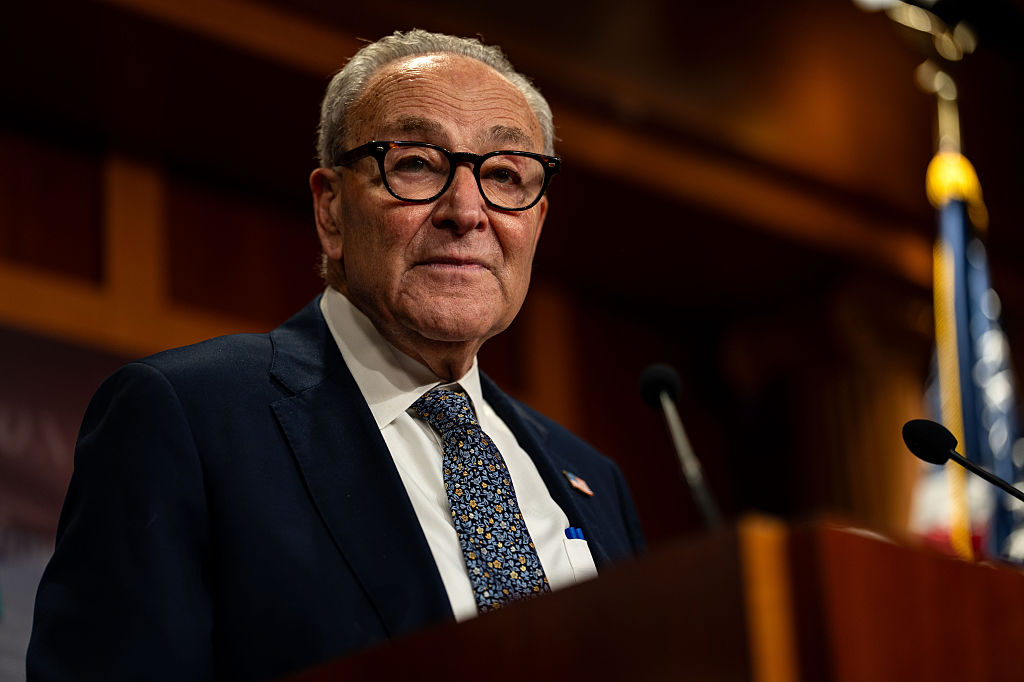
Will Schumer’s strategy work?
Happy Thursday morning. G’mar chatima tovah to those observing Yom Kippur.
It’s Day Two of the government shutdown. It’s difficult to see real movement toward a resolution to the standoff anytime soon.
The Senate isn’t voting today in observance of Yom Kippur. Senators will vote again Friday on both the House-passed Nov. 21 stopgap funding bill and the Democratic counter-proposal. Senate Majority Leader John Thune and Minority Leader Chuck Schumer may meet Friday, their first one-on-one sitdown during this standoff.
This is new: If Democrats block the GOP’s stopgap funding measure again on Friday, Thune will send senators home for the weekend and then force another vote Monday. That means no Saturday votes as originally planned.
There are some informal bipartisan talks centering around Democrats’ chief demand: an extension of the Obamacare enhanced premium tax credits. We took you inside that big bipartisan Senate floor huddle in Wednesday’s Midday edition.
But they’re just that — talks. Party leaders aren’t directly involved. There’s no Senate “gang” to break the deadlock. And the fundamentals of the showdown haven’t changed.
Democrats say they can’t trust Republicans and the White House to clinch a bipartisan deal on Obamacare subsidies without a forcing mechanism. Republicans maintain that negotiations can’t take place until the government is reopened. Even then, getting Hill Republicans on board with an Obamacare deal would be a major challenge, with conservatives opposing any extension. Which brings us back to square one — Democrats’ desire for a guarantee that Thune simply can’t give them.
Additionally, President Donald Trump and OMB Director Russ Vought’s aggressive moves targeting infrastructure and energy projects in blue states are backfiring. Democrats are digging in deeper. If the White House goes ahead with mass layoffs of federal employees, that could drive wobbly Senate Democrats away from the GOP CR and toward Schumer.
Inside Schumer’s thinking. Republicans say Schumer is simply playing to the far left to fend off a primary challenge from Rep. Alexandria Ocasio-Cortez (D-N.Y.) in 2028.
It’s difficult to imagine that Schumer isn’t at least thinking about that, given the long arc of progressives’ anger at him for folding during the March funding fight. But in reality, Schumer’s top priority is the 2026 midterms — and shoring up his standing for the Democratic Caucus leadership elections that will follow soon after.
“I obviously ended up in a different place than leadership in March, but I understood it was a very tough call. I don’t think it’s a tough call this time,” Sen. Chris Murphy (D-Conn.) said.
For now, Schumer is reflecting the will of his caucus. While Democrats aren’t necessarily happy with a shutdown, they’re reasonably satisfied with where things stand — at least publicly. Schumer’s shutdown strategy has the backing of progressives, moderates, vulnerable in-cycle Democrats and even those senators representing states with a large population of federal workers.
“Schumer and Thune are talking about what would it take to re-open government, what are Democrats’ concerns about health care costs,” said Sen. Chris Coons (D-Del.), known as a bipartisan dealmaker. “This is not going to be easy to solve. But our caucus is united, and Schumer is leading well in this moment.”
“It’s not just that there’s a plan, it’s that if we care about our constituents, then let’s show them that,” Sen. Ben Ray Luján (D-N.M.) said when asked about Schumer’s endgame.
Dangers ahead. Yet Wednesday’s massive Senate floor huddle could be a sign some Democrats are already looking for a way out of the shutdown mess. There are Democrats who fear Schumer doesn’t have a real plan for ending the standoff, citing his unsuccessful bid to eliminate the legislative filibuster in 2022 and his March funding strategy as examples of previous missteps.
And there are real concerns about how a shutdown harms average Americans. Sen. Catherine Cortez Masto (Nev.), one of three Democrats now backing the GOP CR, made clear this week that she didn’t want any part of that.
“That just shows you how ridiculous the arguments are on both sides that they’re willing to harm Americans,” Cortez Masto told reporters.
But as of now, Cortez Masto is an outlier and there were no new Democratic defections.
There are several risks for Schumer the longer this drags on. The first is that he suffers a March-like shellacking from the Democratic base if he folds with nothing to show for it — especially if the shutdown lasts a while and progressives are primed to believe Schumer is in it for the long haul.
GOP leaders also are very comfortable with the argument they’re making — Democrats must vote to reopen the government before anything else can be discussed. However, it’s difficult to see Thune agreeing to something significant enough that Democratic leaders could latch onto to justify voting for a CR.
Even if Schumer is able to point to some sort of victory — whether on Obamacare subsidies or something else — there’s a significant faction of the Democratic Caucus that opposes funding “Trump’s government” at all. It’s the same problem Sen. Mitch McConnell (R-Ky.) had with conservatives during his tenure as GOP leader.
Take Sen. Jon Ossoff (D-Ga.), for example. Ossoff is the most vulnerable in-cycle Democrat but is fully behind Schumer’s strategy. Ossoff sidestepped questions about Schumer, instead pivoting to Trump.
“The president needs to be in the room right now with congressional leaders,” Ossoff told us. “They have the White House, they have the Senate, they have the House. This is a question of presidential leadership.”
Also: In a sign of the pressure Schumer is facing from the base, the progressive group MoveOn is mobilizing a large-scale call campaign to urge Senate Democrats to continue opposing the GOP CR.
— Andrew Desiderio, John Bresnahan and Max Cohen
Don’t forget to RSVP for our conversation with Rep. Richard Hudson (R-N.C.) on Thursday, Oct. 9 at 9 a.m. ET. We’ll discuss the news of the day, 5G and spectrum policy. RSVP here!


HASSETT ON FLY OUT DAY
Fly Out Day: Hassett on the shutdown, the Fed and more
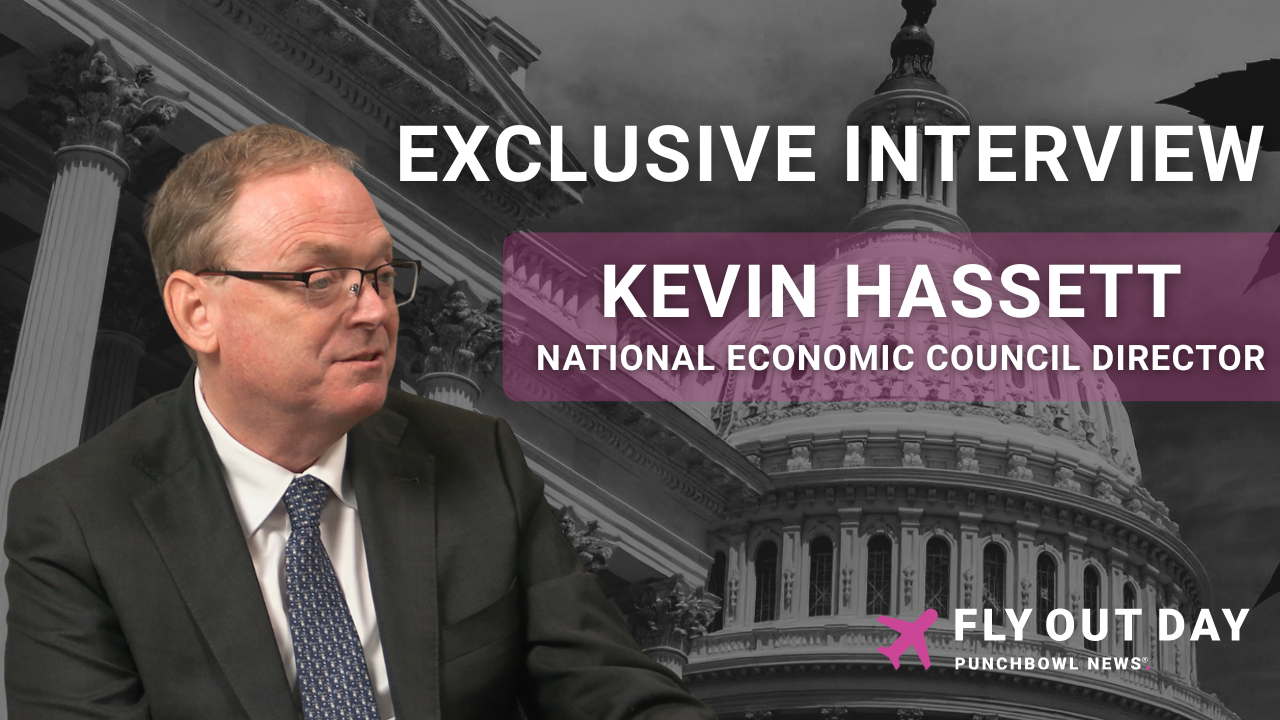
National Economic Council Director Kevin Hassett, President Donald Trump’s top economic adviser, said he wants Democrats to vote to open the government but understands why Senate Minority Leader Chuck Schumer and House Minority Leader Hakeem Jeffries have chosen the funding deadline to pick a fight.
“The issue is that if you’re a minority party, then you don’t necessarily have a lot of leverage over anything,” Hassett said. “And there are a few things like debt limit increases and government shutdowns that give the minority party some leverage. I don’t agree with the Democrats’ position right now, but I do think that it serves democracy for the minority party to have some leverage now and then.”
Hassett came to the Punchbowl News Townhouse on Wednesday to talk about the shutdown, tariffs and even weighed in on the process to select the next chairman of the Federal Reserve.
The shutdown. Hassett, a University of Pennsylvania PhD who was in the first Trump administration, has a unique perch in the White House. He’s the most important economic adviser to the president of the United States. And the Trump administration is taking a different strategy in this shutdown than previous White Houses did.
The Trump administration has said that OMB Director Russ Vought could use the shutdown to drastically reshape the federal bureaucracy. Vought has already stopped funding for the Hudson Tunnel Project and the Second Avenue Subway in New York City and canceled green energy projects in a number of blue states.
Hassett said that Cabinet secretaries can use a shutdown “as an opportunity to change the structure of the human resources team or whatever.”
“And I think the hope is that that doesn’t happen, that the Democrats come back tomorrow, the next day, open the government,” Hassett said. “But I think that it should put a lot more pressure on the Democrats to know that they’re playing with fire a little bit. Because it is possible for Cabinet secretaries, if they so choose, to have reductions in force.”
Hassett added that if it is a long shutdown, “then there would be an economic impact, for sure.”
Hassett sounded a bit bearish on a straight extension of enhanced premium tax credits for Obamacare. Congressional Republicans want to overhaul the tax credits, which are at the heart of the shutdown, while Democrats are seeking a permanent extension. The credits expire at the end of the year, although insurance companies are already raising premiums dramatically.
“They could have made it permanent if they wanted,” Hassett said of Democrats, who extended the credits for three years.
Hassett’s view is that the credits go to middle-income earners, which he views as a political decision.
“You have to choose, where are you going to spend your money?” Hassett said. “You could spend your money on the people that most need it, or are you going to expand the base to people who maybe are more likely to vote for you? And I think that there’s a pretty clear case to be made the expansion of the Affordable Care Act subsidies deep into many times the poverty level is a budgetary problem that potentially could undermine the care for people who really need it.”
The Fed. Trump has said that Hassett is one of the candidates to succeed Jay Powell as the next chair of the Federal Reserve.
Hassett told us he hasn’t had a formal interview to be the next central banker. Hassett did say that Powell should leave the Federal Reserve board when his term is up as chair.
And Hassett also said he thinks the Fed should continue to cut rates aggressively.
“All of a sudden, if inflation takes off next week, you would have to reconsider,” Hassett said. “I think the politically neutral Federal Reserve should be data dependent, and they should watch their targets and make sure that we hit them.”
– Jake Sherman


Tech: Paul shrugs at expiration of cyber law
Senate Homeland Security Committee Chair Rand Paul (R-Ky.) downplayed challenges companies face in discussing cyber-threats with the federal government following the recent lapse of a liability law that businesses are pushing Congress to reauthorize.
“Nothing stops industry from sharing the information to protect cybersecurity,” Paul told us. “It’s a farce and a false argument that somehow something’s going to change.”
Paul’s comments on the Cybersecurity Information Sharing Act come as businesses ask the Hill that any move to reopen the government extend the provision for at least a short time. Industry is also looking to Paul’s committee for a longer-term solution.
The CISA provision expired Sept. 30 and had exempted businesses from certain types of liability. It gave businesses sharing information on cyber-threats, some immunity on antitrust, protections for trade secrets and release from public records laws.
Paul did concede that the lapse of CISA could actually cause some changes in cyber threat-sharing practice.
“All that would change is, industry would have to be a little bit careful about obeying their contracts they have with their consumers,” the chair said.
The Kentucky Republican made clear he’s committed to using reauthorization to forbid a cybersecurity agency (also known as CISA) “from meeting with legacy media, internet media… to try to restrict or coerce the taking down of constitutionally protected speech.”
And Paul said that’s the price for a deal. “We’re going to have to protect the First Amendment if you want your CISA stuff back.”
Corporate America has insisted on the value of the safe harbor.
“In cybersecurity, time matters,” said Amy Shuart, vice president of technology and innovation at the Business Roundtable, a trade group for top CEO’s. “When you’re shifting the decision to share information from the [chief information security] office to the general counsel’s office, that is a delay in being able to share actionable intelligence.”
While CISA reauthorization is broadly popular and was included in the failed Republican and Democratic continuing resolutions, Paul has repeatedly blocked unanimous consent requests to extend the CISA law.
Carr news. Federal Communications Commission Chair Brendan Carr will testify before the Senate Commerce Committee before the year’s end.
The hearing will place Carr face-to-face with the panel’s chair, Sen. Ted Cruz (R-Texas), who compared Carr to a “mafioso” over his reaction to Jimmy Kimmel’s comments about Charlie Kirk’s alleged murderer. The hearing will be on free speech and potential government “censorship” issues.
— Ben Brody and Diego Areas Munhoz
PRESENTED BY HCA HEALTHCARE

When flooding from Hurricane Milton closed Pinellas County’s only transplant program, HCA Florida Healthcare acted quickly to provide uninterrupted, lifesaving care to patients like Jennifer.
MILITARY PAYCHECKS
Will Congress move to pay troops during shutdown?
National security has taken a front-row seat in the messaging war over the federal government shutdown. But that doesn’t mean a bill to continue military pay would sail through Congress.
Lawmakers have a short window to move legislation before Oct. 15, when troops are slated to miss their first paychecks if the shutdown continues.
The bill is from Rep. Jen Kiggans (R-Va.), and it has support from 68 Republicans and 23 Democrats. It would cover military service and Coast Guard members.
In some past shutdowns, Congress has moved to make sure troops get paid. But this clash seems different.
It’s not clear whether GOP leadership would be inclined to take up the Kiggans bill. Republicans believe they have the upper hand in the shutdown fight and have been looking to make the government closure as painful as possible for Democrats.
One day into the shutdown. Republicans have been hitting Democrats hard for the threat they say the lapse in funding poses to national security.
But Democrats have been pointing fingers right back at GP leaders. Sen. Elizabeth Warren (D-Mass.), the top Democrat on the Armed Services personnel panel, repeatedly told us “You’d have to ask the Republicans” when we asked about passage of a standalone military pay bill and whether she’d support the measure.
Other lawmakers are pushing for a quick resolution of the shutdown crisis. “My hope is that we can negotiate a way out of this within one pay period,” Sen. Chris Coons (D-Del.) told us.
Outside military groups have already started weighing in. The National Guard Association of the United States has urged congressional leaders to pass Kiggans’ bill. And more letters are coming, NGAUS President Francis McGinn told us Wednesday.
— Briana Reilly
MAJORITY MATH
More than 100 House Democrats are sending a letter to Speaker Mike Johnson urging him to swear in Rep.-elect Adelita Grijalva (D-Ariz.) when the House meets for a pro forma session on Friday.
The letter notes that Grijalva won the recent special election to replace her father, the late Rep. Raúl Grijalva, by a large margin. Three other members who won special elections this year, Reps. Randy Fine (R-Fla.), Jimmy Patronis (R-Fla.) and James Walkinshaw (D-Va.), were all sworn in 24 hours after their respective wins, the Democrats wrote.
“Per your office’s confirmation, the House has already received the appropriate paperwork necessary from the state of Arizona. Despite this and the established precedent, Representative-elect Grijalva’s ceremony is still not set,” the members wrote in a draft of the letter.
The effort is championed by the Congressional Hispanic Caucus. Democrats have accused Republicans of delaying Grijalva’s swearing-in to avoid having to set a vote to force the release of the Jeffrey Epstein files. Grijalva would be the 218th member to sign a discharge petition to force such a vote.
– Ally Mutnick


Presented by AstraZeneca

The 340B program is supposed to help vulnerable patients—but without strong safeguards, it’s siphoning away funds that could be used for free and charitable medicine. The 340B Rebate Model Pilot improves program integrity, preventing duplicate discounts and strengthening accountability. Urge HHS to implement the pilot today. Learn why it matters.

Crucial Capitol Hill news AM, Midday, and PM—5 times a week
Join a community of some of the most powerful people in Washington and beyond. Exclusive newsmaker events, parties, in-person and virtual briefings and more.
Subscribe to Premium
Special Projects
Explore our deep dives into the issues that matter the most today and will shape tomorrow's future, with expert reporting that goes beyond the headlines and into the heart of the Capitol.
Check it outEvery single issue of Punchbowl News published, all in one place
Visit the archive
Presented by AstraZeneca
The 340B program lacks transparency—making it hard to tell if it’s actually helping vulnerable patients. HHS can fix the problem by implementing the 340B Rebate Model Pilot, ensuring the program is transparent, compliant, and accountable. Learn more.