

December 18, 2025



PRESENTED BY

THE TOP
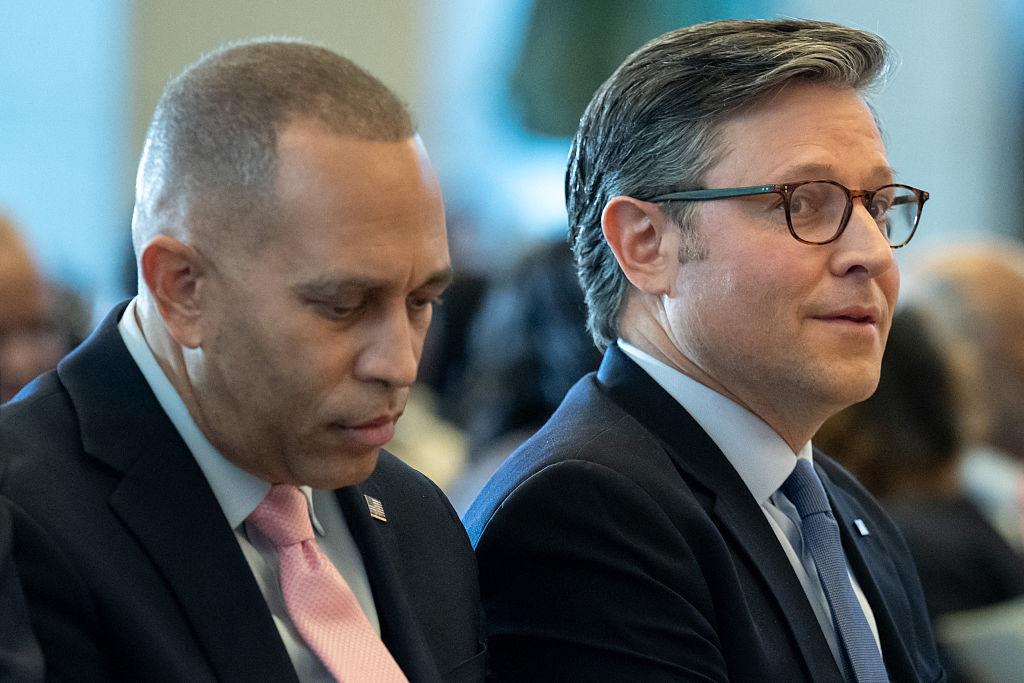
Johnson, Jeffries, GOP mods and a crazy week
Happy Thursday morning.
It’s said there are two sides to every story. But in the House, there are usually dozens.
And after a week like this — a chamber out of control, frayed nerves, angry lawmakers and an embattled speaker — there are endless takes about how the House descended into the chaotic mess it’s become. We’ll get into all of that.
But let’s start with one bright spot for Speaker Mike Johnson. The House on Wednesday evening passed a narrow Republican-drafted health care bill on a party-line 216-211 vote. Rep. Thomas Massie (Ky.) was the only Republican who voted against the bill.
This proposed GOP legislation includes limited reforms of pharmacy benefit managers, cost-sharing reduction and association health plans. The Congressional Budget Office says that the legislation would result in 100,000 people losing their health care, but premiums would fall 11%.
However, these are all policies that the House has passed before — and they’ve been rejected by the Senate. If Senate Majority Leader John Thune brings this bill up, Democrats will almost certainly block it.
So in less than two weeks, millions of Americans will see a huge spike in their premiums or they’ll lose coverage as Congress goes over the Obamacare cliff.
This plays into the growing economic fears felt by many Americans. President Donald Trump spoke to this issue in his Wednesday night address from the White House, although it’s clear Republicans are going to have to go a lot further than he did if they want to turn things around.
In fact, if you zoom out right now, congressional battles are being played, in large part, on Democrats’ turf. They have Republicans talking about health care. Johnson says House Republicans will spend a good chunk of next year on the issue, a topic on which the GOP is typically weak. Next month also will be about government funding and social programs, which again favor Democrats.
On Johnson. This health care episode was a debacle for the House Republican leadership. There’s no other way to put it.
Reps. Brian Fitzpatrick (R-Pa.), Ryan Mackenzie (R-Pa.), Rob Bresnahan (R-Pa.) and Mike Lawler (R-N.Y.) not only signed a discharge petition to force a vote on a three-year extension of the enhanced Obamacare premium subsidies, they signed House Minority Leader Hakeem Jeffries’ discharge petition. They sided with the Democratic leader who will spend tens of millions of dollars to defeat the House GOP majority next year and become speaker himself.
The result: the House will be forced to vote in January on these subsidies — something that’s wildly unpopular in the broader House Republican Conference. Party leadership is supposed to protect their members from bad votes. The GOP leadership didn’t successfully do that here.
Johnson and House Majority Leader Steve Scalise argue that they tried to assuage Fitzpatrick’s group. They say that most of the “Five Families” — the different ideological factions of the House GOP — were on board with the Republican leadership’s plan to offset the Obamacare subsidies and insert Hyde Amendment protections in exchange for a floor vote. Part of that deal would’ve also canceled out Fitzpatrick’s discharge petition and another bipartisan one.
But this was a deal that Fitzpatrick’s group couldn’t accept. Why would Fitzpatrick and other moderates agree to offset the subsidies and add restrictive abortion language when there were discharge petitions to extend the subsidies without any such strings? Plus, the offsets weren’t palatable.
The moderates also argue that they’ve been dragged around by conservatives all Congress and Johnson should’ve just given them a vote — they’re the majority makers after all. Johnson says that would’ve been impossible.
There’s no doubt that Johnson has an incredibly difficult hand to play — a three-seat majority is a treacherous thing. But politics isn’t played on a curve. It’s played with the reality that you have.
This is also true: Since the One Big Beautiful Bill Act passed in July, there’s been a feeling among rank-and-file House Republicans that their leadership has been adrift, lacking any plan for what to do next. Trump, meanwhile, has gone in his own direction on foreign policy, immigration, pushing the limits of executive power and a myriad of other issues.
It also didn’t help that Johnson kept the House out of session for 54 days during the longest government shutdown in American history — a shutdown that Democrats caused. While many House Republicans were supportive of the move at the time, they returned to Washington as free agents, more focused on saving their own political careers than caring what leadership wanted.
Johnson insists this is the most productive Congress in recent memory. And Johnson did succeed in getting the reconciliation bill through by his aggressive July 4 deadline.
But Trump has signed 57 bills into law in this Republican governing trifecta. Former President Joe Biden signed 81 into law by the end of 2021. Trump signed 97 into law by the end of 2017. Former President Barack Obama signed 125 into law by the end of 2009.
On Jeffries. There is no doubt that Jeffries has a markedly easier job. When you’re in the House minority, just vote no. But let’s spend a second talking about him.
Jeffries and Senate Minority Leader Chuck Schumer shut down the government in October over their demand for the Obamacare subsidies to be extended. It was a damaging move for the country and a huge gamble for them politically. But Democrats “won” the shutdown in the long term.
Over this last month, House Democrats have worked with rebellious Republicans to get 218 signatures on three different discharge petitions, a stunning rebuke for Johnson and his leadership team.
Jeffries played his hand wisely during this Obamacare cliff fight. Jeffries was under pressure to throw his support behind a pair of other discharge petitions — one authored by Fitzpatrick and another by Rep. Josh Gottheimer (D-N.J.) — but he didn’t. Jeffries bet that the moderates would see the 214 Democratic signatures on his clean, three-year ACA subsidies petition and sign on. And they did.
– Jake Sherman and John Bresnahan
Don’t miss: Our annual Canvass special edition comes out today. All year long, leaders on K Street and Capitol Hill have weighed in on the top issues in Washington. We’ve got a breakdown of the numbers. Plus, a look at some predictions from our Canvass respondents for 2026. Check your inboxes later this morning for more.
Share Your Thoughts – Take Our Survey Now! Your feedback will play a crucial role in shaping the future of Punchbowl News. And by doing so, you’ll be entered to win Punchbowl News swag. Don’t miss out, take the survey here!


FUNDING FIGHT
January spending sprint takes shape
Democrats won’t flirt with a government shutdown ahead of the Jan. 30 funding deadline and instead want to see a bipartisan appropriations process, Senate Minority Leader Chuck Schumer said on Wednesday.
In an interview in his Capitol office — we’ll feature much more on Friday — the New York Democrat telegraphed a very different posture for his party compared to the last funding deadline, which saw Democrats instigate the longest shutdown in U.S. history over health care subsidies.
Schumer noted that the enhanced Obamacare subsidies will have expired by Jan. 30, and he argued that Republicans have shown they’re incapable of striking a bipartisan deal anyway. Democrats also feel like they’ve succeeded in making health care a top-of-mind issue for voters next November.
“As of Jan. 1, that is a different time than before because the ACA [subsidies] expired,” Schumer told us. “On the other hand, we’d like to get an appropriations bill done. That’s a Jan. 30 deadline … We’re trying to work with the Republicans to get it done.”
To be sure, there will be many Democrats who want to use Jan. 30 as leverage in the Obamacare fight or something else. But Schumer is reflecting the reality that there likely aren’t enough Democrats willing to plunge into another shutdown.
“My sense is that approach and the question of the health care subsidies are now not on the same tracks. They’re not on the same timeline,” said Sen. Brian Schatz (D-Hawaii), an appropriator and the likely next Democratic whip. “Because appropriations is going — I wouldn’t say well, but better than it had been — there’s a desire to get that done.”
Reality check. Democrats’ posture is a notable shift, but there are still major obstacles to averting a shutdown. Both chambers are far behind schedule on finalizing full-year FY2026 funding bills and key disagreements remain.
The Senate is trying to lock in an agreement before leaving for recess today that would set up floor action on a long-stalled package of five funding bills.
The Senate package would include Transportation-HUD, Defense, Labor-HHS, Commerce-Justice-Science and Interior.
Senate GOP leaders on Wednesday were finally able to clear the remaining objections from fiscal hawks who oppose the inclusion of earmarks in the funding bills. Democratic leaders are now checking for objections and amendment vote requests on their side, but say it’ll likely take longer than just a day.
More broadly, senators from both parties said on Wednesday that appropriators and leadership aides will need to spend much of the holiday break working to reconcile both chambers’ funding bills. The Senate Appropriations Committee hasn’t even posted its Homeland Security or State Department-Foreign Operations bills.
“It’s not gonna be easy, but we can get it done,” said Sen. Mike Rounds (R-S.D.), an appropriator.
Senate Appropriations Committee Chair Susan Collins (R-Maine) and House Appropriations Committee Chair Tom Cole (R-Okla.) have been trading offers on topline spending figures for individual bills.
The House. Cole has been adamant that the Senate’s five-bill minibus is too big to move in the House.
Instead, Cole wants to see trios of funding bills pass the House, one for each week the House is in session in January. Republican appropriators are still working out which bills would go first, but Defense and Labor-HHS would likely go last.
Cole also talked with some top House Democratic appropriators this week about their priorities in the remaining funding bills.
As part of the deal to end the government shutdown in November, Congress passed a three-bill minibus funding Legislative Branch, MilCon-Va and Agriculture for FY2026.
Cole said the rest of this appropriations process needs to move “in a bipartisan way.”
“We’re not trying to jam anybody,” Cole said. “There’s a lot of raw feelings after the shutdown. We’re trying to restore the trust inside the committee.”
— Andrew Desiderio and Samantha Handler

THE HOUSE
House Dems wage new discharge petition strategy
House Democratic leaders are trying to upend the chamber once again.
House Democrats — with the backing of their leadership — are preparing to file a discharge petition on a new stock trading ban. The petition is meant to compete directly with Rep. Anna Paulina Luna’s (R-Fla.), which has been accruing signatures. That petition currently has 74 backers, including 59 Democrats.
Several Democrats told us that House Minority Leader Hakeem Jeffries’ leadership team has been quietly urging them to back away from Luna’s petition.
Luna’s bill would restrict stock trades by members and senators. But the Democratic proposal, offered by Reps. Seth Magaziner (D-R.I.), Pramila Jayapal (D-Wash. ) and Joe Morelle (D-N.Y.) this week, would also target President Donald Trump and Vice President JD Vance, a dealbreaker for many Republicans. Magaziner said he submitted the bill at the behest of the Democratic leadership.
The Democratic proposal is also amendable, while the Luna measure isn’t. This means Democrats can make a deal if necessary to attract additional GOP support.
This all comes after Jeffries successfully pushed a discharge petition to extend the expiring enhanced Obamacare subsidies. Four Republicans signed on Wednesday to force a vote in January, a huge rebuke to Speaker Mike Johnson.
Strategy shift. Vulnerable and disaffected House Republicans have transformed discharge petitions from long-shot messaging tools into very real vehicles to get bills to the floor.
That’s opened a door like never before for Democrats, completely changing the strategy for House Democratic leadership.
House Democratic leaders now view any discharge petition they file on a bill with a remote shot at Republican buy-in as a live option. That means they’re looking at bills they put up as having a real chance at becoming law — or at least passing the House.
In addition to the Obamacare subsidies, look at the successful effort to release the Jeffrey Epstein files and Rep. Jared Golden’s (D-Maine) discharge petition to restore collective bargaining rights for federal workers. The House passed Golden’s bill last week.
In this new reality, Democratic leaders need to carefully plot their moves on each discharge petition. It also means that if Democrats feel a compromise petition is a bad deal, Democratic leadership needs to fight back or risk watching their members put it over the top.
“I do think you see members very strategically working across party lines to craft a discharge petition that could potentially actually be successful instead of being a messaging bill,” said Rep. Joe Neguse (D-Colo.), a member of leadership.
Jeffries said Democrats will keep seizing on certain discharge petitions.
“Listen, we’re going to continue to use every procedural tool available to make life better for the American people,” Jeffries said.
— Laura Weiss, Heather Lorenzo and John Bresnahan
PRESENTED BY DUKE ENERGY

At Duke Energy, we’re focused on keeping prices low and supporting growing energy needs. From infrastructure investments to tech advancements, progress will not be slowed.
THE MIDTERMS
Filing deadlines to watch
Republicans are bracing for a slew of retirements as the holidays approach. And both parties are scrambling to plug last-minute recruitment holes.
This behind-the-scenes maneuvering reaches a fever pitch as state filing deadlines approach. The days before those deadlines are often action-packed.
The fields are set in Texas, Arkansas and Illinois, where filing deadlines have already passed. Both Texas and Illinois had filing day surprises, with former Rep. Colin Allred (D-Texas) exiting the Senate race and Rep. Chuy Garcia’s (D-Ill.) controversial retirement move.
Here’s where to look next.
December: North Carolina (12/19) and Mississippi (12/26).
The Tar Heel state once again has a new congressional map. Republican Laurie Buckhout announced Wednesday she’ll seek a rematch with Rep. Don Davis (D-N.C.) in the 1st District.
Democrats launched a recruitment campaign to land someone to run against Rep. Greg Murphy (R-N.C.) in the 3rd District. They may have been successful. Former state Rep. Raymond Smith entered the Democratic primary. Smith is a Gulf War combat veteran.
January: Kentucky (1/9), Alabama (1/23) and West Virginia (1/31).
February: New Mexico (2/3), Ohio (2/4), Indiana (2/6), Louisiana (2/13), Maryland (2/24) and Idaho (2/27).
Maryland will likely need to move its primaries if it does decide to redistrict. And it becomes harder to do so once the filing deadline passes.
Meanwhile, Democrats still have some recruiting to do in Ohio, where they plan to target GOP Reps. Mike Turner, Mike Carey and Max Miller.
Correction: An earlier version of this story had the incorrect date for Oklahoma’s filing deadline. Oklahoma’s filing deadline is April 3.
– Ally Mutnick
THE CAMPAIGN
News: We told you in Wednesday’s AM edition that GOP Rep. Rob Wittman (Va.) confronted Virginia Gov.-elect Abigail Spanberger over redistricting during a meeting Tuesday.
But that wasn’t the only gathering to touch on a potential redraw. House Minority Leader Hakeem Jeffries huddled with Virginia state house Speaker Don Scott on Tuesday and asked if Scott would be willing to accept outside help on the new map, per multiple sources familiar with the meeting.
Democratic Rep. Bobby Scott, the dean of Virginia’s delegation, also joined. The Virginia delegation will likely discuss redistricting again next week.
Democrats in DC and Richmond are committed to redistricting. But there are outstanding questions on two issues.
First, will Democrats try to pick up three seats? Four? Some members of the delegation are unsure a 10D-1R map will work. But Don Scott and Virginia Senate President Pro Tempore L. Louise Lucas have been pushing that configuration.
Next, will Democrats show voters a proposed map before the referendum to amend the state constitution and scrap the independent redistricting commission? Presenting a map before the vote would be more transparent, but it could also risk turning off voters if it looks too gerrymandered.
Endorsement watch. The Congressional Hispanic Caucus BOLD PAC is endorsing Lisa Ramirez in California’s 40th District. This seat is currently represented by Rep. Young Kim (R-Calif.).
— Ally Mutnick and Max Cohen


Presented by Comcast

Live sports streaming has driven many of the top 10 Internet traffic events in Comcast network history in just the past two years alone. Comcast is innovating its network so fans can stream the biggest moments in sports with the most reliable connection and ultra-low latency.

Crucial Capitol Hill news AM, Midday, and PM—5 times a week
Join a community of some of the most powerful people in Washington and beyond. Exclusive newsmaker events, parties, in-person and virtual briefings and more.
Subscribe to Premium
The Canvass Year-End Report
And what senior aides and downtown figures believe will happen in 2023.
Check it outEvery single issue of Punchbowl News published, all in one place
Visit the archive
Presented by Comcast
Live sports streaming has driven many of the top 10 Internet traffic events in Comcast network history in just the past two years alone. Comcast is innovating its network so fans can stream the biggest moments in sports with the most reliable connection and ultra-low latency.