

December 5, 2025



PRESENTED BY

THE TOP
Thune’s leadership style put to the test
Happy Friday morning.
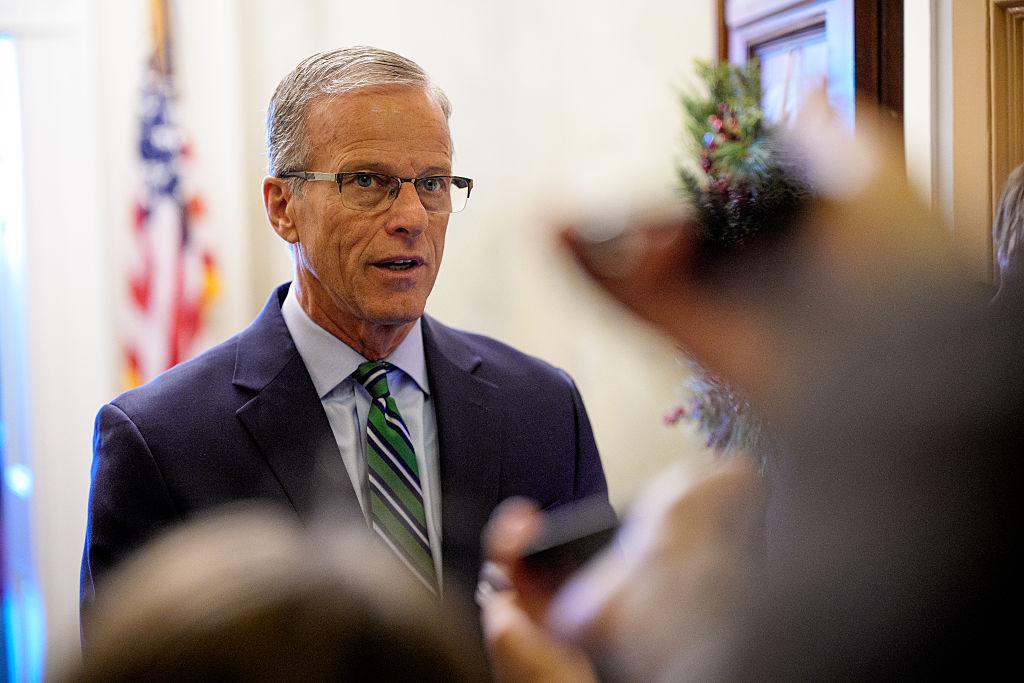
Senate Majority Leader John Thune is in unfamiliar territory — taking heat from all sides of his conference with no clear path out of the mess. It’s a precarious position for Thune, one that’s testing the limits of the leadership philosophy that helped him win the job.
Less than a year into his tenure as Senate Republican leader, Thune has been able to successfully steer Republicans through some of the most challenging moments of his career. From the One Big Beautiful Bill Act to Cabinet nominations to a record-breaking government shutdown and a high-profile rules change, Thune has allowed the GOP conference to reach a consensus on its own rather than dictating an outcome from above.
And Thune has done all of this without getting on the wrong side of President Donald Trump, a huge feat on its own.
But amid the year-end frenzy, the strategy that helped Thune score big wins earlier this year is failing to produce results on multiple fronts, angering several GOP factions simultaneously and reviving longstanding tensions within the conference.
Thune is getting heat from both conservatives and appropriators as he struggles to break the logjam on a FY2026 funding package. This threatens to derail his promise to return to regular order on appropriations bills.
Senate Republicans are flailing around on health care, unable to decide whether to offer their own plan to counter next week’s vote on Democrats’ Obamacare subsidy bill.
And the uproar over a Thune-backed provision allowing senators to sue the federal government if their phone records are obtained is still playing out.
There aren’t any Republican senators taking open shots at Thune. The affable South Dakota Republican faces nowhere near the internal heat that Speaker Mike Johnson has to deal with on a daily basis.
Yet it’s new terrain for Thune, who had a front-row seat to similar drama when he served as Mitch McConnell’s No. 2 prior to becoming leader.
Some Republicans are wondering whether Thune should go “full McConnell” if the current headaches persist — meaning governing with an iron fist. For the moment, Thune seems to be ruling that out.
“We’re trying to go through the concerns that our members have and hoping we can land something soon,” Thune told us on the funding situation. “We need to legislate and do appropriations bills the old-fashioned way under regular order.”
Thune’s Way. When Thune launched his bid to succeed McConnell as GOP leader, the veteran senator knew he needed to distance himself from the Kentucky Republican’s leadership style, which had become incredibly unpopular among Senate Republicans.
So Thune made a number of promises that marked an explicit departure from the McConnell era. This included making decisions based on the will of the Senate GOP conference and ending the practice of crafting “omnibus” spending bills in secret negotiations.
“He’s very good about giving everybody a chance to have their input,” Sen. John Hoeven (R-N.D.) said. “He’s patient, works through everything diligently.”
Health care. Senate Republicans are having vigorous internal debates over health care and how to address their broader political problem of affordability. But ahead of next week’s planned Senate vote on Democrats’ bill to extend Obamacare subsidies, Republicans haven’t coalesced around a health care plan of their own.
As of Thursday, Thune hadn’t decided whether Republicans will even offer an alternative to the Democratic proposal. Some GOP senators think it’s political malpractice not to present a plan that would avert massive premium hikes in the new year. Others don’t see a reason to engage in what is essentially a political exercise for Democrats, especially since there isn’t anything concrete that unites Republicans.
Rank-and-file senators want Thune to be more proactive and make the tough decisions, especially with the White House disengaged.
“We’ve known about this cliff for a long time. Democrats spent the entire shutdown wringing our necks over it. And our leadership wasn’t ready with a response?” said a GOP senator granted anonymity to candidly assess the situation.
The irony is that many of the Republicans begging Thune to make these decisions criticized McConnell for doing the same.
Appropriations. Thune is trying to get all Republicans on board with a package of funding bills for floor consideration, but a group of fiscal hawks is standing in the way. The plan requires unanimous consent.
As we wrote in Thursday’s AM edition, some GOP appropriators have complained privately that Thune isn’t twisting enough arms. Appropriators spent all week pressing Thune to hold the first procedural vote on the effort as a way to ramp up pressure on the holdouts.
“Time is getting short, and we’re ready to go,” Senate Appropriations Committee Chair Susan Collins (R-Maine) said. Thune needs to keep a lot of people happy — especially Collins, who’s up for reelection next year and is the only Republican who could win that seat.
Conservatives believe Thune is embracing a funding effort that abandons the party’s values, citing higher spending levels and billions of dollars in earmarks. Those same senators are also pushing Thune to do a second party-line reconciliation bill next year — another divisive issue in the conference.
So Thune is in a no-win situation. He hasn’t been able to persuade fiscal hawks to drop their holds, and he’s got appropriators breathing down his neck to get the ball rolling on funding with the Jan. 30 deadline right around the corner.
— Andrew Desiderio and Max Cohen
Don’t miss: Our own Briana Reilly will be at the Reagan National Defense Forum in Simi Valley, Calif., this weekend — don’t miss her coverage in Monday’s AM newsletter. Expect a grab bag of news on NDAA, DOD’s newly finalized national security strategy, the domestic missile defense shield project known as Golden Dome and more.
This year’s lineup features a series of top Pentagon and administration officials ranging from Office of Management and Budget Director Russ Vought to Joint Chiefs of Staff Chair Dan Caine. Keynoting the forum will be Defense Secretary Pete Hegseth. Several key lawmakers are also planning to attend.


THE LONE STAR STATE
SCOTUS lets redrawn Texas map stay for 2026
The Supreme Court gifted Texas Republicans back their gerrymandered congressional map for the midterms Thursday evening, reversing a lower court ruling that invalidated the map last month.
It’s hard to overstate the importance of this SCOTUS opinion. House Republicans had suffered a string of redistricting setbacks that left many questioning the prudence of the Texas remap that started the nationwide scramble for seats. With this ruling, Republicans get five new red-leaning seats. They’re very likely to win at least three of them.
This decision is a lifeline for the GOP, coming just days before the Dec. 8 filing deadline in Texas.
Reversing a lower-court decision, the conservative majority on the Supreme Court said Texas was “likely to succeed on the merits of its claim” and that the lower court erred when it ruled the map was an illegal racial gerrymander.
Supreme Court Justice Samuel Alito issued a temporary stay of the lower court ruling shortly before Thanksgiving, so Thursday’s subsequent ruling wasn’t unexpected.
For those keeping count, Republicans have secured favorable new maps in Texas, North Carolina and Missouri. Democrats notched wins in California and Utah. Ohio’s new map is somewhat of a wash. The two biggest question marks remaining — Florida and Virginia.
Democratic shuffle. This ruling most heavily affects the Democrats in the Texas delegation. They’ve already been positioning behind the scenes for the available seats in the wake of the aggressive GOP gerrymander.
The new Republican-drawn map created red districts in the Rio Grande Valley, Dallas, Houston and around Austin. It displaced Democratic Rep. Julie Johnson and drew Democratic Reps. Lloyd Doggett and Greg Casar into one district.
If Rep. Jasmine Crockett (D-Texas) runs for Senate, as many expect she will, most Texas Democratic incumbents will have a seat.
Democratic Rep. Marc Veasey plans to run for the new version of Crockett’s Dallas-area district if she does make a statewide bid. Veasey’s home base in Fort Worth got drawn out of his new district.
That leaves Johnson open to run for the new version of Veasey’s seat. But that district is now heavily Hispanic and many Democrats expect a bid from Domingo García, a former president of the League of United Latin American Citizens.
Meanwhile, Doggett said he’d retire if the new map held up following pressure from Casar allies. Casar will run for the Austin-area seat.
Reps. Henry Cuellar (D-Texas) and Vicente Gonzalez (D-Texas) will now have to run in districts that President Donald Trump won handily in 2024. But both plan to seek reelection. Trump issued a stunning pardon for Cuellar this week in a federal bribery and money-laundering case.
The loss of a Democratic-leaning district in the Houston area means there will only be one winnable seat for Rep. Al Green (D-Texas) or the eventual winner of the race to succeed the late Democratic Rep. Sheila Jackson Lee.
– Ally Mutnick

HEALTH CARE FIGHT
House GOP leaders’ health vote dilemma
Speaker Mike Johnson said Thursday that House Republicans are close to wrapping up their health care bill. Johnson said it will be finalized Monday or Tuesday and it will get a floor vote by the end of this month.
The bill is certain to include a hodge podge of Republican health care policies — items such as an expansion of health savings accounts, insurance risk pools and a long-awaited reform of pharmacy benefit managers.
But one key question lingers: Will the bill include an extension of the enhanced Obamacare premium subsidies?
This is a critical choice for Johnson, House Majority Leader Steve Scalise and House Majority Whip Tom Emmer.
As of last night, several senior House Republican leadership sources said the decision hasn’t been made as to whether they will include an extension in the bill. Remember that the subsidies expire Dec. 31 — that’s the entire reason Congress is focused on health care at the moment in the wake of the record 43-day government shutdown.
There are pros and cons with either approach.
Including the subsidies. It’s abundantly clear to the House GOP leadership that the vast majority of the Republican conference doesn’t want to extend the Obamacare subsidies. Count Johnson and Scalise in that camp.
But the GOP lawmakers who want to extend the subsidies are the majority makers — the Republicans in districts that will be up for grabs in 2026. This includes Reps. Brian Fitzpatrick (R-Pa.), Mike Lawler (R-N.Y.) and Jen Kiggans (R-Va.).
And if you’re going to pass a health care bill in the midst of this crisis that has absolutely no chance of becoming law (this bill doesn’t), you might as well try to include an extension of the premium subsidies that are at the heart of the matter.
But you should also have no doubt that if the Obamacare subsidies are in the bill, hardline conservatives will go absolutely crazy, risking passage of the legislation and blowback for Johnson.
One option for the GOP leadership is to put together a package of several bills so lawmakers can choose what policies they want to vote on. Republican moderates could vote to extend the subsidies, conservatives could vote no and everyone could be politically satisfied.
If House GOP leaders take this path, they’d need to add Hyde Amendment language restricting the use of subsidies for abortions. Many Republican lawmakers have become convinced that’s a necessity in recent weeks as anti-abortion groups hammer the issue. But adding the Hyde Amendment language would put off Democrats.
Whichever choice the leadership makes threatens to upset a portion of the House GOP conference while tensions are already flaring. But facing political headwinds, Johnson wants a vote, so these are the tough decisions that entails.
– Jake Sherman, Laura Weiss and John Bresnahan
PRESENTED BY WALMART

Over two-thirds of the products Walmart buys, like healthy dried fruit from The Ugly Co., are made, grown, or assembled in America. Learn more.
FLY OUT DAY
Stefanik eases up on Johnson – and gives him advice
Rep. Elise Stefanik (R-N.Y.) spent much of this week warring with Speaker Mike Johnson. It was a leadership scuffle that, quite frankly, we haven’t seen in some time.
But Stefanik got her way. Johnson and President Donald Trump agreed to insert into the annual Pentagon policy bill a provision that would force the FBI to alert Congress about any counterintelligence operation against a federally elected official or candidate.
During an appearance on Fly Out Day Thursday, Stefanik was insistent on ratcheting down her war of words with Johnson.
But Stefanik did offer some interesting analysis of where the House Republican Conference is right now and why there is so much tension in the ranks.
Here’s Stefanik on what’s at the heart of the complaints in the House GOP:
Stefanik said Johnson “has plans” to do that.
Let’s be fair to Johnson for a second. The speaker has a razor-thin majority and a huge assortment of personalities who want him to lead the conference in a variety of different directions. It’s nearly impossible to juggle all these different priorities.
We asked Johnson what he thought of the unrest that was at the heart of some of Stefanik’s earlier complaints. And clearly, he doesn’t really think much.
“We have a large conference of people … and there’s a lot of opinions,” Johnson said. “We are moving a very aggressive agenda on a very short timeframe with the smallest margins in the history of this institution. So nothing’s going to be perfect.”
Interestingly enough, Stefanik – who is also running for governor of New York – said that Republicans should “engage in discussions” about a one- or three-year extension of the enhanced Obamacare premium subsidies.
“We need to deliver results that will lower health care costs,” Stefanik asserted
We asked Stefanik if she’s going to stay in the GOP leadership. She was quite non-committal.
“I think that we have a lot of work to do, and we’re going to get that work done,” she said.
– Jake Sherman
PUNCHBOWL NEWS EVENTS
Collins on Alzheimer’s disease care, ACA subsidies

Sen. Susan Collins (R-Maine) is pushing for a two-year extension of the Obamacare premium tax credits. And Collins said she’s “still optimistic” a bipartisan bill will come together this month during a Punchbowl News event on Thursday.
The Maine Republican urged the Centers for Medicare & Medicaid Services to cover the cost of new blood testing for Alzheimer’s disease that could enable early treatment and planning for the brain disorder.
Collins said her recently introduced bill, the Alzheimer’s Screening and Prevention Act, would require CMS to do so. Collins also said the legislation includes guardrails to protect against the rescission or rejection of medical research grants.
“CMS should stay in its lane,” Collins said. “CMS is not in charge of approving drugs. That’s the job of the FDA. So if the FDA approves a drug or a new test, then CMS ought to cover it.”
You can watch the full recording here.
– Shania Shelton


Presented by Apollo Global Management

America’s economic growth requires bold investment. Apollo is investing in American companies to help them hire, grow and build for the road ahead. Learn more.

Crucial Capitol Hill news AM, Midday, and PM—5 times a week
Join a community of some of the most powerful people in Washington and beyond. Exclusive newsmaker events, parties, in-person and virtual briefings and more.
Subscribe to Premium
The Canvass Year-End Report
And what senior aides and downtown figures believe will happen in 2023.
Check it outEvery single issue of Punchbowl News published, all in one place
Visit the archive
Presented by Apollo Global Management
America’s economic growth requires bold investment. Apollo is investing in American companies to help them hire, grow and build for the road ahead. Learn more.